EUR/USD, GBP/USD
Slowly and aggressively, the dollar is set for global strengthening. U.S. Treasury Secretary Steven Mnuchin optimistically stated that after preliminary discussions on raising the state debt with congressmen, he has no doubts that the ceiling will be lifted in time (by September 29). There never had been such skepticism about this, but there are doubts that the tax reform plan proposed by Donald Trump will be adopted. However, the issue of reforms is the next stage in the development of the market. Reuters continues to assure investors that members of the Governing Council of the ECB are concerned about the high euro exchange rate and can extend the current policy of stimulating inflation.
In Germany, July retail sales fell by 1.2% against expectations of -0.5%. In Italy, unemployment has increased from 11.2% to 11.3% against the expectation of its decline to 11.1%. In general, the eurozone unemployment rate remained at 9.1%. The consumer price index of Reuters rose in the August estimate from 1.3% y/y to 1.5% y/y, with expectations for growth to 1.4% y/y. The basic CPI was held at 1.2% y/y.
As for Brexit's prospects, two polarizing opinions came yesterday: first, the main negotiator from the EU, Michel Barnier, said that the next stage of negotiations was wasted, then the British Minister for Brexit David Davis reported on the achievement of "concrete progress" (primarily in determining the borders between Ireland and the North Ireland).
In the US, personal income of consumers increased in July by 0.4% against the forecast of 0.3%. Personal expenses increased by 0.3%, the expectation was 0.4%. The index of business activity in the manufacturing sector of Chicago in August, contrary to the forecast, did not decrease to 58.7 from July 58.9, but remained at that value. Pending home sales in the secondary real estate market in July decreased by 0.8% against expectations of growth of 0.4%. Investors' concerns about the Fed's unchanged intention to continue the plan to tighten monetary policy have escalated with the release of the weaker price index for personal consumption (PCE Price Index), the base figure of which fell from 1.5% y/y to 1.4% y/y. Expectations to raise rates in December fell from 37.0% to 36.4%, and as a result, the euro and pound closed the day with a slight increase. Indirect impact on the weakening of the dollar was seen on the Canadian currency, which strengthened by 140 points due to the release of an excellent GDP for June of 0.3% against the forecast of 0.1% and growth in oil that blocked the previous two-day decline.
Today, in the UK, the August Manufacturing PMI is expected to fall from 55.1 to 55.0. The European manufacturing PMI in the final estimate is expected to remain unchanged at 57.4 points.
The main news will be the number of new jobs outside the U.S. agricultural sector (Change in Non-farm Payrolls). The consensus forecast of economists assumes 180, 000 after the 209,000 increase in July. As written in yesterday's review, there are good prerequisites to the fact that the indicator will be better than the forecast. The average hourly wage is expected to grow by 0.2% m/m. Business production activity (ISM Manufacturing PMI), compared to the stagnation in Europe, is expected to increase from 56.3 to 56.5. Construction spending are projected to show an increase of 0.5%. Only in terms of consumer confidence in August, the final estimate is expected to decrease to 97.4 from 97.6.
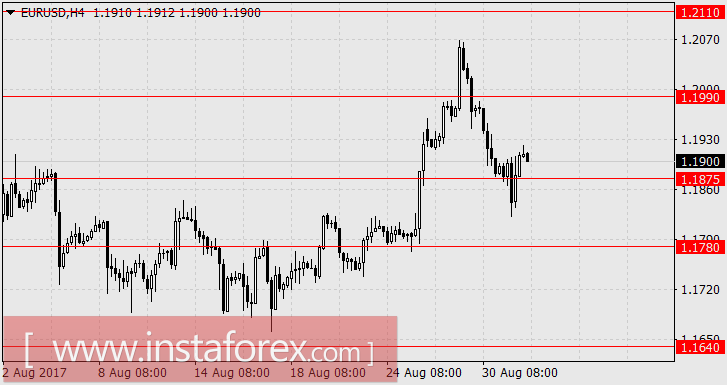
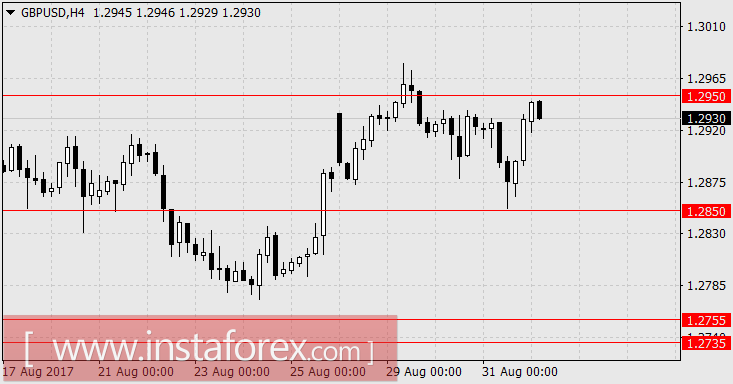
The euro is expected at 1.1640, while the pound sterling is expected in the range of 1.2735/55.
AUD/USD
On Thursday, the Australian economic indicators came out better than expected, and against the background of weak dynamics of the US dollar, the "Australian" decided to grow a bit, adding 42 points per day. The monthly rate of mortgage lending stayed at 0.5% (in the July estimate), lending to the private sector increased by an expected 0.5%. Private new investment in the second quarter increased by 0.8% against expectations of 0.3%, while investment in production equipment for the same period increased by 2.7%. Only investment in construction for the quarter decreased: -0.5% against 1.4% in the first quarter.
In the morning, the Australian manufacturing activity index for August showed an increase from 56.0 to 59.8.
Chinese business activity data came out mixed. The index of business activity in the manufacturing sector (Manufacturing PMI) for August increased from 51.4 to 51.7, in the non-manufacturing sector it fell from 54.5 to 53.4. The PMI estimate from Caixin (Caixin Manufacturing PMI) today confirmed the growth of the index: 51.6 against the earlier month's 51.1. The stock indexes of the Asia-Pacific region, except for South Korea, are rising. Iron ore went up by 3.7%, to $78.91 per ton (in the USA, $75.11), coking coal + 0.5%.
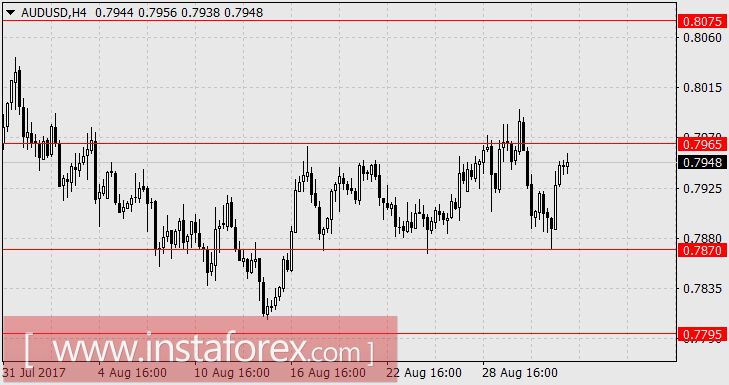
Today, in connection with the expected good data on the US labor market, the weakening of the "Aussie" is expected along with European currencies, with the target at 0.7795.