


















In July last year, Theresa May was named as the new Prime Minister of Great Britain, replacing her fellow party member David Cameron. This news had a positive impact on the British currency: Brexit at that time was already an inevitable event, and the political conflict inside the government between supporters of Cameron and May would only aggravate the situation. Therefore, after the new prime minister took office and formed the cabinet, the pair pound/dollar soared by 600 points for one week .
It is not random that events of a year ago are recalled. Today, again, the issue if Theresa May will remain as Prime Minister on the agenda: within the Conservative Party a kind of dispute was brewing, which could result in a full-scale political crisis. All this is reflected in the pound, which paired with the dollar fell last week to the bottom of the 30th figure. However, a preliminary analysis of the political situation in Britain gives hope for the restoration of stability. Despite very serious political pressure, Theresa May, most likely, will remain at the head of the government.
The essence of the intra-party crisis is quite simple: some conservatives believe that May is politically responsible for the failure of the parliamentary elections, which she herself initiated. The Tories lost a majority in parliament and were forced to look for coalition allies. Only thanks to a coalition with the Democratic Unionist Party of Northern Ireland, the Conservatives were able to form a government and avoid a political crisis. But initially, May wanted to strengthen its position before the start of negotiations with Brussels - but this attempt as a result has suffered a collapse.
Naturally, after such results, May party members raised the question of the benefit of her being the prime minister and leader of the party. In particular, as the former head of the Conservative Party, Grant Shapps, said, about three dozen parliamentarians called on the prime minister to leave her post. Rumors of a possible resignation intensified last week due to a confrontation between Foreign Minister Boris Johnson and Theresa May. The head of the British Foreign Ministry, who always advocated the harshest scenario of the "divorce" of London and Brussels, recently issued a resonant statement that Britain must put the EU four conditions under which the deal will be concluded. Their essence boils down to the fact that the UK, after 2019, will neither submit to EU legal norms, nor will it transfer any funds to the EU budget.
But this point of view, firstly, runs counter to the general concept of Theresa May, which has a more flexible position on this issue, and secondly, it contradicts "official subordination" - as Brexit's questions in Britain are dealt with by a separate minister, not by the Johnson's agency. In other words, the Foreign Minister made a political move, voicing the opinion of the sympathizers of the most rigid and uncompromising scenario of the country's exit from the EU. And it was after these words in the British press that they began talking about the possibility that Boris Johnson could take the chair of Theresa May, with the support of a group of conservatives. Actually, against this background, the pound has collapsed all over the market, including when it is paired with the US dollar.
But all this was last week. At the moment, commotions died down and Theresa May responded. In an interview with The Sunday Times, she transparently hinted that Boris Johnson would lose his post as a result of personnel reshuffles in the government. Tentatively, this will happen after October 20, after the meeting of the European Council
In addition, this week, several high-ranking officials (including ministers) denied the likely resignation of Theresa May. Here it is worth noting that most Britons do not support the idea of the Prime Minister's resignation - at least until the end of the Brexit procedure. Forty-two percent of respondents surveyed by Sky Data believe that the resignation of the leader of the conservatives will negatively affect the negotiation process for Brexit. This factor plays a rather large role in the British political situation: May is responsible for Brexit, including any possible failures in the negotiation process. According to most political experts, now it is unlikely that any one of the party's party members will want to take over the reins of government, risking a political career.
Thus, despite all the hype, Theresa May's resignation is quite unlikely, at least in the foreseeable future. The GBPUSD pair reacted to this fact by a 200-point increase, which stalled today. The reason is the absence of any progress is the occurrence of the fifth round of talks between London and Brussels. The parties still do not want to make concessions, and Britain has already started taking into serious consideration that the country will leave the EU without reaching a deal.
The last stage of the negotiations will last until tomorrow, October 12. After that, the EU summit (October 19-20) will take place, where the participants will sum up the preliminary results of the Brexit negotiations. Depending on the tone of the final meeting, the pound will determine the direction of its movement.
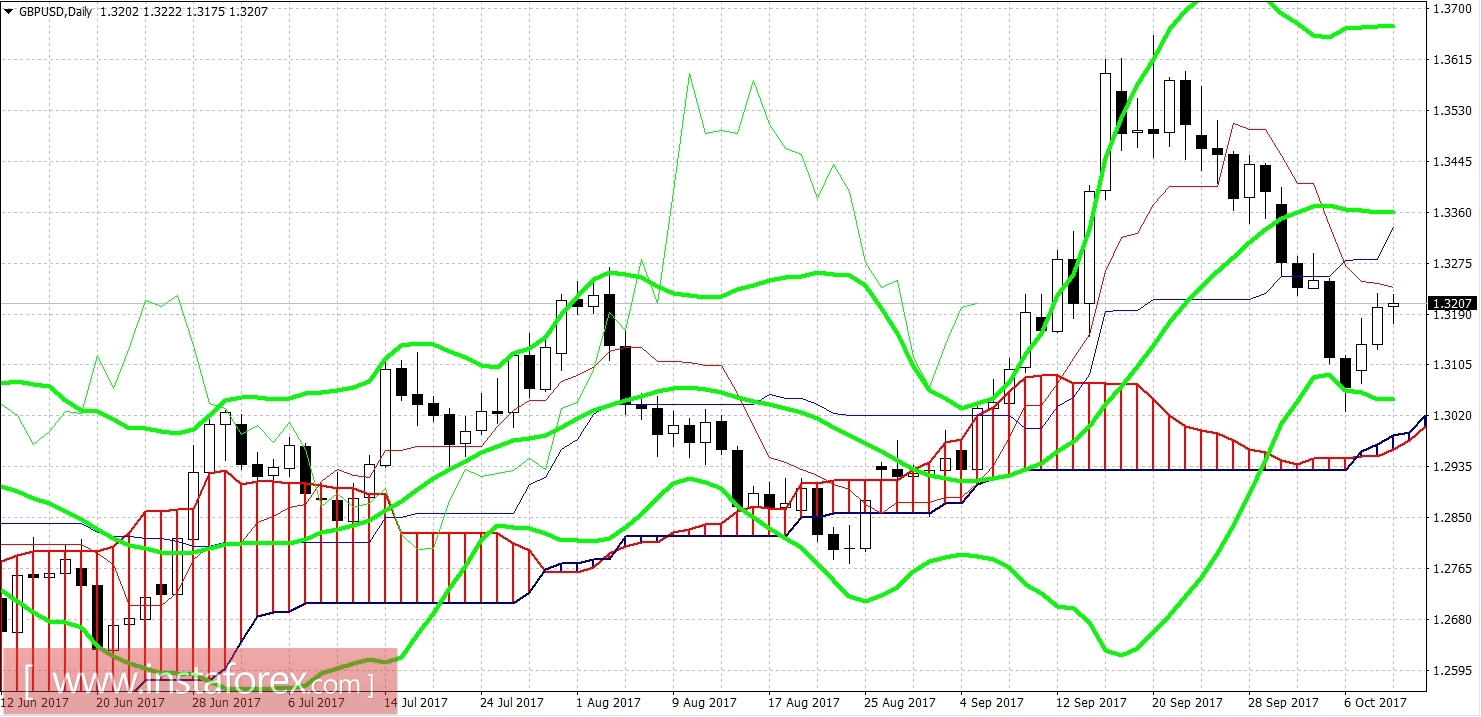
Predict the reaction of the market is difficult, so for now, one can focus on the technical analysis of the GBPUSD pair, which allows the probability of a return to decline. On the daily chart, the indicator Ichimoku Kinko Hyo generated "Dead Cross" signal , at which the lines Tenkan-sen and Kijun-sen are above the price, and the cloud Kumo is under it. This signal indicates a probable trend change in the downward direction with the original target of 1.3040 as the bottom line of the Bollinger Bands indicator.


