


















The pound deserves the title of the most stable currency this year: despite a whole list of "bearish" factors, the British currency managed to stay in the area of 30 figures. Now the GBPUSD pair again demonstrates the upward momentum, which can undergo a large-scale development.
The British currency fluctuated several weeks in the flat, moving in the price range of 1.3050-1.3200. The currency could not determine the direction of its movement for two reasons: on one hand, the currency was pressured by the issue of Brexit. The series of disastrous negotiations and the probability of a unilateral withdrawal from the EU without any deal made investors nervous. On the other side of the scale is British inflation, which remains at a three-percent level. This fact did not allow the currency to fall too low (breaking through the 30th figure), so traders had to trade in the flat waiting for new information drivers.
It did not take long before new reasons surfaced. UK Finance Minister Philip Hammond said that the British side has developed new proposals on the "cost of exit" from the European Union. And although the treasurer did not give an exact figure of the "bill", the market took the news positively. Especially since some details began to leak into the press.
So, according to the Times, London decided to spend a "divorce" bill of more than 40 billion pounds. This is twice the amount originally proposed, but still less than the amount required by Brussels (60 billion). Nevertheless, this is a fairly strong "bid for victory", as Europe is also interested in concluding the final deal. Almost all experts and politicians (both from the European and the English side) are warning about the catastrophic nature of the unilateral end of relations. In December, Theresa May will be able to operate with more weighty arguments - which means that the probability of reaching a compromise has increased.
Thus, until the middle of December, when the next EU summit takes place, the pound will be guided only by rumors. The final decision of the summit will be the "final chord" for the British this year, regardless of its content. At the moment, there are indirect signs that the parties will complete the interim negotiations on a positive note: the transaction amount will be approved, and the discussion of the remaining positions will be postponed to 2018. Such a scenario will provide the pound with a significant increase in the new price range of 1.35-1.37. At the moment, interest in the British currency is fueled only by rumors, but this is enough for gradual growth.
The economic calendar for the GBPUSD pair this week is not so saturated. Tomorrow the results of stress tests of the largest banks in Britain will be published, and on Friday the release of the PMI index for the manufacturing sector is expected.
Here it is worth noting that at the end of September, the Bank of England already conducted similar stress tests, which revealed a growing consumer debt. The hypothetical scenario of the test consisted in the growth of interest rates to 4%, with the simultaneous rise in the unemployment rate to 9.5%. The result turned out to be pessimistic: the regulator determined that the banks would incur losses of 30 billion pounds in that case. If the results of the November stress tests differ for the better from the announced figures, the GBPUSD pair will receive some support.
As for the production PMI index, a slight increase to 56.6 points is expected. Nevertheless, in this case, it will be the third month of positive dynamics (albeit gradual): this factor will favorably affect the British currency.
In terms of the technical picture, the GBPUSD pair is traded on the uplink, as evidenced by the signals from the Ichimoku indicator Kinko Hyo, which on the daily chart generated the strongest trend of a"Line Parade" signal, in which the indicator lines Tenkan-sen and Kijun-sen, as well as the cloud Kumo are under the price schedule. The upward direction is confirmed by the signals of the Bollinger Bands indicator, thanks to which it can be seen that the pair has broken and fixed above the top line of the indicator.
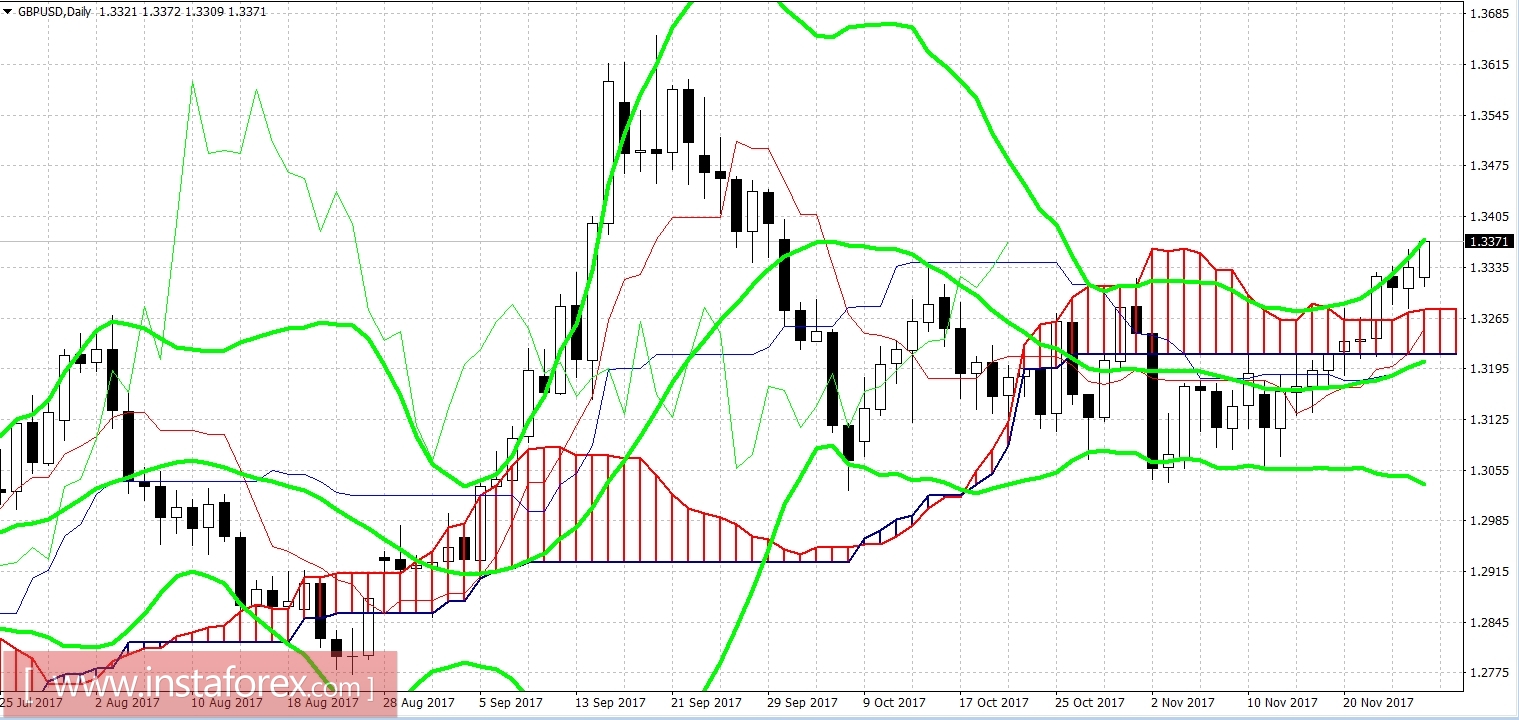
To determine the target levels, let's move to the weekly chart. On W1 it is evident that the nearest resistance level is the price area 1.3500-1.3550. Here, the upper boundary of the Kumo cloud coincides with the upper line of the Bollinger Bands indicator. If this level is overcome, the price will target the 1.37 area (Kijun-sen line on the monthly chart), but it's too early to speak about such heights.
This scenario is realized with the successful outcome of the December talks against the backdrop of recording profits at the end of the year. In the meantime, we can discuss the nearest northern targets, which are located on the border of the 35th figure. If speculation about the "compromised amount" of the deal continue to find confirmation, the pair will continue its upward movement.


