


















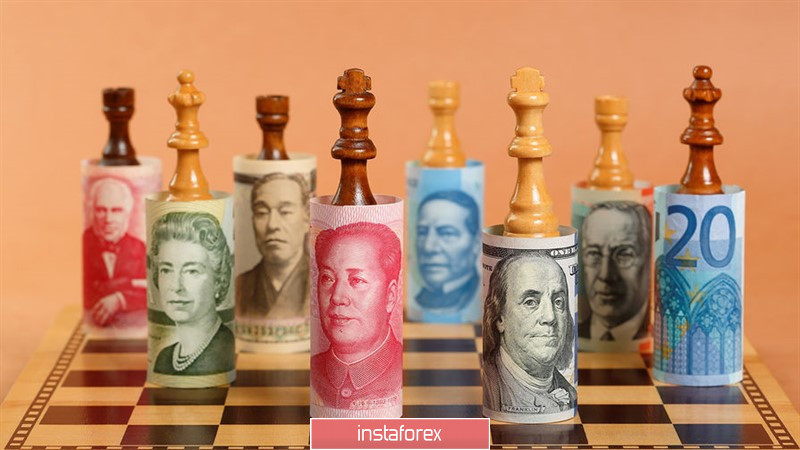
Trade tensions between Beijing and Washington spilled over into the foreign exchange market.
Last Monday, after the People's Bank of China allowed the yuan to drop below 7.0 against the dollar, the US Treasury officially recognized China as a currency manipulator.
It is noteworthy that China received a "black mark" for sitting idly by.
However, the passive position of PBOC, which did not want to interfere in the life of the foreign exchange market, is nothing more than a demonstration of weapons. That is, Beijing clearly demonstrated to Washington that it has something to respond to threats to its economy and that if a full-scale trade war begins, not only China will suffer serious losses.
However, the current actions of the US administration are caused not only by the desire to put pressure on China in order to accelerate trade negotiations, but also by the desire to stir up the Fed.
Goldman Sachs analysts believe that the growing tension in trade relations between the United States and China means that this year the Federal Reserve will lower the interest rate twice more.
"This year the Fed is increasingly responding to the threats of a trade war, the expectations of the bond market and the problems of global growth," they said.
Meanwhile, trade tensions and a slowdown in the global economy are causing concern not only among the US central bank.
One of the newsmakers of yesterday was the Reserve Bank of New Zealand, which cut the interest rate immediately by 50 basis points, to 1%, while the vast majority of analysts expected it to decrease by only 25 basis points. As a result, the NZD/USD pair collapsed to the level of 0.6400, the lowest level since 2016.
The minutes of the RBNZ meeting showed that the regulator is greatly alarmed by the recent escalation of the trade conflict between the United States and China, which could adversely affect investment and economic growth in New Zealand.
The kiwi sharply fell following the aussie. The AUD/USD pair plummeted below 0.67, reaching its lowest level in the last ten years due to rumors that the Reserve Bank of Australia could follow the example of its New Zealand counterpart and lower interest rates more than expected.
The central bank of India also gave investors a surprise yesterday, immediately cutting the key rate by 35 basis points.
According to analysts, national governments are now faced with a difficult choice: they can either put pressure on their currencies by lowering interest rates or direct intervention in the market, or allow exchange rates to strengthen and jeopardize their economies.
"It is not yet clear what exactly the United States will do, but the need to act is clearly brewing, given the devaluation of the renminbi rate, which is becoming cheaper at a record pace since 1994," strategists at ING said.
Recall that Donald Trump has long been lamenting that an overly expensive greenback will offset the competitive advantages of the United States. Recently, rumors have been circulating that the country's authorities are about to devalue the dollar.
JPMorgan is confident that lowering the USD against major world currencies such as the euro and the yen will not be difficult, but there may be a problem with the yuan, whose rate is not floating.
So far, Trump has been using tariffs as the main weapon in the trade war, however, Nomura believes that the head of the White House can change his strategy and begin to manipulate exchange rates himself.
But Goldman Sachs analysts doubt the reality of the U.S. Treasury Department's interventions aimed at depreciating the dollar. They note that the United States has not attempted to devalue the national currency since 1985, so the decision to do so now would even look strange and frighten off foreign investors, jeopardizing all US assets - from Treasuries to stocks.


