


















The pound paired with the dollar continues to remain under pressure, consolidating in the middle of the 28th figure yesterday. Both bears and bulls of GBP/USD are careful not to risk opening large positions - the fundamental background for the pair is changing too quickly. Obviously, the deputies of the House of Commons will not have time to consider the draft deal until October 31 - negotiations on this issue between Johnson and Corbyn ended in failure. Therefore, now either Britain is applying for a postponement of Brexit, or the prime minister is still deciding on a "hard" scenario. Yesterday, the head of the British government complicated the solution to this problem by setting a new ultimatum for MPs: a postponement in exchange for early elections.

Johnson's new conditions are not hypothetical in nature. The government will submit a corresponding vote to the House of Commons on Monday. The prime minister proposes to hold early parliamentary elections on December 12, while the current composition of Parliament will be dissolved on November 6 - so that deputies have time to conduct an election campaign. Thus, the MPs will have one and a half weeks to consider the draft deal (from the three-week period allotted by law).
It is worth noting that Johnson will have to negotiate with the opposition in this matter, as early elections can be called with the support of two-thirds of the Parliament (434 deputies). Laborites, in turn, have twice blocked the government's election initiative. Jeremy Corbyn set counter conditions: first, Brexit's postponement, then elections. He reiterated his position yesterday, commenting on the initiative of the prime minister. He demanded to exclude the possibility of a hard scenario in exchange for Johnson's support. The Labour leader also added that their political power had been seeking re-elections for a "long time", but in the current situation, he could not agree to them due to the risk of a chaotic Brexit.
British law allows Johnson to take other paths. The first option involves a vote of no confidence in the government - after the completion of the two-week period (which is allotted for the formation of a new cabinet), the Parliament "automatically" dissolves. But this option has its own nuances: first, the Labour Party can make amendments to this proposal that are unfavorable for Johnson, adjusting the timing or procedure for holding elections. Secondly, a simple majority (326 deputies) is needed to approve a vote of no confidence. Whereas the prime minister can now count only on 267 members of the parliamentary faction of the Conservative Party + hypothetically on 20 independent deputies who were expelled from the faction for violation of party discipline.
Another development scenario is the issuance of a special government decree with a specific election date. But in this case, the prime minister also needs to enlist the support of the allies (primarily the DUP), since the resolution should be approved by a simple majority. By and large, any of these options forces Johnson to negotiate with opponents or temporary allies, since Conservatives do not have their own majority, "thanks" to Theresa May. The previous prime minister wanted to strengthen her position in Parliament, but in the end she achieved the opposite result - the Tories were unable to get enough votes and were forced to unite with the Unionists.
However, judging by the latest ratings, this time the Conservative Party can really strengthen its position by gaining an independent majority in the House of Commons. So, according to the latest YouGov polls, Conservatives still have a good chance of winning. After joining Johnson and his confident, consistent and correct (from the Tory point of view) actions in relation to Brussels and Brexit, the party's rating significantly grew. According to sociologists, 34% of Britons are ready to cast their votes for the Conservative Party, whose leader is Johnson (under such a condition). Another 23% of respondents would support Labour, 21% - the Party of Liberal Democrats. Thus, thanks to re-election, Conservatives can regain a majority in Parliament, and accordingly agree on a "Johnson deal."
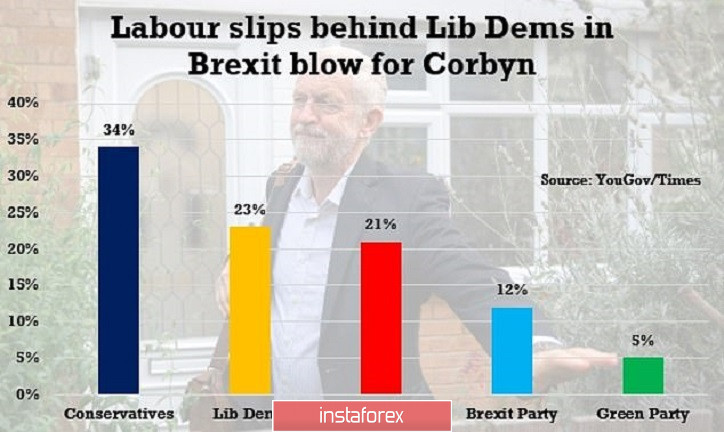
It is also worth noting that last week, YouGov published new data according to which 41% of British voters would like Parliament to approve Johnson's deal, while only 24% are against this decision. This suggests that the policy of the current prime minister is supported by the British, while the destructive position of the Laborites is unpopular, since they, in fact, prolong the annoying negotiation process to everyone. In addition, many (including among Labour) have a personal dislike of Jeremy Corbyn, accusing him of lack of leadership and political charisma. This fact also should not be discounted, given the increased likelihood of re-election in the foreseeable future.
Thus, if before the British currency was afraid of early re-elections (when Johnson "in full swing" led the country to a hard Brexit), now the situation has changed dramatically: it is early elections that will allow the British prime minister to put an end to the negotiating epic. Given these circumstances, the pound froze in anticipation of parliamentary battles. However, short positions on the GBP/USD pair still look risky. The fact is that Brussels already has a formal appeal from the British government with a request for a postponement. Today, leaders of EU countries in a written procedure (which eliminates the need for an extraordinary summit) can provide London with a technical delay of several weeks. In this case, the Parliament can either agree on a deal during this time period or agree to snap elections. Any of the options voiced will be in favor of the British currency.


