


















4-hour timeframe
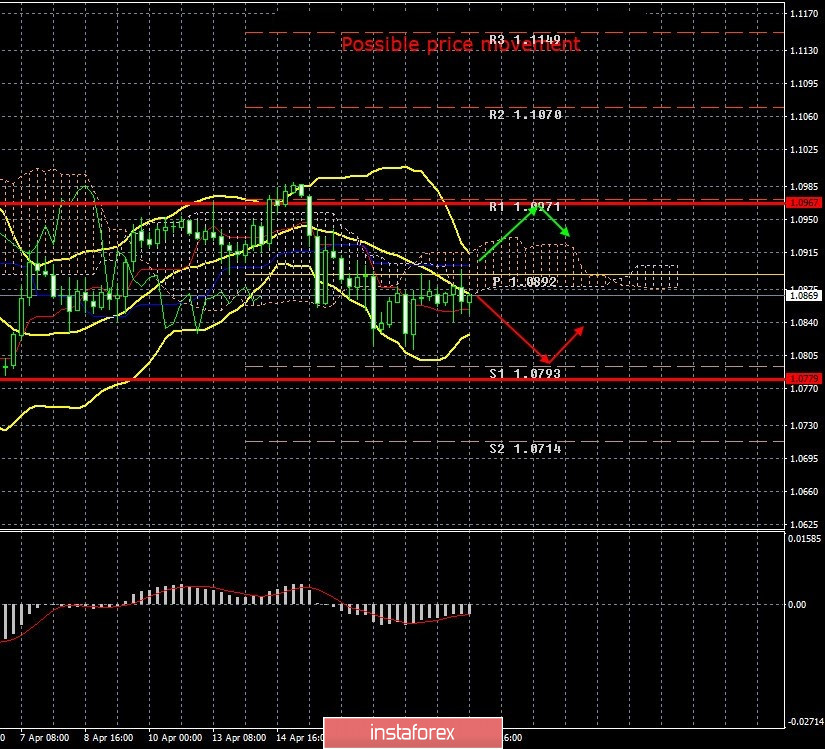
Average volatility over the past five days: 94p (high).
The EUR/USD currency pair showed absolutely nothing on Monday. However, this is not surprising, since the macroeconomic and fundamental background was empty. And if you remember the fact that traders persist in ignoring most of the macroeconomic publications, it becomes clear why the first trading day of the week was so boring. We would also like to remind you that after completing the previous upward movement around the 1.0985 level (we predicted $1.10), we expected consolidation, that is, movement for some time in the 1.08-1.09 range. Thus, we can also assume that after a completely crazy 5-6 weeks, traders have calmed down completely and now new reasons are needed in order for a new trend to start.
Panic from two months ago formed due to the coronavirus and was not initially taken too seriously. The attitude was like a seasonal flu. Hardly anyone could have predicted that more than two million people around the world would get it. Moreover, we are sure that more than two million people are sick with the common flu every year, but no one is counting them. Thus, when it became clear that the virus was spreading very quickly and that 70-80% of the population could get sick in a matter of weeks, governments began to take very tough measures, and central banks began to stimulate the economy. All these actions led to panic in all world markets. Now we can say that the world is stable. However, this is not the stability that we would like to see. Despite the fact that there is a decrease in the growth rate of the COVID-2019 virus, as well as a decrease in the number of deaths in the United States, Italy, Spain and other countries, it still continues to spread. Regardless of the quarantines and closed borders of most countries in the world. However, this is not surprising for the currency market. The same can be said about oil prices, which fell to absolute lows in the region of $12 per barrel (WTI grade) today. Given the huge drop in oil demand and the upcoming reduction in production by OPEC+ countries, it was possible to assume that the price of oil would go up in any case. But before that, there will be a so-called acceleration. In fact, this is exactly what we are seeing. It should be understood that oil cannot be cheaper than the cost for a long time. This is not profitable for the countries that produce it. It is also not profitable to sell oil, with a profit of 1-2 dollars. Thus, in any case, the OPEC+ countries will sign new agreements and do everything possible to stabilize the price of oil. There is simply no other way. The price war between Saudi Arabia and Russia did not last long. After it became clear that other market participants also suffer from such oil prices. It will also happen this time, if the price does not grow after May 1, when the agreement to reduce production by ten million barrels per day comes into force, then a new deal will be signed, implying a reduction of 20 million barrels. By the way, US President Donald Trump has already spoken about such a deal. Trump believes that such agreements have already been reached. That is, first of all, the next drop in oil prices is not surprising at all, and, secondly, prices will go back up in any case. Sooner or later, the crisis will end, a vaccine will be found, and the economy will begin to recover. This means that the demand for oil will also be restored.
Thus, it would seem that the situation in the world has become even worse than a month and a half ago, and, on the contrary, the foreign exchange market calmed down. There is no panic factor, no surprises – no storm. We believe that a flat is even possible for some time now. The total volatility was no more than 46 points during the day, which is the second lowest value in the last 30 business days. We don't see a reason why trade could begin more actively in the coming days. Therefore, we believe that there will be movement inside the side channel for some time. Bollinger bands began to narrow, which also speaks in favor of a decrease in market activity.
It should also be noted that China's economy shows that recovery from the crisis caused by the epidemic can indeed be relatively rapid (not decades or years). No matter what figures and information China hides, the main thing is that its economy is already beginning to recover, and, according to the IMF, even GDP growth of 1.2% will be recorded by the end of 2020.
4-hour timeframe
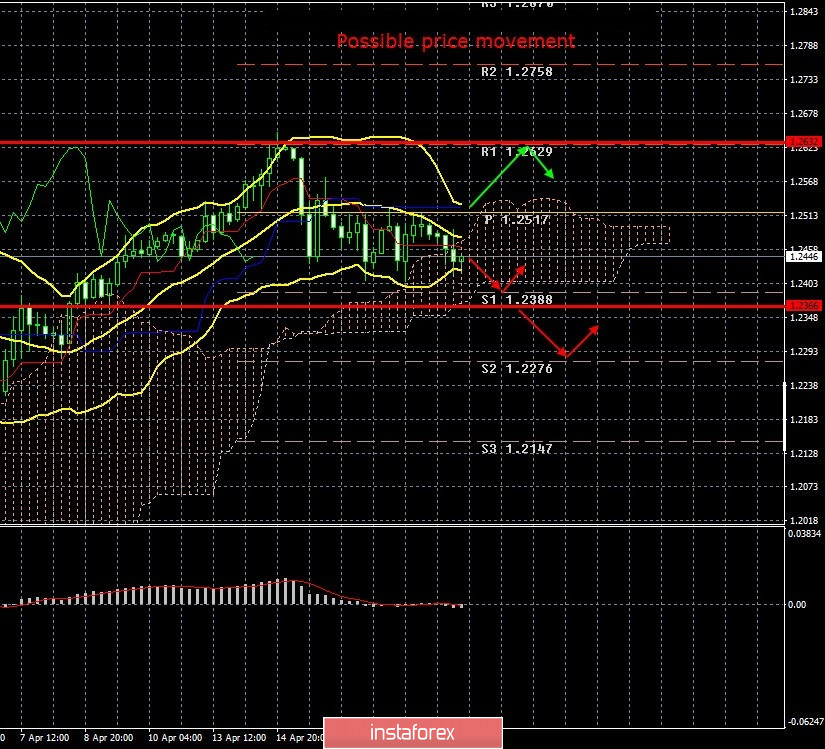
Average volatility over the past five days: 133p (high).
The GBP/USD currency pair was also very reluctant to trade on April 20. The reasons are the same as for the EUR/USD pair. First, market participants calmed down after a month of panic. Second, all governments and central banks have supported their economies. Third, it has become more or less clear what to expect from the COVID-2019 virus. Thus, the pound may also start to consolidate in a narrow price range. The pound/dollar pair has been trading slightly below the Kijun-sen line in the last few trading days, and according to the linear regression channels system, it is trading near the moving average. Both of these factors, in fact, speak of a flat. There are signs of an upward reversal even when the British currency has fallen to previous local lows around 1.2410. Thus, as in the case of the euro, we believe that a flat is now possible. The coronavirus situation in the UK is the same as in the whole world. It might even be worse. Britain could be the new center of the pandemic in the coming weeks. You can talk about the reasons as much as you want, the main thing is that people continue to get infected and die, and the economy continues to idle. It should also be understood that governments and the central bank will not be able to support their economies forever by simply pouring cash into them. There is already talk of an increase in inflation in 2020 – the United States, the European Union and others have pumped money into their economies too much. There is more money, and the number of goods and services produced in the world, on the contrary, has decreased. Conclusion - inflation. So, in any case, the virus must be defeated.
Recommendations for EUR/USD:
For short positions:
The EUR/USD pair continues to adjust on the 4-hour timeframe. Thus, sell orders are now relevant with targets at 1.0793 and 1.0779, but after the correction is completed, there is a rebound from the Kijun-sen line or the MACD indicator could turn down. In addition, there is a fairly high probability of a flat.
For long positions:
It is recommended to return to purchases of the currency pair only when the price has been consolidated above the Kijun-sen critical line with the first target at the resistance level of 1.0971.
Recommendations for GBP/USD:
For short positions:
The pound/dollar is trying to continue the downward movement, but so far the picture is also similar to a flat. Thus, now traders are advised to wait for the Ichimoku cloud to exit, that is, to consolidate the price below the Senkou Span B line and after that it will be possible to sell the pound with the target of 1.2276.
For long positions:
It is recommended to consider new purchases of the GBP/USD pair before consolidating the price above the Kijun-sen line with the aim of the resistance level of 1.2629.


