



















The Australian dollar continues its intraday rise against the weakening U.S. dollar, reaching new highs not seen since late October and approaching the 0.6600 level. The market's initial reaction to weak Australian economic growth data proved short-lived, as expectations of further monetary easing by the Reserve Bank of Australia (RBA) have diminished. This factor remains a key driver supporting the Australian dollar.
In addition, positive sentiment in equity markets helps offset a subdued report on China's services PMI and contributes to the Australian dollar's relative outperformance.
Today, the Governor of the Reserve Bank of Australia, Michele Bullock, spoke before a parliamentary committee, stating that the regulator is carefully analyzing recent inflation data to determine whether price pressures are temporary. Bullock noted that if inflation remains persistent, this will influence future decisions on raising or lowering interest rates. These comments reduce the likelihood of further easing of financial conditions and support the strengthening of the Australian dollar. In October, Australia's consumer price index rose from 3.5% to 3.8% year-over-year, exceeding the RBA's 2–3% target range. The RBA's trimmed mean CPI also increased by 3.3% for the month, indicating ongoing inflationary trends.
The Australian dollar continues to lead against the U.S. dollar due to the divergence in monetary policy between the Reserve Bank of Australia and the Federal Reserve. According to CME Group data, there is a 90% probability of a 25-basis-point Fed rate cut in December. In addition, expectations of interest rate reductions in the U.S. and hopes for a peaceful resolution to the Russia–Ukraine conflict are supporting positive sentiment in equity markets, which negatively affects the dollar as a safe-haven asset.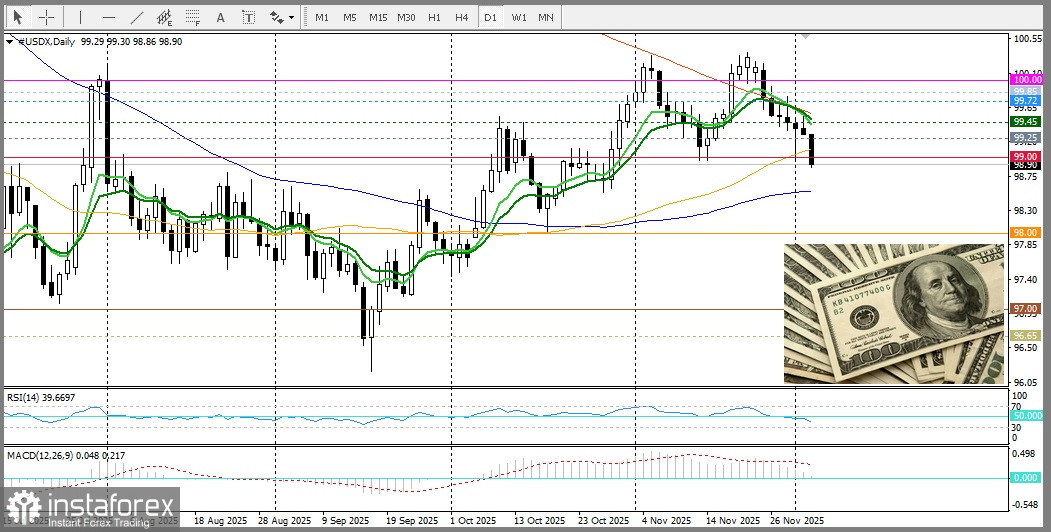
A key event for the market will be the publication of the U.S. Personal Consumption Expenditures (PCE) Price Index scheduled for Friday. This indicator will be closely analyzed to assess the Fed's future monetary policy. The results could significantly impact the U.S. dollar and the direction of the AUD/USD pair. Overall, the fundamental backdrop remains favorable for market participants inclined toward optimistic scenarios.
From a technical standpoint, the recent breakout above the 100-day Simple Moving Average (SMA) and sustained trading above it favor AUD/USD bulls. Moreover, oscillators on the daily chart are gaining positive momentum and are still far from overbought territory. This, in turn, supports the short-term bullish outlook, suggesting that any corrective pullback may be viewed as a buying opportunity above the 100-day SMA.
However, a decisive break below 0.6500 would make AUD/USD vulnerable to further decline toward the 200-day SMA, currently at 0.6466, and then toward the multi-month low around 0.6420 reached in November.
Nevertheless, the AUD/USD pair is attempting to overcome the round level of 0.6600 and move higher.


