


















Trade review and trading tips for the Japanese yen
A test of the 156.56 level occurred when the MACD indicator had already moved significantly below the zero line, which limited the pair's downward potential. A second test of 156.56, with the MACD in oversold territory, led to the implementation of Buy Scenario No. 2 for the dollar, resulting in a 20-point rise in the pair.
In the second half of the day, economic data will be released, including weekly U.S. initial jobless claims, the trade balance, and consumer credit figures.
The number of new jobless claims is a key indicator of labor market health. An increase in this figure may signal a slowdown in economic growth and a possible decline in consumer activity. Conversely, a decrease in claims may point to strengthening labor market conditions and increase the likelihood of further interest rate hikes by the Federal Reserve. The trade balance shows the relationship between exports and imports. However, given that it is consistently negative in the United States, changes in this indicator are unlikely to have a strong impact on the dollar.
Consumer credit data will show how actively U.S. consumers are using borrowed funds to purchase goods and services. An increase in lending may indicate consumer optimism, which could support the dollar and weaken the Japanese yen.
As for the intraday strategy, I will mainly rely on the implementation of Scenarios No. 1 and No. 2.
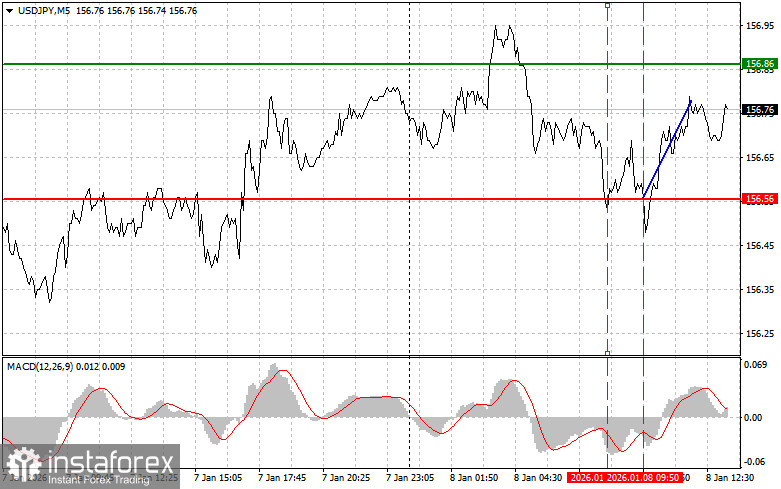
Buy Signal
Scenario No. 1: I plan to buy USD/JPY today if the price reaches the entry area around 156.86 (green line on the chart), targeting a rise toward 157.30 (the thicker green line on the chart). Around 157.30, I plan to exit long positions and open short positions in the opposite direction, aiming for a 30–35 point move from that level. Further growth in the pair can be expected in line with the prevailing trend.Important! Before buying, make sure the MACD indicator is above the zero line and is just starting to rise from it.
Scenario No. 2: I also plan to buy USD/JPY today in the event of two consecutive tests of the 156.64 level while the MACD indicator is in oversold territory. This will limit the pair's downward potential and lead to a reversal upward. A move toward the opposite levels of 156.86 and 157.30 can be expected.
Sell Signal
Scenario No. 1: I plan to sell USD/JPY today after a break below the 156.64 level (red line on the chart), which should result in a rapid decline in the pair. The key target for sellers will be 156.15, where I plan to exit short positions and immediately open long positions in the opposite direction, aiming for a 20–25 point move from that level. Selling pressure on the pair may return today in the event of weak U.S. data.Important! Before selling, make sure the MACD indicator is below the zero line and is just starting to decline from it.
Scenario No. 2: I also plan to sell USD/JPY today in the event of two consecutive tests of the 156.86 level while the MACD indicator is in overbought territory. This will limit the pair's upward potential and lead to a reversal downward. A decline toward the opposite levels of 156.64 and 156.15 can be expected.

What's on the chart:
- Thin green line – the entry price at which the trading instrument can be bought;
- Thick green line – the projected price level where Take Profit orders can be placed or profits can be taken manually, as further growth above this level is unlikely;
- Thin red line – the entry price at which the trading instrument can be sold;
- Thick red line – the projected price level where Take Profit orders can be placed or profits can be taken manually, as further decline below this level is unlikely;
- MACD indicator – when entering the market, it is important to rely on overbought and oversold zones.
Important: Beginner Forex traders should be extremely cautious when making market entry decisions. Ahead of major fundamental reports, it is best to stay out of the market to avoid sharp price swings. If you decide to trade during news releases, always place stop-loss orders to minimize losses. Without stop orders, you can lose your entire deposit very quickly, especially if you do not use proper money management and trade large volumes.
And remember, successful trading requires a clear trading plan, like the one presented above. Making spontaneous trading decisions based on the current market situation is an inherently losing strategy for an intraday trader.


