


















On Tuesday, the USD/CAD pair is attempting to recover part of yesterday's losses.
Recent US Bureau of Labor Statistics data indicate that the disinflation process in the US economy continues, although it is not complete. Annual growth of the consumer price index (CPI) in December was 2.7%, matching both the previous month's figure and the consensus forecast. Core CPI, excluding food and energy, remained at 2.6% year-on-year, failing to meet expectations.
On a monthly basis, headline inflation rose 0.3%, while core inflation increased by 0.2%, with housing costs remaining a key source of price pressure.
These data confirm the continuation of the disinflation process, strengthening expectations of a gradual easing of monetary policy by the Federal Reserve. At this point, there is a 95% probability that the Fed will keep policy rates unchanged at its January meeting.
Labour market indicators in the US are mixed. ADP data show that the four-week average of private sector job additions in mid-December rose to 11,750 per week compared with 11,000 previously. These points point to some positives in the labour market, but are not sufficient to dispel concerns about slowing economic growth.
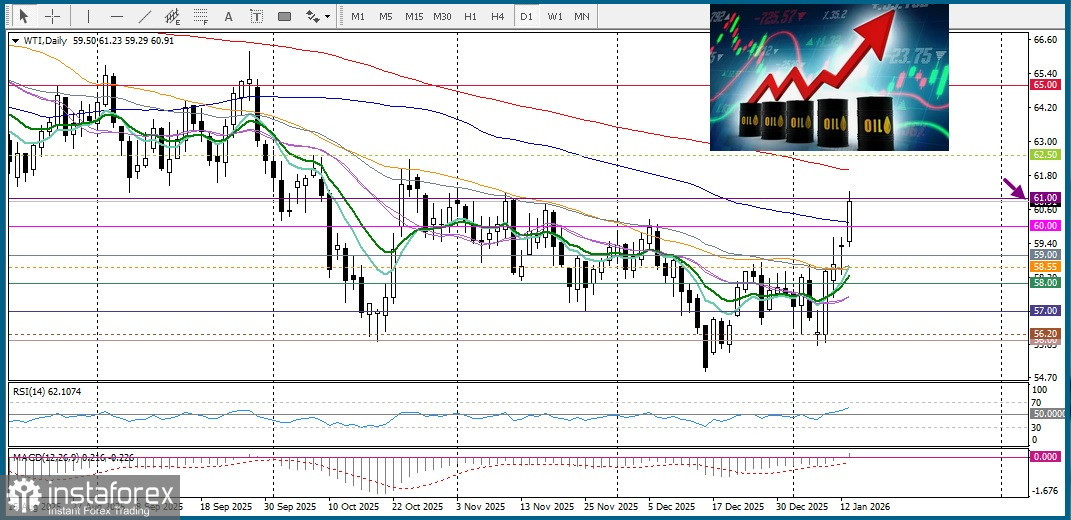
In Canada, the dynamics of the national currency remain largely determined by the energy market. The Canadian dollar is supported by steady gains in crude oil prices, which are important given Canada's role as one of the largest oil suppliers to the US. WTI quotes have risen for a fourth consecutive session, holding near the round level of $61 per barrel amid rising supply concerns driven by escalating geopolitical tensions in Iran. An additional uncertainty factor for the oil market is the upcoming weekly inventory update from the American Petroleum Institute (API). The report, expected on Wednesday, may adjust market sentiment and affect both oil dynamics and demand for commodity-linked currencies, including the Canadian dollar.
As a result, the balance between a moderately "hawkish" interpretation of US inflation data—which cools expectations of rapid Fed easing—and support for the Canadian dollar from rising oil prices keeps USD/CAD in consolidation. In the absence of a clear short-term catalyst, price movement remains within a limited range, and market participants prefer to wait for new signals on inflation, rates, and oil inventories.
From a technical point of view, the pair has run into resistance at the round level of 1.3900, above which lies the convergence of the 100- and 50-day SMAs. The pair also showed resilience below the 1.3855 level and below the very important 200-day SMA.
Oscillators on the daily chart are mixed, suggesting the pair is not in a consolidation.