


















Trade analysis and trading tips for the Japanese yen
No tests of the levels I identified occurred during the first half of the day. As a result, I remained without any trades.
In the second half of the day, trading will be influenced by data on U.S. GDP for the third quarter of 2025. The publication will be an important event, as it will help assess how prepared the U.S. economy is for current challenges, such as persistent inflation and Trump's protectionist policies. The core Personal Consumption Expenditures index will also be released. Any deviations from forecasts may cause market fluctuations, as traders adjust their expectations for future Fed policy. If inflation exceeds expected values, the Federal Reserve may continue to keep interest rates at high levels, which would support the U.S. dollar and put pressure on the yen. Data on U.S. household income and spending will provide additional insight into consumer demand, which plays an important role in economic development. Income growth outpacing spending growth may indicate that people are restraining their spending due to fears about the future. Taken together, these data will allow for a more comprehensive assessment of the state of the U.S. economy and its prospects.
As for the intraday strategy, I will rely more on the implementation of scenarios No. 1 and No. 2.
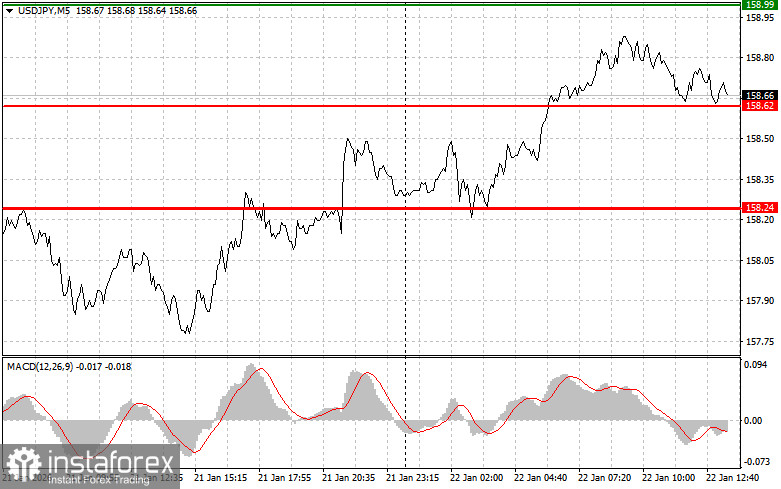
Buy Signal
Scenario No. 1: Today, I plan to buy USD/JPY when the price reaches the entry point around 158.77 (green line on the chart), with a target move toward the 159.21 level (the thicker green line on the chart). Around 159.21, I will exit long positions and open short positions in the opposite direction (aiming for a move of 30–35 points from the level). Further growth of the pair can be expected in line with the prevailing trend. Important! Before buying, make sure the MACD indicator is above the zero line and is just starting to rise from it.
Scenario No. 2: I also plan to buy USD/JPY today in the event of two consecutive tests of the 158.62 price level when the MACD indicator is in the oversold area. This will limit the pair's downward potential and lead to a reversal upward. Growth toward the opposite levels of 158.77 and 159.21 can be expected.
Sell Signal
Scenario No. 1: I plan to sell USD/JPY today after a break of the 158.62 level (red line on the chart), which would lead to a rapid decline in the pair. The key target for sellers will be the 158.24 level, where I plan to exit short positions and also immediately open long positions in the opposite direction (aiming for a move of 20–25 points from the level). Pressure on the pair may return today in the event of weak U.S. economic data. Important! Before selling, make sure the MACD indicator is below the zero line and is just starting to fall from it.
Scenario No. 2: I also plan to sell USD/JPY today in the event of two consecutive tests of the 158.77 price level when the MACD indicator is in the overbought area. This will limit the pair's upward potential and lead to a reversal downward. A decline toward the opposite levels of 158.62 and 158.24 can be expected.
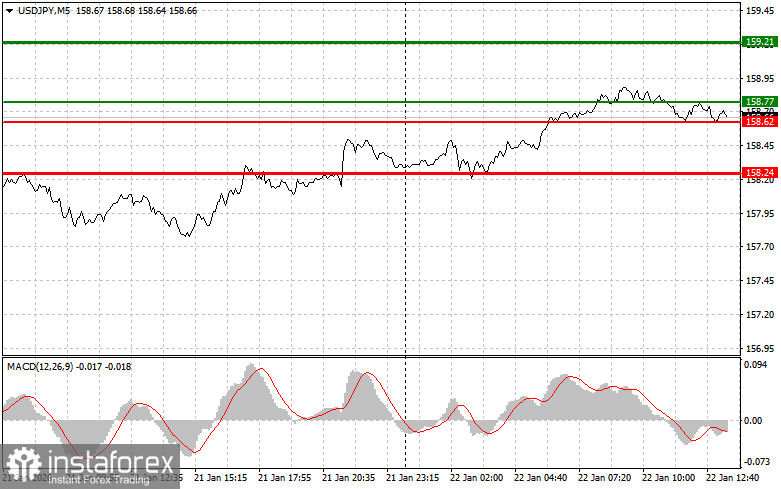
What's on the Chart:
- Thin green line – entry price at which the trading instrument can be bought;
- Thick green line – estimated price level where Take Profit orders can be placed or profits can be taken manually, as further growth above this level is unlikely;
- Thin red line – entry price at which the trading instrument can be sold;
- Thick red line – estimated price level where Take Profit orders can be placed or profits can be taken manually, as further decline below this level is unlikely;
- MACD indicator – when entering the market, it is important to rely on overbought and oversold zones.
Important: Beginner Forex traders should make market entry decisions very cautiously. Ahead of important fundamental reports, it is best to stay out of the market to avoid sharp price fluctuations. If you decide to trade during news releases, always place stop-loss orders to minimize losses. Without stop-loss orders, you can lose your entire deposit very quickly, especially if you do not use proper money management and trade large volumes.
And remember that successful trading requires a clear trading plan, like the one presented above. Making spontaneous trading decisions based on the current market situation is an inherently losing strategy for an intraday trader.


