


















Trade Analysis and Trading Tips for the Japanese Yen
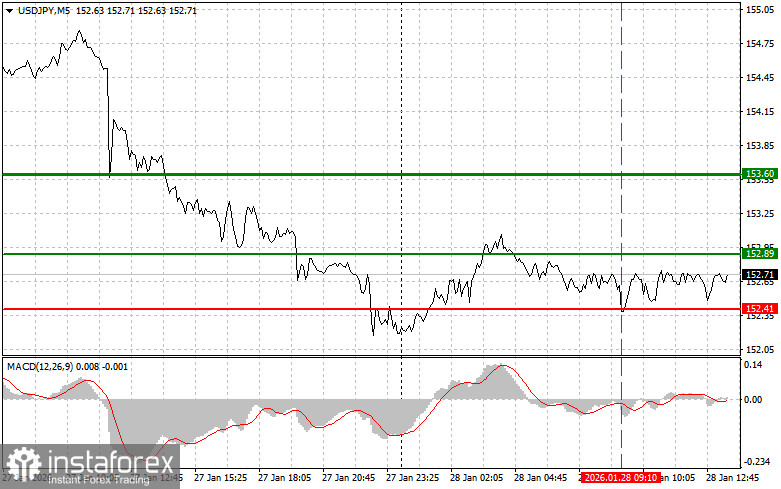
The test of the 152.41 price level occurred at a moment when the MACD indicator had moved significantly downward from the zero line, which limited the dollar's downward potential. For this reason, I did not open short positions.
In the second half of the day, market attention is focused on a number of key events: the publication of the Federal Open Market Committee's decision on the key interest rate, the subsequent statement, and the press conference by Federal Reserve Chairman Jerome Powell. The main question lies in Powell's interpretation of monetary policy prospects, his assessment of the labor market, and his reaction to a potential increase in inflation caused by the weakening dollar. Dovish rhetoric aimed at stimulating economic growth and supporting the labor market may push the dollar lower against the yen; however, ignoring inflation risks could lead to more serious problems in the future. External factors should also not be overlooked. Geopolitical instability and tensions in U.S.–Iran relations are putting additional pressure on market participants who are ready at any moment to continue selling the dollar.
As for the intraday strategy, I will rely more on the implementation of Scenarios No. 1 and No. 2.
Buy Signal
Scenario No. 1: Today, I plan to buy USD/JPY upon reaching an entry point around 152.89 (green line on the chart), with a target of growth toward the 153.60 level (thicker green line on the chart). Around 153.60, I will exit long positions and open short positions in the opposite direction (expecting a 30–35 point move in the opposite direction from that level). Today, a rise in the pair can be expected after the Fed's decision.Important! Before buying, make sure that the MACD indicator is above the zero line and is just beginning to rise from it.
Scenario No. 2: I also plan to buy USD/JPY today in the event of two consecutive tests of the 152.41 price level while the MACD indicator is in the oversold area. This will limit the pair's downward potential and lead to a bullish market reversal. A rise toward the opposite levels of 152.89 and 153.60 can be expected.
Sell Signal
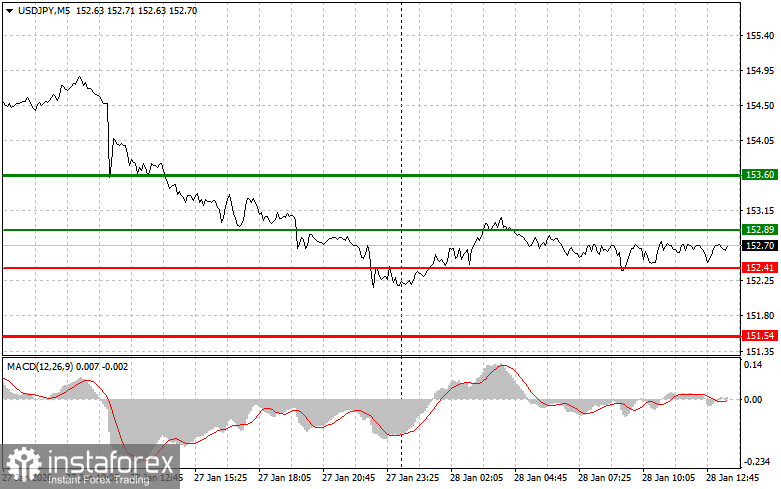
Scenario No. 1: Today, I plan to sell USD/JPY after the 152.41 level is broken (red line on the chart), which will lead to a rapid decline in the pair. The key target for sellers will be the 151.54 level, where I will exit short positions and immediately open long positions in the opposite direction (expecting a 20–25 point move in the opposite direction from that level). Pressure on the pair will return in the case of a dovish Fed stance.Important! Before selling, make sure that the MACD indicator is below the zero line and is just beginning to decline from it.
Scenario No. 2: I also plan to sell USD/JPY today in the event of two consecutive tests of the 152.89 price level while the MACD indicator is in the overbought area. This will limit the pair's upward potential and lead to a bearish market reversal. A decline toward the opposite levels of 152.41 and 151.54 can be expected.
What's on the Chart:
- Thin green line – entry price at which the trading instrument can be bought;
- Thick green line – estimated price where Take Profit orders can be placed or profits can be fixed manually, as further growth above this level is unlikely;
- Thin red line – entry price at which the trading instrument can be sold;
- Thick red line – estimated price where Take Profit orders can be placed or profits can be fixed manually, as further decline below this level is unlikely;
- MACD indicator – when entering the market, it is important to consider overbought and oversold zones.
Important. Beginner Forex traders should be very cautious when making market entry decisions. Before the release of major fundamental reports, it is best to stay out of the market to avoid being caught in sharp price fluctuations. If you decide to trade during news releases, always place stop orders to minimize losses. Without stop orders, you can lose your entire deposit very quickly—especially if you do not use proper money management and trade large volumes.
And remember that successful trading requires a clear trading plan, such as the one presented above. Spontaneous trading decisions based on the current market situation are an inherently losing strategy for an intraday trader.


