


















Analysis of Trades and Trading Tips for the Japanese Yen
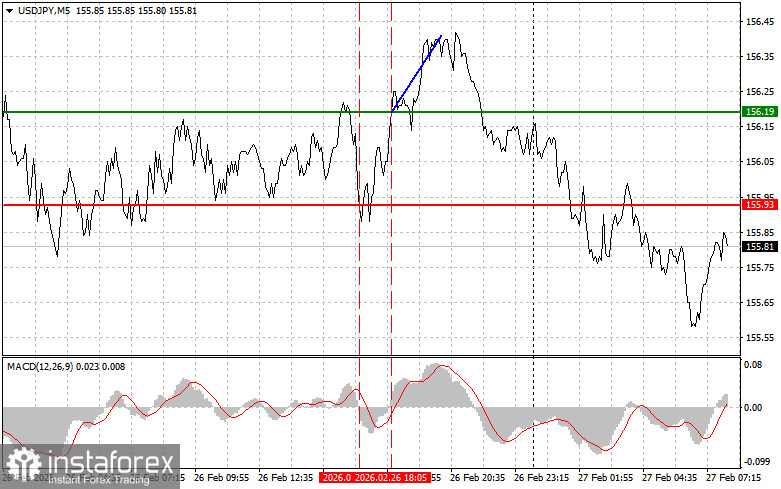
The price test at 156.19 coincided with the MACD indicator just beginning to move upward from the zero mark, confirming a correct entry point for buying the dollar. As a result, the pair rose by 20 pips.
According to today's data, the inflation index in Tokyo has decreased, as utility subsidies introduced by Prime Minister Sanae Takaichi have lowered household energy costs, creating challenges for the Bank of Japan ahead of any further interest rate hikes. The decline in inflation reflected in the latest consumer price index came as a surprise to many economists, who had expected more persistent price pressures. Government measures aimed at mitigating the effects of rising energy prices have proven effective, directly influencing the spending basket of ordinary Japanese families. The drop in utility costs, in particular, played a key role in this trend.
This dynamic creates challenges for the BOJ, as the likelihood of further near-term interest rate hikes diminishes, which may also exert further pressure on the Japanese yen against the dollar. For this reason, the upward trend in the USD/JPY pair may continue, and any potential downward corrections will be viewed by traders as an opportunity to buy at attractive prices.
As for the intraday strategy, I will primarily rely on the implementations of Scenarios #1 and #2.
Buy Scenarios
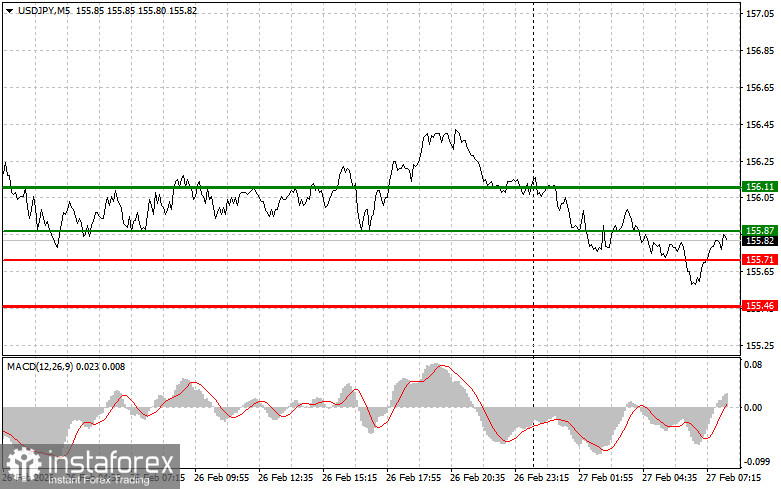
Scenario #1: Today, I plan to buy USD/JPY at the entry point around 155.87 (green line on the chart), with a target at 156.11 (thicker green line on the chart). At point 156.11, I plan to exit my long positions and open short positions in the opposite direction (expecting a movement of 30-35 pips back from the level). It is best to resume buying the pair during corrections and significant pullbacks in USD/JPY. Important! Before buying, ensure the MACD indicator is above the zero mark and just beginning an upward move.
Scenario #2: I also plan to buy USD/JPY today in the event of two consecutive tests of the price at 155.71 when the MACD indicator is in the oversold area. This will limit the pair's downside potential and lead to an upward market reversal. One could expect a rise to the opposing levels of 155.87 and 156.11.
Sell Scenarios
Scenario #1: I plan to sell USD/JPY today only after breaking the level of 155.71 (red line on the chart), which could lead to a quick decline in the pair. The key target for sellers will be the 155.46 level, where I plan to exit my shorts and open longs immediately in the opposite direction (expecting a 20-25-pip reversal from the level). It is preferable to sell as high as possible. Important! Before selling, ensure the MACD indicator is below the zero mark and just beginning its downward movement.
Scenario #2: I also plan to sell USD/JPY today if the price tests 155.87 twice in a row while the MACD indicator is in the overbought area. This will limit the upward potential of the pair and lead to a market reversal downward. One could expect a decline to the opposing levels of 155.71 and 155.46.
What the Chart Shows:
- Thin Green Line: Entry price for buying the trading instrument.
- Thick Green Line: Estimated price for setting Take Profit or locking in profits, as further growth above this level is unlikely.
- Thin Red Line: Entry price for selling the trading instrument.
- Thick Red Line: Estimated price for setting Take Profit or locking in profits, as further decline below this level is unlikely.
- MACD Indicator: When entering the market, focus on the overbought and oversold zones.
Important:
Beginner traders in the Forex market must make entry decisions very cautiously. It is best to stay out of the market before significant fundamental reports are released to avoid sudden price fluctuations. If you decide to trade during news releases, always set stop orders to minimize losses. Without stop orders, you can quickly lose your entire deposit, especially if you do not use money management and trade large volumes.
Remember, to trade successfully, you must have a clear trading plan, as presented above. Spontaneous trading decisions based on the current market situation are a losing strategy for intraday traders.


