


















Bitcoin has reached $72,000 and shows no signs of stopping there. Major Asian purchases maintain the potential for further movement toward $73,000 and $75,000. Ethereum has also shown growth during morning trading, reaching $2,150.

Recently, a significant event in the cryptocurrency world was reported: BlackRock, the world's largest asset manager, is officially launching a new Ethereum-based exchange-traded fund (ETF) that will include a staking feature. This step marks an important milestone in the industry as it enables institutional players to offer investors direct access to the ability to earn rewards for holding and supporting the Ethereum network.
The launch of this ETF opens new opportunities for traditional investors, who may have previously been wary of direct involvement in crypto assets due to their complexity and volatility. The integration of staking into the ETF structure makes investing in Ethereum more attractive, as it offers a chance for passive income similar to dividends on stocks or coupon payments on bonds. This could attract a wider range of investors looking to diversify their portfolios with crypto assets while preferring established institutional tools.
It's important to recall that the staking feature in Ethereum involves locking a certain amount of ETH to ensure the security and functionality of the blockchain. In return, participants earn rewards in the form of new ETH. Through this new ETF, BlackRock effectively acts as an intermediary, managing the staking process on behalf of investors. This alleviates the technical complexities and risks associated with managing crypto assets independently, making the process more accessible and secure.
Regarding intraday strategies in the cryptocurrency market, I will continue to rely on significant pullbacks in Bitcoin and Ethereum in anticipation of the bull market continuing in the long term, which remains robust.
As for short-term trading, the strategy and conditions are described below.
Bitcoin
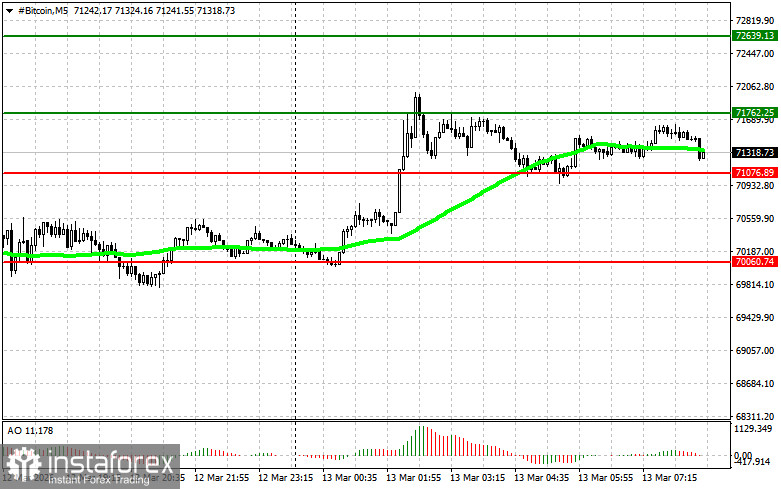
Buy Scenario
Scenario #1: I plan to buy Bitcoin today when the price reaches an entry point around $71,700, targeting a move to $72,700. At around $72,700, I will exit the buys and sell immediately on the rebound. Before buying on the breakout, ensure that the 50-day moving average is below the current price and the Awesome indicator is above zero.
Scenario #2: I can buy Bitcoin from the lower boundary of $71,000 if there is no market reaction to its breakout back to levels $71,700 and $72,700.
Sell Scenario
Scenario #1: I will sell Bitcoin today upon reaching an entry point around $71,000, targeting a drop to $70,000. At around $70,000, I will exit the sales and buy immediately on the rebound. Before selling on the breakout, ensure that the 50-day moving average is above the current price and the Awesome indicator is below zero.
Scenario #2: I can sell Bitcoin from the upper boundary of $71,700 if there is no market reaction to its breakout back to levels $71,000 and $70,000.
Ethereum
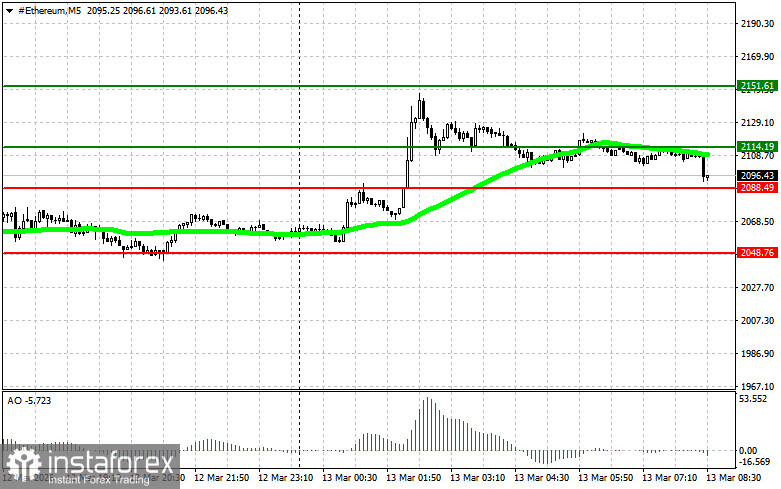
Buy Scenario
Scenario #1: I will buy Ethereum today when the price reaches an entry point around $2,114, targeting a move to $2,151. At around $2,151, I plan to exit the buys and sell immediately on the rebound. Before buying on a breakout, ensure the 50-day moving average is below the current price and the Awesome indicator is above zero.
Scenario #2: I can buy Ethereum from the lower boundary of $2,088 if there is no market reaction to its breakout back to levels $2,114 and $2,151.
Sell Scenario
Scenario #1: I will sell Ethereum today upon reaching an entry point around $2,088, targeting a drop to $2,048. At around $2,048, I plan to exit the sales and buy immediately on the rebound. Before selling on a breakout, ensure the 50-day moving average is above the current price and the Awesome indicator is below zero.
Scenario #2: I can sell Ethereum from the upper boundary of $2,114 if there is no market reaction to its breakout back to levels $2,088 and $2,048.


