


















Donald Trump affirms that oil prices will soon collapse. However, Iran warns they could hit $200 per barrel. Judging by events in the Middle East, the latter scenario looks more likely. Brent has closed above the psychologically important $100 level for the third time in three days. The confrontation is now in its third week with no end in sight.
At the start of the conflict, investors compared the situation to summer 2025, when strikes on Iran lasted 12 days, and to 2022. Four years ago, fighting in Ukraine pushed Brent above $133/bbl. Back then, analysts argued about the potential exclusion of the world's largest producer, Russia, from markets. Russian output was roughly 10 million b/d, with about a third of that going to Europe. An EU embargo on Russian oil risked a shortfall of some 3 million b/d and pushed prices sharply higher.
Flows through the Strait of Hormuz
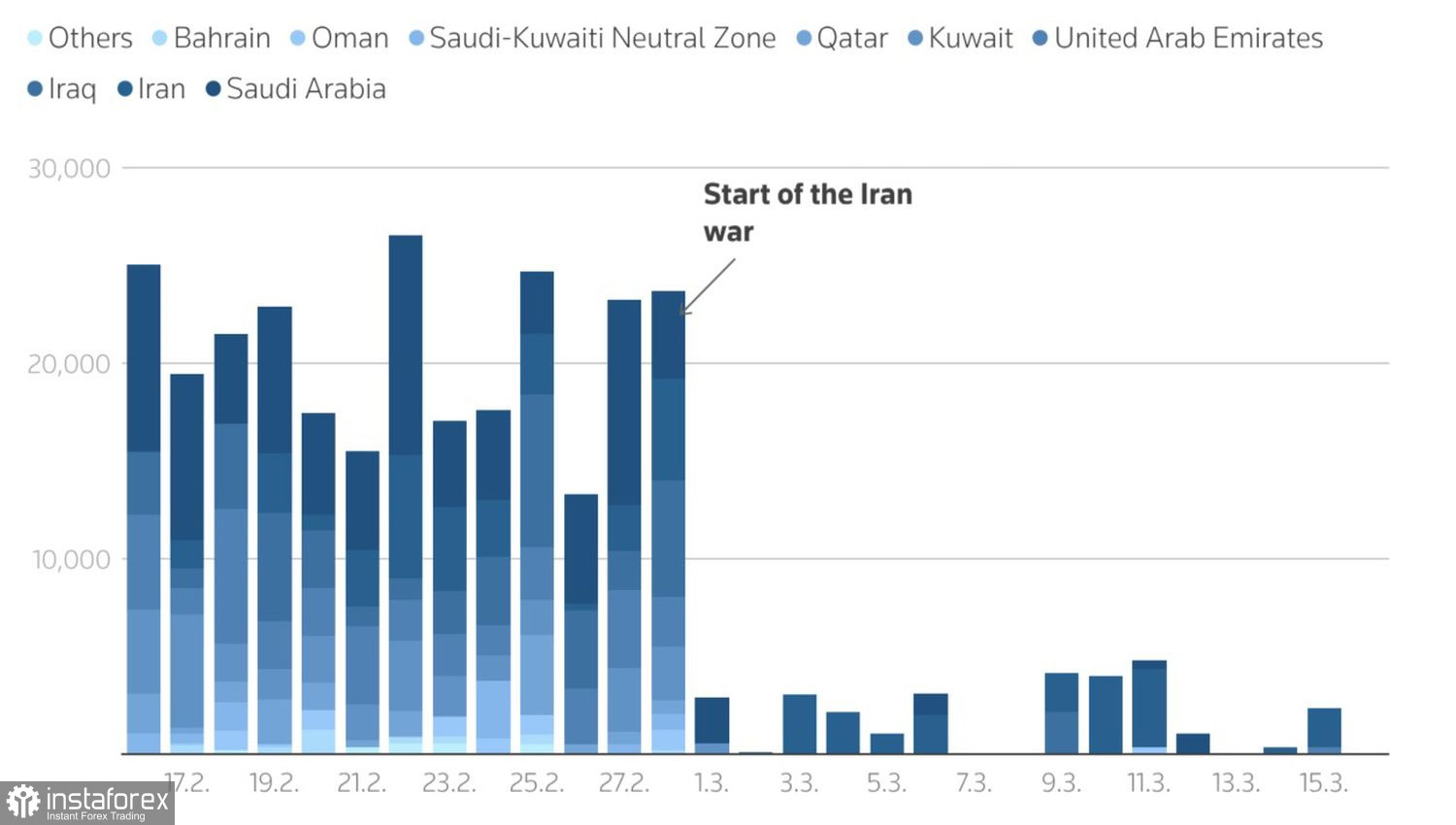
Today, the losses are many times larger. Before the war, roughly 20 million b/d transited the Strait of Hormuz; in March, flows have shrunk by almost 95%. What still moves through the world's main oil artery is largely Iranian crude. Yes, some tankers from India managed to lift cargoes, briefly sending Brent down, but those shipments were the result of a Tehran?Delhi agreement.
Iraq is trying similar workarounds, but its oil production has plunged from 4.4 million b/d to 1.2 million b/d. When exports stop, storage fills, and production must be cut. UAE losses rose from 500–800k b/d a week earlier to 1.5 million b/d. Kuwait's output has fallen by 1.3 million b/d.
Trump is twisting in the pan, urging other countries to join US warships in escorting tankers through Hormuz. Most allies refuse. Germany has said plainly, this is not its war and will not participate.
At the same time, the US president threatens to bomb Iran's infrastructure on Kharg Island, through which about 95% of local oil flows. But such strikes could push prices even higher. So long as something still moves through Hormuz, the supply shortfall is not yet extreme, but the window is closing fast.
The scale of this catastrophe far exceeds that of early 2022 after the Ukraine war began. The only mitigating factor is that the market was clearly "bearish" before the conflict. The IEA says it can release 400 million barrels from strategic reserves — that's only part of the story; in fact, up to 1.4 billion barrels could be mobilized if needed.
Technical picture
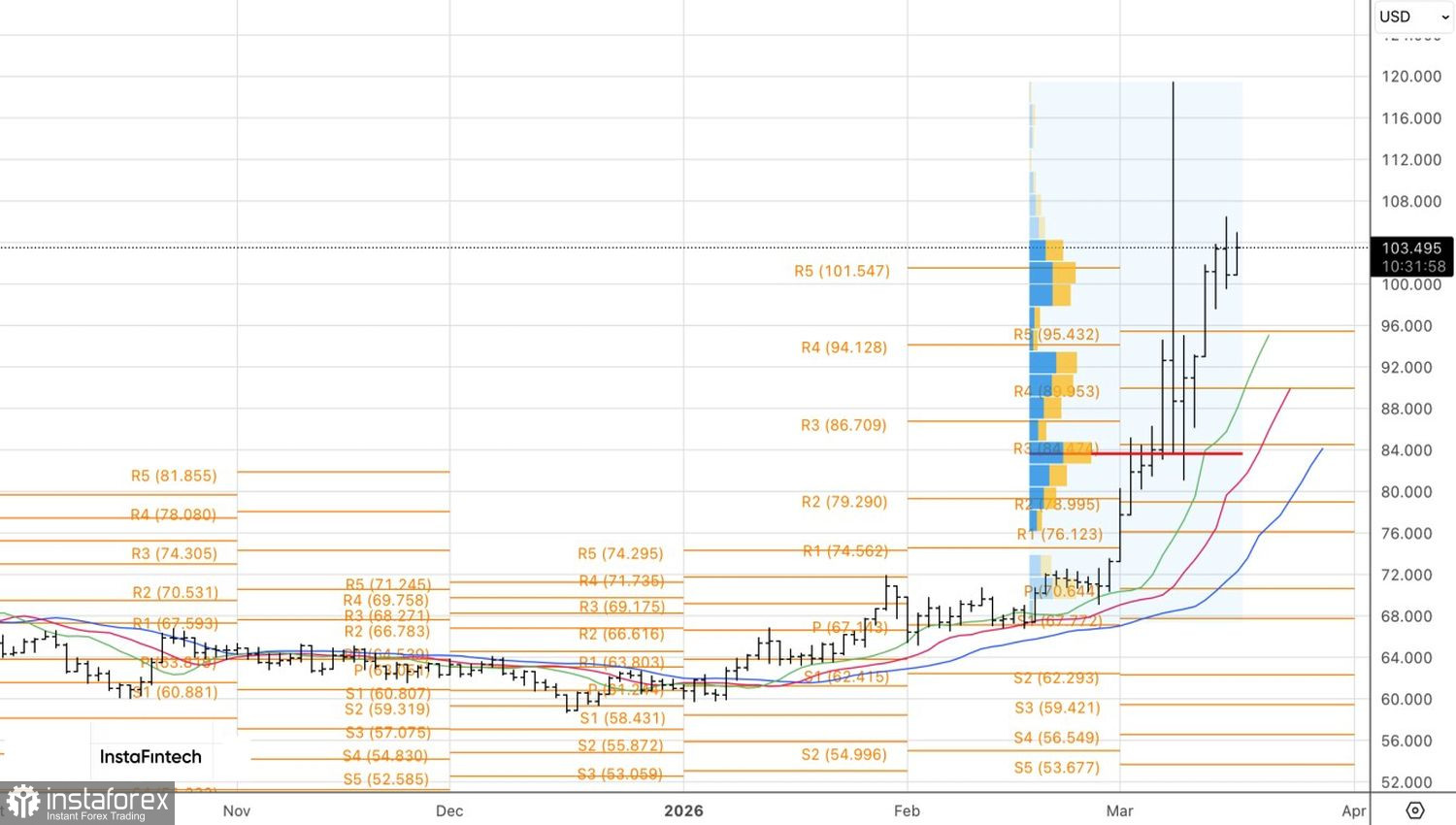
On the daily chart, Brent is in a clear uptrend. Pullbacks look short-lived and should be used to build long positions in the North Sea benchmark. Initial targets: $110 and $120 per barrel.


