


















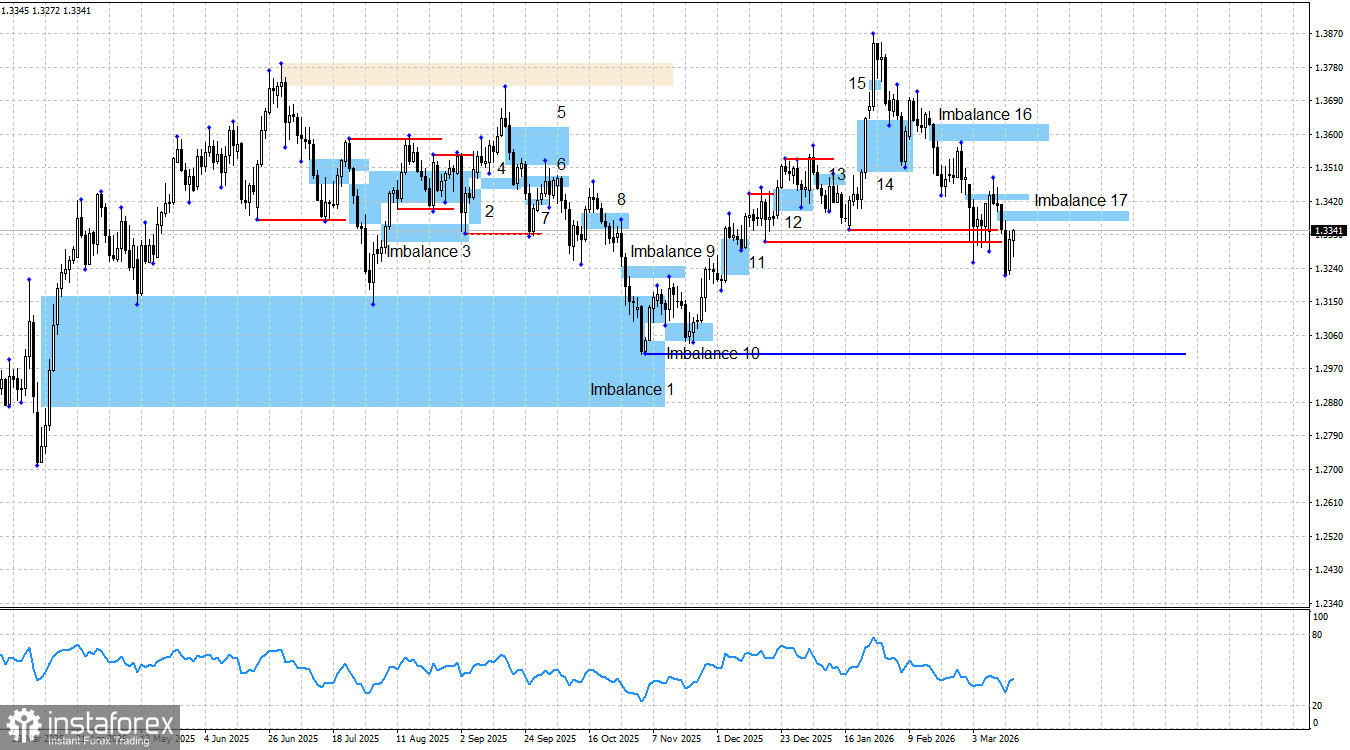
The GBP/USD pair reversed in an imbalance zone (without a numerical label) and resumed its decline without a specific target. Last week, another bearish imbalance was formed, which may trigger a price reaction and a new sell signal as early as today. A similar pattern is present in EUR/USD, so it is still too early to talk about the end of the bearish phase. On the contrary, bullish positions are very weak. To expect a new wave of a bullish trend, at minimum, imbalance 17 needs to be invalidated. As traders already know, geopolitics is currently the key market driver, accounting for about 90% of the U.S. dollar's strength. But what if, in recent weeks, the market was not concerned about high oil prices, rising inflation, or recession? What if the market feared that the Federal Reserve would abandon further monetary easing due to inflation growth linked to the Middle East conflict? In that case, this factor may already be priced in.
There was no major escalation in the Middle East last week, but the overall situation has not improved. Iran continues to block the Strait of Hormuz, Gulf states continue missile and drone exchanges, Donald Trump is demanding support from EU countries in the region, and EU nations are trying to resolve the looming energy crisis on their own. At this point, speculating about when the conflict will end is no longer meaningful. The fact remains: the conflict continues, and without its resolution, global stability will not return. But can the U.S. dollar continue to strengthen throughout the conflict?
At present, there are no bullish patterns, but a new sell signal may form today within imbalance 17. The euro also has a similar imbalance, so EUR/USD and GBP/USD may again produce identical trading signals. The probability of further declines in both pairs remains relatively high, though not absolute. Any discussion of a bullish resurgence at this stage is speculative and lacks confirmation.
The long-term trend for the pound remains bullish. As long as it holds above 1.3012, more attention should be paid to bullish signals. However, there are currently no such patterns or signals, while geopolitical factors continue to weigh on both the euro and the pound.
The news background on Monday and Tuesday was essentially absent, while Friday's data was unfavorable for both the pound and the dollar. Nevertheless, it is unlikely that either UK or U.S. reports had a meaningful impact on trader sentiment, despite their importance.
In the United States, the overall information backdrop suggests that, in the long term, the dollar should weaken. The conflict between the U.S. and Iran does not significantly change this outlook. The situation for the dollar remains challenging in the long term but favorable in the short term. U.S. labor market data continues to disappoint more often than it surprises positively. Three of the last four FOMC meetings ended with dovish decisions. Political and structural challenges in the U.S.—including Trump's military actions, tensions with various countries, legal actions involving Jerome Powell, government shutdown risks, political scandals, potential impeachment risks, and possible electoral losses—further complicate the outlook.
In this context, there are sufficient conditions for a potential bullish recovery in 2026, but for now, traders are primarily focused on geopolitics and the energy crisis.
A sustained bearish trend in GBP/USD would require a strong and stable positive background for the U.S. dollar, which is difficult to expect under current political conditions. While geopolitical factors could provide support, their impact is uncertain. In an extreme scenario of a broader global conflict, the dollar could strengthen significantly, but such an outcome remains speculative. Under current conditions, the dollar's upward potential is limited by the nature of ongoing geopolitical developments.
Economic calendar for the U.S. and the UK:
- U.S. – Producer Price Index (12:30 UTC)
- U.S. – Federal Reserve interest rate decision (18:00 UTC)
- U.S. – Dot plot (18:00 UTC)
- U.S. – Press conference with Jerome Powell (18:30 UTC)
On March 18, the economic calendar includes four events, three of which are considered significant. The impact of the news flow on market sentiment on Wednesday may be strong, particularly in the second half of the day.
GBP/USD forecast and trading advice:
For the pound, the long-term outlook remains bullish. However, there are currently no active bullish patterns. Only a new bearish imbalance (17) is present, and the price must first return to this zone and react to it before traders can consider new sell positions.
It is worth noting that the pound's decline in recent weeks has been driven by a combination of unfavorable factors. Without escalating geopolitical tensions, including military actions in the Middle East, the dollar's strength would likely have been less pronounced. This decline may end as abruptly as it began, but for now, it continues. If new signals emerge, the pound may decline further toward the 1.3000–1.3100 level.


