


















Analysis of Trades and Trading Tips for the British Pound
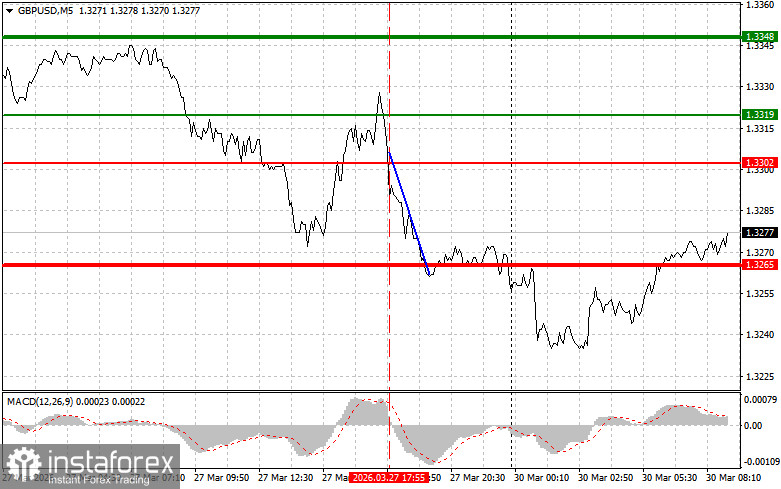
The price test at 1.3302 coincided with the MACD indicator just beginning to move down from the zero mark, confirming the correct entry point for selling the pound. As a result, the pair declined towards the target level of 1.3265.
The rise in energy prices and the risk of increasing inflationary pressure in the UK, alongside the unstable geopolitical situation—including tensions in the Middle East—continue to fuel demand for the US dollar against the pound. Acting as a safe-haven asset, the dollar attracts capital, especially during periods of uncertainty. This creates pressure on currencies of less stable economies or those more vulnerable to external shocks. The British pound, in turn, faces additional challenges. In addition to global factors, internal economic problems in the UK are affecting the pound's exchange rate, including persistent inflation despite the Bank of England's efforts to contain it.
Today, the first half of the day is expected to feature the release of several key macroeconomic data points from the UK. These indicators may significantly affect the British pound's exchange rate. Of particular interest to investors are figures on approved mortgage applications, consumer loan volume, and the dynamics of the M4 money supply.
The mortgage market serves as an important indicator of consumer confidence and the state of the housing sector, while data on net personal loans will provide insights into consumer spending and household debt levels. Changes in the M4 money supply reflect liquidity in the banking system and the total amount of money in circulation. An increase in M4 may indicate an expansion of the money supply, which could potentially fuel inflation. Conversely, a decrease in M4 may indicate a tightening of monetary policy.
The combination of this data will provide a more comprehensive picture of the state of the British economy and help forecast short-term movements in the British pound.
Regarding the intraday strategy, I will primarily rely on implementing Scenarios #1 and #2.
Buying Scenarios:
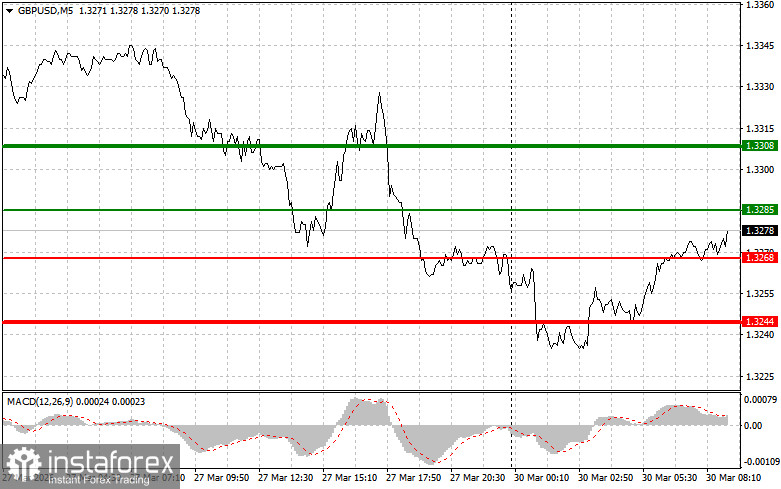
Scenario #1: I plan to buy the pound today when it reaches an entry point around 1.3285 (green line on the chart), targeting a move to 1.3308 (thicker green line on the chart). Near 1.3308, I will exit my long positions and sell back in the opposite direction, aiming for a movement of 30-35 pips from the entry point. One can expect the pound to rise only after receiving good data today. Important! Before buying, ensure the MACD indicator is above the zero mark and just beginning an upward move from it.
Scenario #2: I also plan to buy the pound today if the price tests 1.3268 twice in a row, when the MACD indicator is in the oversold area. This will limit the downside potential of the pair and lead to a market reversal upwards. One can expect growth towards the opposite levels of 1.3285 and 1.3308.
Selling Scenarios:
Scenario #1: I plan to sell the pound after the 1.3268 level is updated (red line on the chart), which will trigger a rapid decline in the pair. The key target for sellers will be the 1.3244 level, where I intend to exit my short positions and immediately buy back in the opposite direction (aiming for a move of 20-25 pips in the opposite direction from the level). Pressure on the pound could return if the data is negative. Important! Before selling, ensure the MACD indicator is below the zero mark and just starting its downward move.
Scenario #2: I also plan to sell the pound today if two consecutive tests of 1.3285 occur while the MACD indicator is in the overbought area. This will limit the upside potential of the pair and lead to a market reversal downwards. One can expect a decline towards the opposite levels of 1.3268 and 1.3244.
What's on the Chart:
- The thin green line represents the entry price at which you can buy the trading instrument;
- The thick green line is the assumed price where you can set Take Profit or manually take profit, as further growth above this level is unlikely;
- The thin red line indicates the entry price at which you can sell the trading instrument;
- The thick red line is the assumed price where you can set Take Profit or manually take profit, as further decline below this level is unlikely;
- The MACD indicator. When entering the market, it's important to refer to the overbought and oversold zones.
Important: Beginner traders in the forex market need to make entry decisions very carefully. It is best to stay out of the market before the release of important fundamental reports to avoid sharp fluctuations in prices. If you choose to trade during the release of news, always set Stop Loss orders to minimize losses. Without placing Stop Loss orders, you can quickly lose your entire deposit, especially if you do not use money management and trade large volumes.
And remember, successful trading requires a clear trading plan, like the one presented above. Making spontaneous trading decisions based on the current market situation is inherently a losing strategy for intraday traders.


