


















Last week, the GBP/USD pair gained nearly 300 points amid sharply rising expectations of a lasting ceasefire between Iran and the United States. However, those hopes did not materialize, as the negotiations in Islamabad failed. As a result, the new week began with the pair dropping by 80 points. Surprisingly, though, bulls resumed their advance on Monday. What could explain this?
There are two reasons. The first is technical. Last week, a new bullish imbalance was formed, and the price effectively tested it overnight, producing a reaction. In other words, a bullish signal was generated. The second reason is geopolitical. The market has already had enough time and opportunity to price in the most pessimistic scenario for the Middle East. After the failed negotiations in Islamabad, nothing has fundamentally changed. Oil has not hit new record highs, no new missile strikes have occurred, and the Strait of Hormuz remains blocked. The situation has not improved—but it has not worsened either.
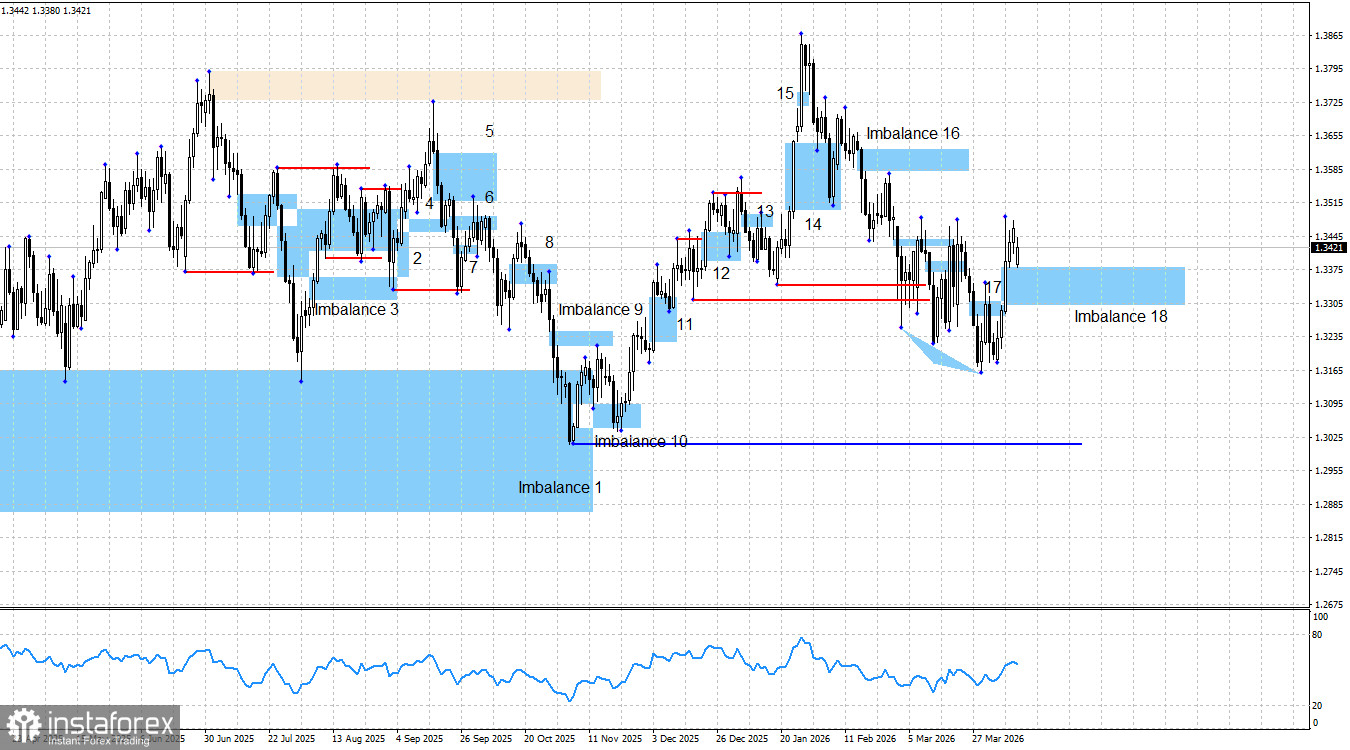
As mentioned in previous articles, an important and relatively rare "Three Drives Pattern" was formed, which triggered the subsequent upward movement. Thus, traders received a bullish signal, while the overall trend remained bullish throughout. Geopolitics supported the bulls, resulting in a nearly 300-point rally.
At present, the ceasefire remains fragile, and the parties to the conflict have yet to decide whether to resume negotiations or return to military action. Talks may resume this week, which is a positive factor. However, the Strait of Hormuz could face a dual blockade, and the Bab el-Mandeb Strait could join it—this is a negative factor. As of Monday, however, the overall situation remains unchanged.
The probability of a decline in both pairs remains relatively high due to the fragility of the ceasefire. At the same time, the "Three Drives Pattern," marked on the chart by a triangle, enabled bulls to take control, which is already a positive sign. This pattern consists of three successive swings, each slightly lower than the previous one, indicating the exhaustion of a bearish impulse (in this case).
Thus, technical analysis suggests solid potential for further gains in the pound, although additional geopolitical support would be beneficial. In fact, a new bullish signal from imbalance 18 was formed on Monday. From a chart perspective, this supports the continuation of the upward movement.
There was no significant economic news on Monday, meaning the pound's rise was not driven by macroeconomic data. While geopolitics did not improve over the weekend, the worst-case scenario had already been priced in. The situation in the Middle East would need to deteriorate significantly further for bears to regain control. In the United States, the broader information backdrop still suggests that, in the long term, the dollar is more likely to weaken. The conflict between the US and Iran has not materially changed this outlook. The US dollar's position remains challenging in the long term, with only short-term support.
The labor market continues to struggle, the economy is moving closer to recession, and unlike the ECB and the Bank of England, the Federal Reserve is not expected to tighten monetary policy in 2026. Additionally, a fourth major wave of protests against Donald Trump has taken place across the country. From an economic standpoint, there are currently no strong reasons for the dollar to strengthen.
A sustained bearish trend in GBP/USD would require a strong and stable positive backdrop for the dollar—something difficult to expect under current conditions. Geopolitics supported the dollar for two months, but this support will eventually fade—or may already be fading. It is hard to determine exactly when, so a renewed rise in the dollar cannot be ruled out.
Economic Calendar for the US and the UK:
- US – ADP Employment Change (12:15 UTC)
- US – Producer Price Index (12:30 UTC)
On April 14, the economic calendar contains two secondary events. Their impact on market sentiment on Tuesday is expected to be minimal. Traders continue to focus primarily on geopolitical developments.
GBP/USD Forecast and Trading Advice:
For the pound, the long-term outlook remains bullish. The "Three Drives Pattern" signaled potential growth, followed by the formation of a bullish imbalance and a bullish signal. The price has taken liquidity from the last two bullish swings, yet bears have not entered the market—another positive sign for the pound.
Therefore, despite geopolitical uncertainties, I believe the upward movement is likely to continue. The euro is also likely to keep rising, even without its own bullish signals.
The main target for the pound is the 2026 high. The nearest target is the 1.3580 level—imbalance 16, which has not yet been tested.