


















Yesterday, stock indices closed lower. The S&P 500 fell by 0.41%, while the Nasdaq 100 declined by 0.89%. The Dow Jones Industrial Average dropped by 0.36%.
Markets were hit by a fresh wave of volatility driven by an escalation in the Middle East conflict. Indices plunged sharply, reflecting growing investor concern about the outlook. At the same time, oil prices spiked. That jump is directly linked to the threat of a prolonged closure of the Strait of Hormuz, the critical route for global energy shipments.
Deepening geopolitical tension raises the real prospect of significant energy supply disruptions. The Strait of Hormuz, through which a large share of world oil exports transit, has seen restrictions that already created a sharp supply deficit. Continued closure would push oil prices higher and weigh on the global economy, slowing growth and accelerating inflation.
Already the renewed confrontation has pushed Brent above $105. Fears that peace talks have stalled, together with rising military threats, limit upside potential for equity indices and other risk assets.
Yesterday, President Donald Trump ordered US naval forces to fire on any vessel laying mines in the strait, while US forces reported intercepting two supertankers attempting to evade efforts to prevent passage to and from Iranian ports.
Later the same day, Trump said that if Iran does not deliver oil, its infrastructure will collapse. He also stated that Iran wants a deal and that the US is engaged in talks with Tehran. The US president warned Americans to expect higher gasoline prices for some time.
Meanwhile, Iranian news agency Mehr reported that air-defense systems had been activated in parts of Tehran to counter hostile targets, and semi-official agency Fars said the move was a response to small drone activity.
All this underscores uncertainty in diplomatic relations between the two sides. The persistent ambiguity over the Strait of Hormuz is particularly troubling. The absence of a clear plan to reopen the waterway increases uncertainty and puts pressure on risk assets.
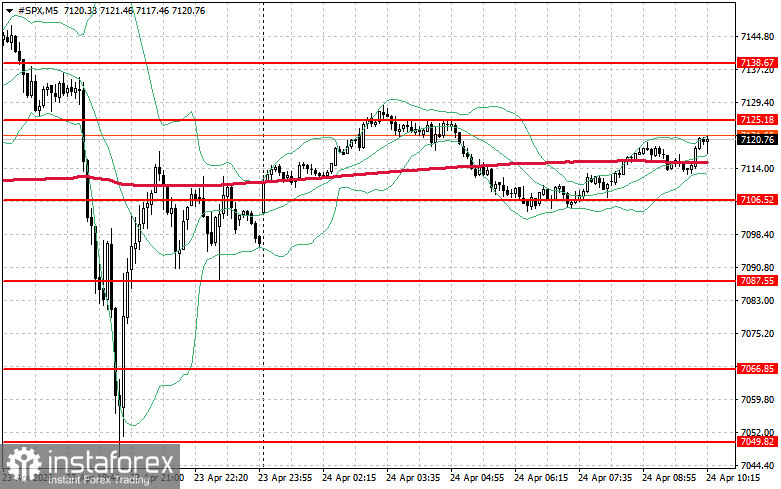
As for the S&P 500 technical picture, the primary task for buyers today will be to overcome the nearest resistance level of $7,125. That would help the index gain upside momentum and could pave the way for a surge to $7,138. Equally a priority for bulls will be control above $7,156, which would strengthen buyers' positions. In the event of a downside move amid reduced risk appetite, buyers must defend around $7,106. A break below that level would quickly push the instrument back to $7,087 and could open the way to $7,066.


