


















Trade Review and Tips for Trading the Euro
The test of the 1.1764 price level occurred when the MACD indicator had just started moving upward from the zero line, confirming a valid entry point for buying the euro. As a result, the pair rose by 10 points.
Against the backdrop of relatively acceptable eurozone data, the single currency continued the strengthening that began yesterday. However, the growth appeared rather restrained, as reports from France and Germany failed to support the overall optimism.
Later, investors' attention will shift to U.S. macroeconomic reports. The focus will be on initial jobless claims data. This leading indicator of the health of a key component of the U.S. economy could determine the future direction of the dollar. Significant deviations from forecasts may act as a trigger, instantly offsetting the dollar's recent decline.
At the same time, speeches from Federal Reserve Open Market Committee members are scheduled. Particular attention will be paid to statements by Beth M. Hammack and John Williams. Every remark — including nuances regarding inflation expectations and future interest rate changes — will be carefully analyzed.
And, of course, do not forget about Trump and his promises to bring peace and order to the Middle East.
As for the intraday strategy, I will rely primarily on the implementation of Scenarios No. 1 and No. 2.
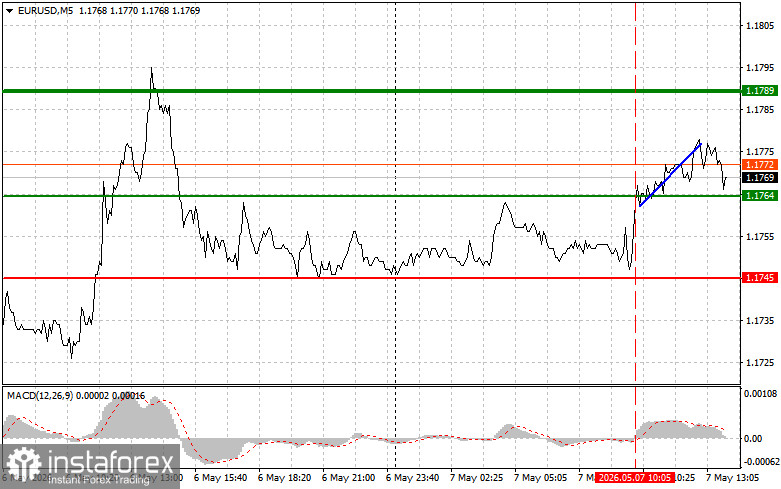
Buy Signal
Scenario No. 1:
Today, buying the euro is possible upon reaching the 1.1779 price level (green line on the chart), with a target of 1.1805. At 1.1805, I plan to exit the market and also sell the euro in the opposite direction, targeting a 30–35 point move from the entry point. Further euro growth today can only be expected after weak U.S. data.
Important: Before buying, make sure the MACD indicator is above the zero line and just beginning its upward movement.
Scenario No. 2:
I also plan to buy the euro today in the event of two consecutive tests of the 1.1761 level while the MACD indicator is in oversold territory. This would limit the pair's downward potential and lead to a market reversal upward. Growth toward the opposite levels of 1.1779 and 1.1805 can then be expected.
Sell Signal
Scenario No. 1:
I plan to sell the euro after the pair reaches the 1.1761 level (red line on the chart). The target will be 1.1730, where I intend to exit the market and immediately buy in the opposite direction, targeting a 20–25 point move upward from that level. Pressure on the pair may return today if strong U.S. data is released.
Important: Before selling, make sure the MACD indicator is below the zero line and just beginning its downward movement.
Scenario No. 2:
I also plan to sell the euro today in the event of two consecutive tests of the 1.1779 level while the MACD indicator is in overbought territory. This would limit the pair's upward potential and lead to a downward market reversal. A decline toward the opposite levels of 1.1761 and 1.1730 can then be expected.
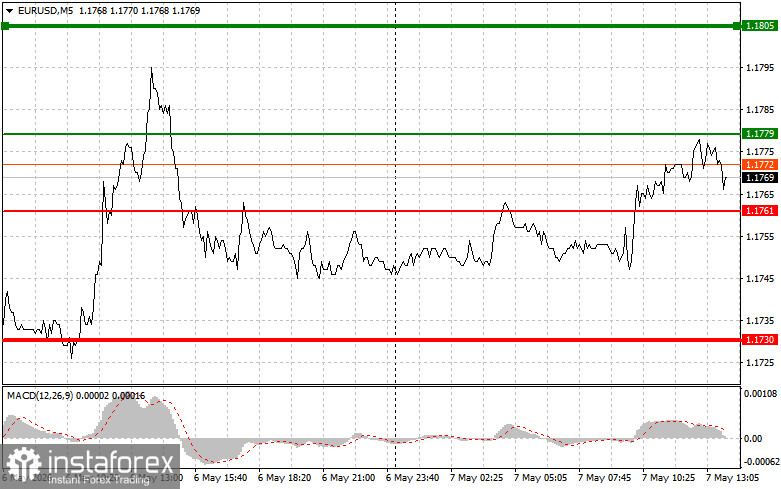
Chart Explanation
- Thin green line – entry price for buying the trading instrument;
- Thick green line – estimated Take Profit level or area for manually locking in profits, as further growth above this level is unlikely;
- Thin red line – entry price for selling the trading instrument;
- Thick red line – estimated Take Profit level or area for manually locking in profits, as further decline below this level is unlikely;
- MACD Indicator – when entering the market, it is important to use overbought and oversold zones as guidance.
Important
Beginner Forex traders should make market entry decisions very carefully. Before the release of important fundamental reports, it is best to stay out of the market to avoid sharp price fluctuations. If you decide to trade during news releases, always place stop-loss orders to minimize losses. Without stop-loss orders, you can lose your entire deposit very quickly, especially if you do not use proper money management and trade large volumes.
Remember that successful trading requires a clear trading plan, such as the one presented above. Spontaneous trading decisions based solely on the current market situation are inherently a losing strategy for an intraday trader.


