


















Analysis of Tuesday's Trades:
1H Chart of EUR/USD:
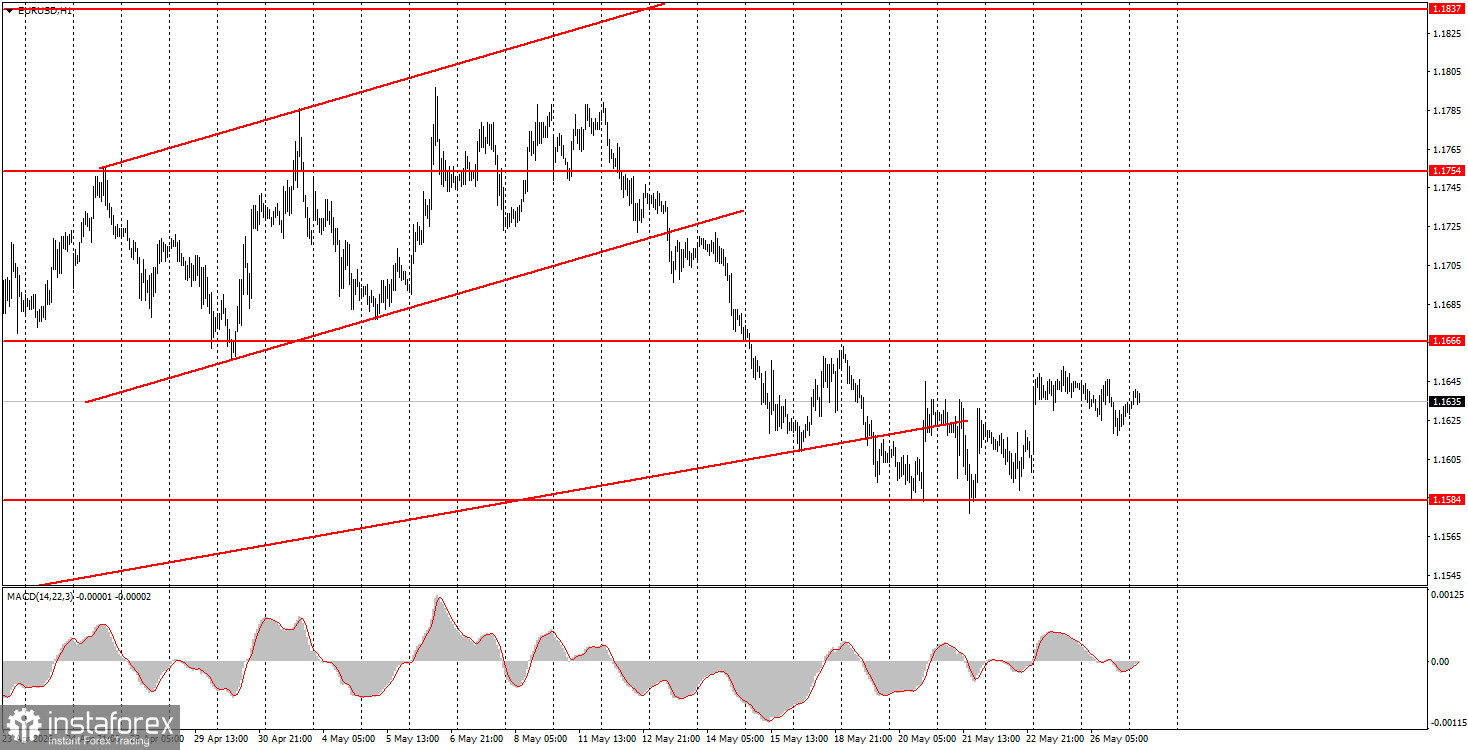
The EUR/USD currency pair traded with low volatility on Tuesday, showing no notable movements, as seen on the 5-minute timeframe. There were no noteworthy reports throughout the day from either the Eurozone or the U.S., and the market began to ignore geopolitical news once again, as it has grown tired of the ever-changing geopolitical backdrop. Yesterday, it was revealed that just when negotiations were at their peak, and "five minutes before signing the deal," the U.S. struck in southern Iran near the Strait of Hormuz. There's no need to delve into which targets were hit. The fact remains that negotiations were once again on the brink of collapse, just as the ceasefire between Tehran and Washington was. Interestingly, the dollar did not rise at all. Thus, the market is no longer willing to react to every strike, every piece of news, every statement. Volatility continues to decline, reflecting the market's reluctance to trade on unverified or meaningless messages.
5M Chart of EUR/USD:
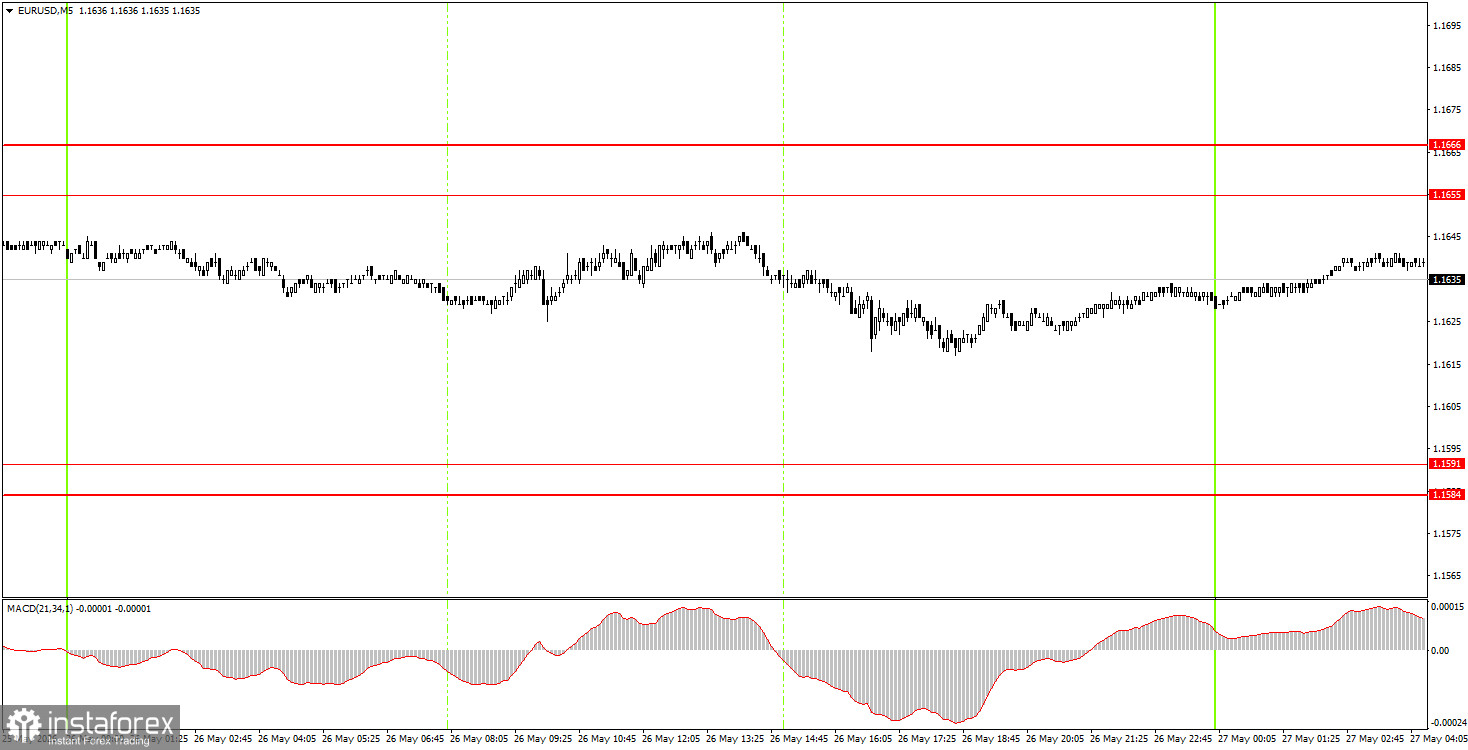
On the 5-minute timeframe, no trading signals were formed on Tuesday. Throughout the day, the euro moved 30 pips from its minimum to its maximum, without approaching any significant areas or levels. Therefore, traders had no basis for opening positions.
How to Trade on Wednesday:
On the hourly timeframe, the euro has been in a corrective phase for a whole month. The growth of the American currency resumed last week as the conflict in the Middle East was on the brink of escalation, but we still do not anticipate prolonged dollar strength. The market largely continues to ignore fundamentals and macroeconomics, while geopolitics swings the EUR/USD pair up and down.
On Wednesday, novice traders may stay in short positions targeting 1.1584-1.1591, as the price has bounced from the 1.1655-1.1666 area back on Monday. New long positions can be considered upon the price consolidating above the 1.1655-1.1666 area, targeting 1.1745-1.1754.
On the 5-minute timeframe, levels to consider include 1.1354-1.1363, 1.1413, 1.1455-1.1474, 1.1527-1.1531, 1.1584-1.1591, 1.1655-1.1666, 1.1745-1.1754, 1.1830-1.1837, and 1.1899-1.1908. On Wednesday, there are again no significant events or reports scheduled in the Eurozone or the U.S., and the market will await geopolitical developments and confirmations of Trump's weekend statements, as well as the consequences of the U.S. attack on Iran, on Tuesday.
Main Rules of the Trading System:
- The strength of the signal is determined by the time it took to form the signal (bounce or breakout of the level). The less time it took, the stronger the signal.
- If two or more trades were opened near any level based on false signals, all subsequent signals from this level should be ignored.
- In a flat market, any pair can generate many false signals or none at all. Technical levels may be ignored.
- On the hourly timeframe, it is preferable to trade signals from the MACD indicator only in the presence of good volatility and a trend that is confirmed by a trend line or trend channel.
- If two levels are too close together (5-20 pips apart), treat them as a support or resistance zone.
- After a move of 15 pips in the right direction, a Stop Loss should be set to breakeven.
What is on the Charts:
Price levels (areas) of support and resistance – levels that are targets when opening purchases or sales, or sources of signals.
Red lines – channels or trend lines that display the current trend and indicate which direction is preferable to trade now.
MACD indicator (14, 22, 3) – histogram and signal line – a supporting indicator that can also be used as a source of signals.
Important speeches and reports (contained in the news calendar) can significantly influence the movement of the currency pair. Therefore, during their release, trading should be done as cautiously as possible, or one should exit the market to avoid a sharp price reversal against the preceding movement.
Beginners trading in the Forex market should remember that not every trade can be profitable. Developing a clear strategy and effective money management are key to long-term trading success.


