


















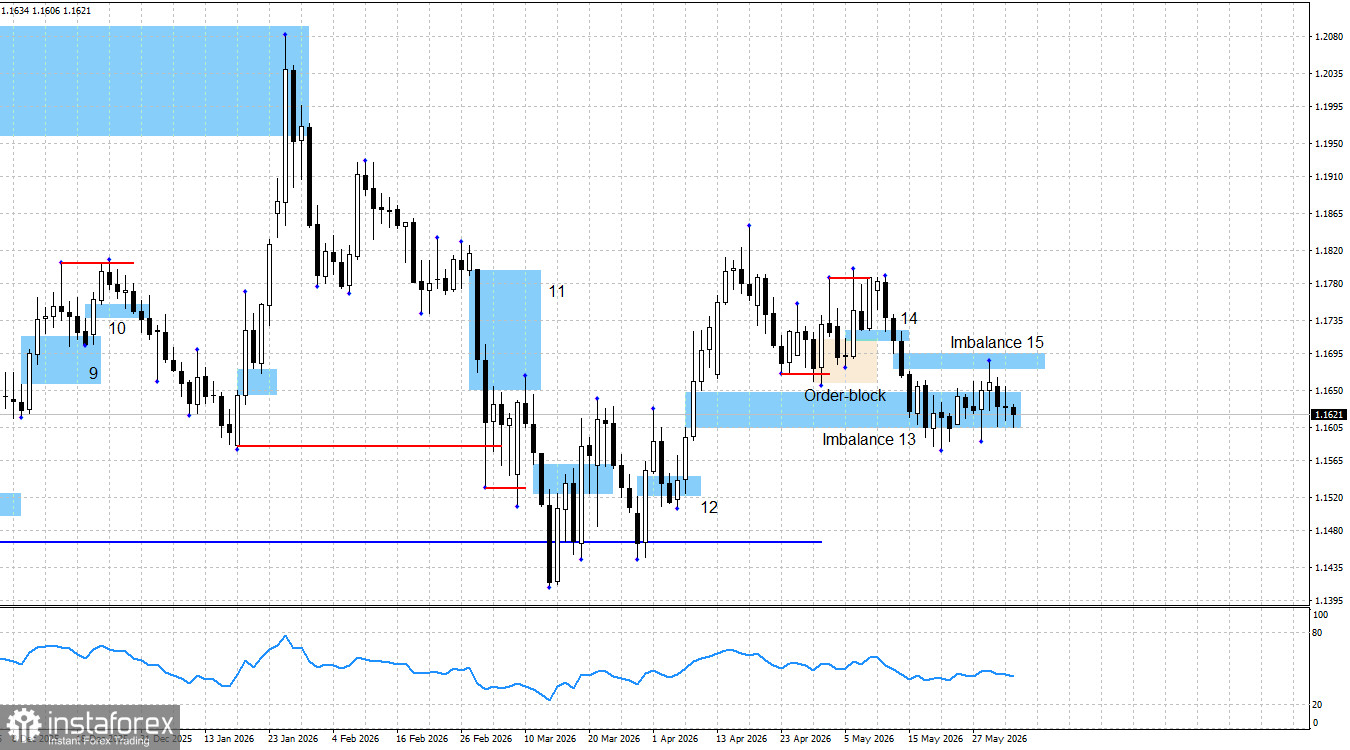
For the second consecutive week, the EUR/USD pair has been attempting to reverse in favor of the euro and resume its upward movement. The bullish trend remains intact, and Bullish Imbalance 13 has not been invalidated. However, it can now be stated with confidence that bulls lack sufficient strength for a new advance.
The current chart structure clearly suggests that the reaction to Bullish Imbalance 13 has been weak and unconvincing, while the reaction to Bearish Imbalance 15 was precise and decisive. At the same time, bears also lack compelling reasons to launch a sustained attack. EUR/USD has effectively been moving sideways for several weeks.
What is the market waiting for? In my view, it is not waiting for anything in particular; rather, it is simply ignoring a large portion of the incoming news flow. In June 2026, geopolitics completely overshadowed all other market themes. At the same time, geopolitical headlines require careful filtering to separate meaningful developments from noise. At present, traders are effectively disregarding nearly all news entering the information space, and for good reason, as none of the recent headlines have materially changed the situation in the Middle East or the prospects for relations between Iran and the United States.
Nevertheless, geopolitical developments will continue to determine both price action and market sentiment in the near term. If Tehran and Washington eventually sign a memorandum of understanding, extend the ceasefire, and make progress in negotiations on the nuclear issue, it will become much easier for bulls to regain momentum, allowing both the euro and the pound to resume their upward trends.
The problem, however, is that the likelihood of such an optimistic scenario appears to be decreasing with each passing day.
Under current conditions, traders can either expect a reaction from Bullish Imbalance 13, which remains the latest bullish pattern within the current bullish impulse, or its eventual invalidation. If the recent decline is viewed as a corrective pullback, it may already have been completed within Imbalance 13.
However, without geopolitical support, bullish traders will struggle to push the market higher, something that has been clearly demonstrated over the past two weeks. If the current move is interpreted as the beginning of a new bearish trend, then traders should expect negotiations to fail and the conflict to escalate once again. In that case, the sell signal formed within Bearish Imbalance 15 would become increasingly relevant.
It is worth emphasizing once again that the U.S. dollar's appreciation between January and March was driven almost entirely by geopolitical developments. As soon as the United States and Iran agreed to a ceasefire, bearish pressure on EUR/USD quickly faded, and bulls dominated the market for more than a month.
At present, the chances of reaching a comprehensive agreement are declining once again, while the market remains highly skeptical of any reports suggesting that the conflict is close to resolution. More precisely, a deal will likely be signed eventually, but "eventually" is not sufficient to support a strong and sustained rally in EUR/USD.
The overall technical picture remains relatively clear. The bullish trend is still intact, but it desperately requires support. Ideally, that support should come from geopolitics through at least a framework agreement between Iran and the United States, followed by continued negotiations regarding Iran's nuclear program.
Without a favorable news backdrop, a renewed advance in the euro appears unlikely.
Economic data released on Wednesday once again failed to attract traders' attention. The only potentially market-moving report was the ISM Services PMI, but earlier in the week the Manufacturing PMI had little impact on sentiment. Other important releases, including Eurozone inflation data, were largely ignored by the market.
Bulls still have numerous reasons to remain active in 2026, and the outbreak of conflict in the Middle East has done little to change the broader picture. Structurally and fundamentally, the policies that contributed to the dollar's significant decline last year remain unchanged.
Over the coming months, the U.S. dollar may occasionally strengthen as investors seek safe-haven assets, but such support would require continuous escalation in the Middle East. I still do not believe a sustainable bearish trend in EUR/USD is developing. The dollar has received temporary support from geopolitical events, but it remains unclear what factors could sustain a long-term dollar rally.
- Economic Calendar for the United States and the Eurozone
- Eurozone – Speech by ECB President Christine Lagarde (08:00 UTC).
- Eurozone – Retail Sales (09:00 UTC).
- United States – Initial Jobless Claims (12:30 UTC).
The June 4 economic calendar contains three scheduled events, none of which I consider particularly significant. As a result, the economic backdrop may have little or no impact on market sentiment throughout Thursday.
EUR/USD Forecast and Trading Recommendations
In my view, the pair remains in the process of forming a bullish trend. The fundamental backdrop changed dramatically three months ago, but the broader trend cannot yet be considered invalidated or completed.
Therefore, bulls may resume their advance in the near future if they receive even modest support from geopolitical developments.
Traders previously had opportunities to open long positions based on signals from Imbalance 12 and the Order Block. The upward movement could eventually resume toward this year's highs, with Bullish Imbalance 13 serving as the key reference zone.
At present, however, it is crucial that bulls maintain market control. For the euro to continue rising without significant obstacles, the Middle East conflict must move toward a durable peace. A breakdown in negotiations, rejection of a framework agreement by either side, or another ceasefire violation could strengthen bearish pressure.
A sell signal has already formed within Bearish Imbalance 15. If the geopolitical situation fails to improve this week, a decline toward 1.1500 will become increasingly likely. Nevertheless, Bullish Imbalance 13 continues to act as a strong support zone.


