


















Analysis of Wednesday's Trades:
1H Chart of the GBP/USD Pair
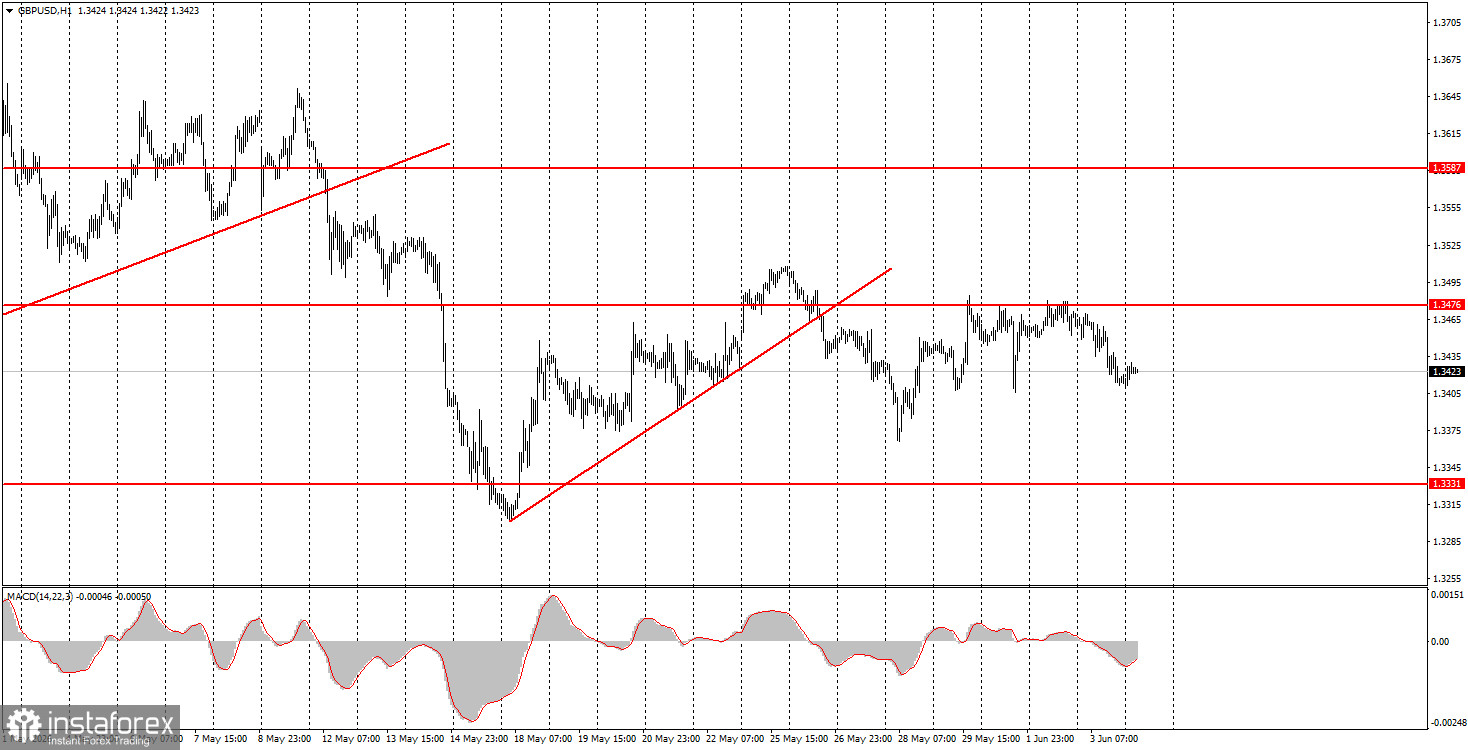
On Wednesday, the GBP/USD pair showed a slight decline, which could be attributed to the latest escalation of the conflict in the Middle East and the strong ISM services activity index in the US. However, it is important to recall what we have discussed over the past few weeks. The market's reaction may be evident in response to individual events and reports, but in practice, it is extremely difficult to determine whether the market reacted or we are simply observing market noise. Yesterday, the British pound exhibited volatility of around 50 pips. This is very low. The dollar did indeed appreciate, but the market's reaction to Wednesday's events (if any) was extremely weak and had no significant impact. The GBP/USD pair struggled several times to breach the 1.3456-1.3476 area, so the decline in quotes could have been triggered by technical factors. Additionally, the ascending trend line was breached a week and a half ago, making the pound's decline more logical.
5M Chart of the GBP/USD Pair
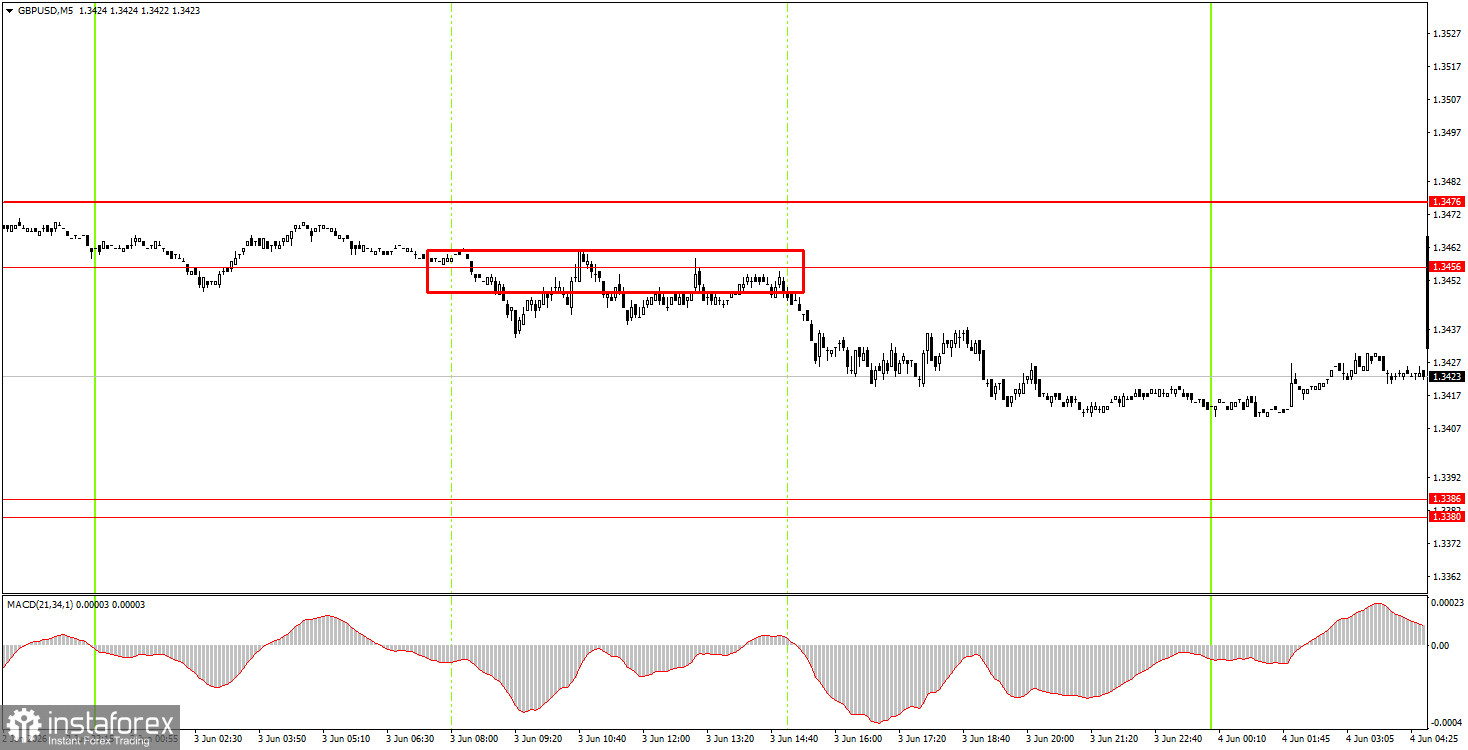
On the 5-minute timeframe on Wednesday, several overlapping sell signals were generated. During the European trading session, the price bounced several times from the 1.3456-1.3476 area but did not begin its decline until the American session. Therefore, novice traders could have opened one short position and, by the evening, realized a profit of about 25 pips. This trade could also be carried over to Thursday.
How to Trade on Thursday:
On the hourly timeframe, the GBP/USD pair continues to form a downward trend as geopolitics worsen again, and the trend line has been breached. However, without the resumption of a full-scale war in the Middle East, the dollar cannot be expected to rise as it did in February-March. Individual events may still prompt further strengthening, but we do not believe the market will initiate a new wave of risk aversion.
On Thursday, novice traders can remain in short positions targeting 1.3380-1.3386 after a rebound from the area of 1.3456-1.3476. A price rebound from the 1.3380-1.3386 area will allow for long positions targeting 1.3456-1.3476. However, be mindful of the low volatility.
On the 5-minute timeframe, consider trading the following levels: 1.3175-1.3180, 1.3259-1.3267, 1.3319-1.3331, 1.3380-1.3386, 1.3456-1.3476, 1.3587-1.3598, 1.3631-1.3641, 1.3695, and 1.3741-1.3751. The event calendar in the UK remains empty for Thursday, while in the US, a minor report on jobless claims will be released.
Basic Rules of the Trading System:
- The strength of a signal is determined by the time required to form it (a bounce or a breakout). The less time taken, the stronger the signal.
- If two or more trades were opened at a particular level based on false signals, subsequent signals from that level should be ignored.
- In a flat market, any pair may form many false signals or none at all. Technical levels may be disregarded.
- On the hourly timeframe, trading signals from the MACD indicator should be executed only when volatility is good, and a trend is confirmed by a trend line or channel.
- If two levels are too close together (5 to 20 pips), they should be considered a support or resistance area.
- After moving 15 pips in the correct direction, a Stop Loss should be set at breakeven.
What's on the Charts:
Price levels (areas) of support and resistance are targets when opening long or short positions or sources of signals.
Red lines indicate channels or trend lines that display the current trend and indicate the preferred direction for trading.
The MACD indicator (14,22,3) – histogram and signal line – is a supplementary indicator that can also be used as a source of signals.
Important speeches and reports (contained in the news calendar) can significantly impact the movement of the currency pair. Therefore, during their release, trading should be conducted with maximum caution, or one should exit the market to avoid sharp reversals against preceding movements.
Beginners trading in the forex market should remember that not every trade can be profitable. Developing a clear strategy and practicing money management are keys to success in trading over the long term.


