


















Bitcoin and Ethereum continue to decline, showing no desire to correct even slightly. Over the past week, Bitcoin has lost 17% in value, while Ethereum has dropped 21%. One can argue endlessly about why the cryptocurrency market is crashing again, but we have consistently warned about this for the past three months, regardless of geopolitical factors, inflation, or changes in the Federal Reserve's sentiment.
Meanwhile, experts continue to insist that Bitcoin is at the "bottom" or close to it. Analysts from various firms note that more than half of Bitcoin coins are currently at a loss, which in itself indicates the formation of a "bottom," as similar patterns were observed in 2011, 2018, and 2022. In those cases, Bitcoin reached its lowest value in the cycle within a month, demonstrating further declines of 15-25%, and then began to establish a "bullish" trend. Analysts also point out that Bitcoin has dropped to the 200-day moving average, which serves as a marker for "bearish" cycles, and that the fear-and-greed index has plummeted to its lowest level. All this "indicates the proximity of the end of the downward trend."
We do not find such conclusions and predictions convincing. What prevents institutions from continuing to channel capital into the AI sector? What stops Tehran and Washington from continuing the war for several more months or years? What prevents inflation in the US from continuing to rise, forcing the Fed to prepare for not just one tightening of monetary policy in 2026, but for several? It's important to remember that historical models eventually stop working. Typically, in the first year after a "halving," Bitcoin has shown significant growth, but in 2025, this pattern ceased to hold. Bitcoin cannot rise indefinitely. We are not opponents of a new upward trend, but we consider such foundations to be a common attempt to present wishes as realities. Many experts are investors in the first cryptocurrency themselves and thus are interested parties. For example, it is beneficial for Kathy Wood or, even more so, Michael Saylor if Bitcoin only appreciates. And for that to happen, they need to convince other market participants of the inevitability of growth, prompting them to buy rather than sell and triggering a new bullish impulse.
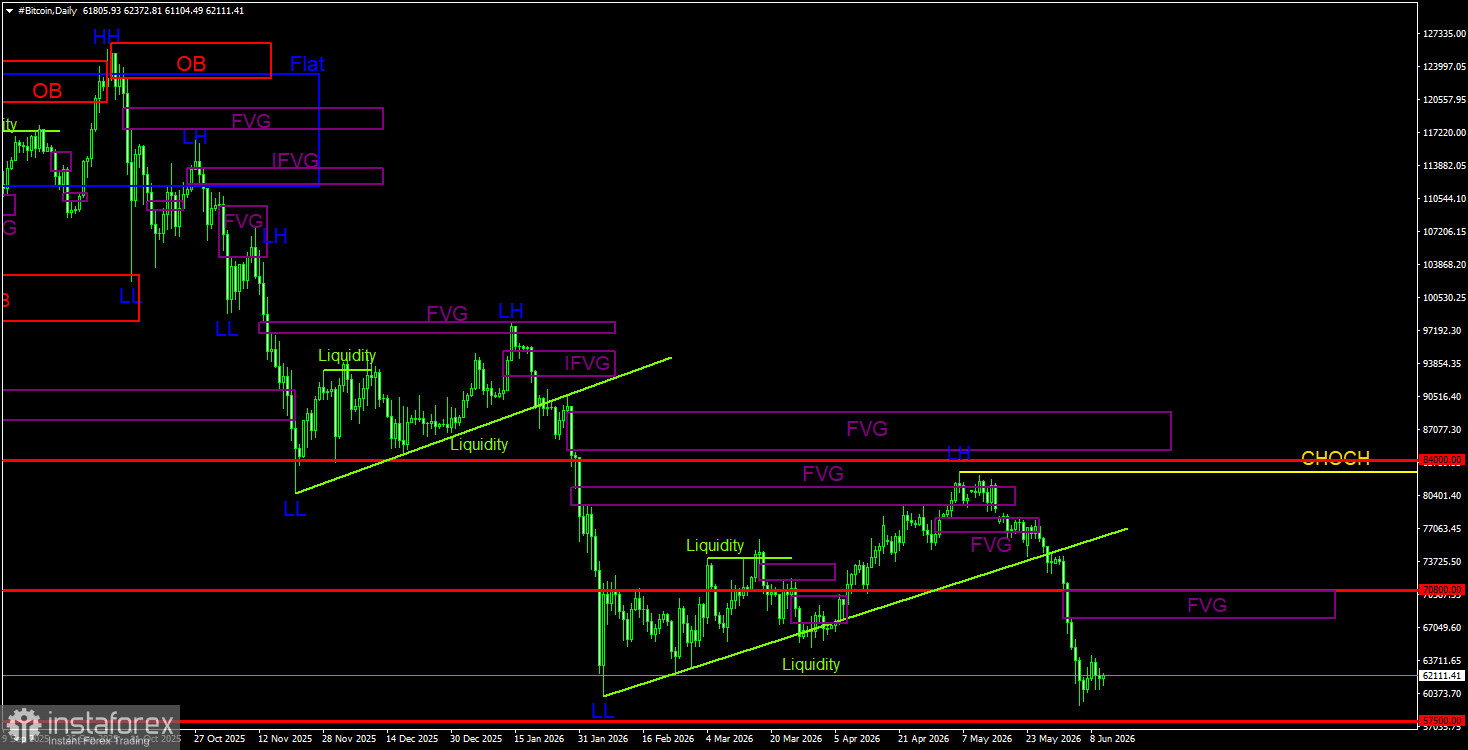
Trading Recommendations for BTC/USD:
On the daily timeframe, Bitcoin has resumed forming a downward trend. The structure of the trend is identified as downward, and the CHOCH line has been moved to $82,800, as a new LL (Lower Low) has been formed. Only above this level can we consider that the downward trend is over. Since there are still no signs of an upward trend reversal, we believe the decline will continue. A new bearish FVG has formed in the $68,000 - $70,700 range. If desired, other FVG can be identified during Bitcoin's current decline, but this one is the most obvious. Thus, new sell signals may be formed within this pattern in the future.
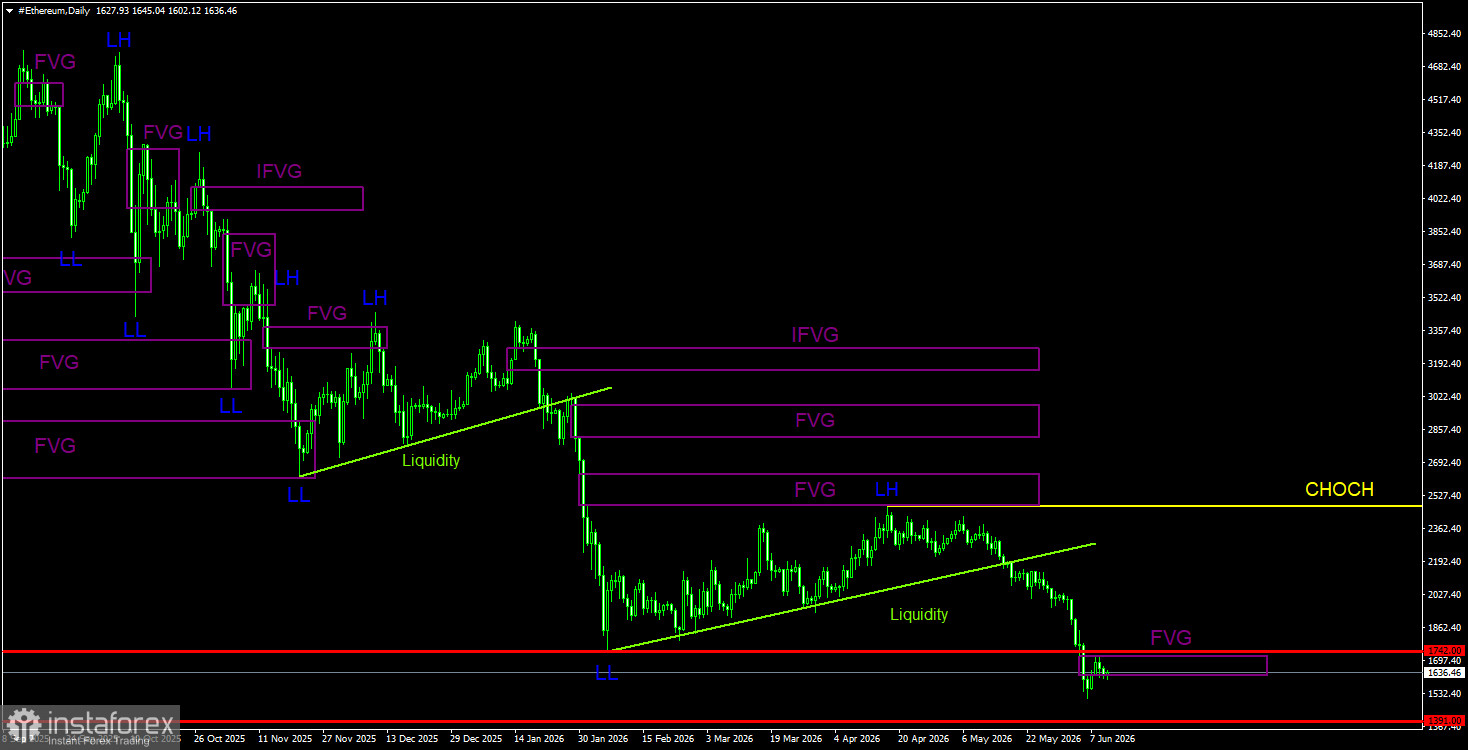
Trading Recommendations for ETH/USD:
On the daily timeframe, the formation of a downward trend, which began in August of last year, continues. The key pattern for selling has been and remains a bearish order block on the weekly timeframe. As we previously warned, the movement triggered by this signal can be strong and prolonged. We do not believe it has ended, as there are no signs of a downward trend's completion for either Bitcoin or Ethereum. In the near future, Ethereum may resume its decline with targets at $1,391 and $788. An upward correction can be expected when at least some bullish pattern or other signs of a price reversal to the upside are formed on at least the 4-hour timeframe. Among the new POI areas for short positions, we note the FVG in the $1,624-$1,720 range. If this pattern is ignored, traders will receive a signal for a correction.
Notes on Illustrations:
- CHOCH – Change in trend structure.
- Liquidity – Stop Loss, pending orders used by market makers to build their positions.
- FVG – Fair Value Gap. Price moves rapidly through such areas, indicating a complete lack of one side in the market. Subsequently, the price tends to return and respond to these areas in continuation of the main trend.
- IFVG – Inverted Fair Value Gap. After returning to such an area, the price does not react to it but breaks through impulsively before testing it from the other side.
- OB – Order Block. A candle in which a market maker opened a position to acquire liquidity to form their own position in the opposite direction.


