


















Trade Breakdown and Trading Advice for the British Pound
A price test of 1.3195 occurred at the moment when the MACD indicator was just beginning to move downward from the zero line, which confirmed a valid entry point for selling the pound; however, no significant decline followed.
The pound showed remarkable resilience despite the main political news of the day—the announcement by UK Prime Minister Keir Starmer of his resignation. The financial market's reaction to this event was surprisingly subdued, and there is a simple reason for this: the resignation had largely been priced in in advance. The market appears to have already fully incorporated the possible leadership change scenario, which allowed the currency to maintain its position. Further behavior of the British pound will depend on the broader context—global economic trends, as well as the first statements and actions of the new leadership that is yet to be selected.
During the U.S. session, there is also no economic data from the United States, so attention will shift to remarks from FOMC member Christopher Waller. It will be particularly interesting to hear his comments regarding the Fed's recent shift toward a more hawkish tone. Special attention will be paid to the tone of his statements. Any signals regarding the continuation of tight monetary policy or, conversely, potential easing could trigger significant volatility in the currency market. In addition, Waller's comments on geopolitical developments, particularly the reopening of the Strait of Hormuz, may also have some impact on the U.S. dollar.
Regarding intraday strategy, I will mainly rely on the execution of scenarios #1 and #2.
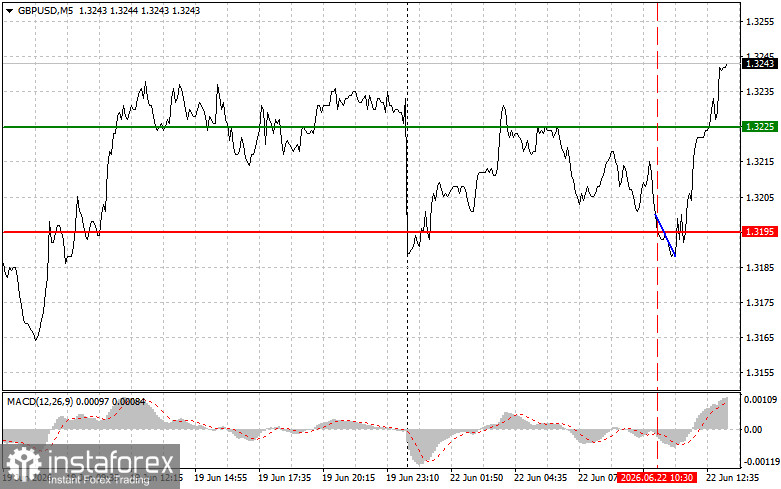
Buy Signal
Scenario #1: Today I plan to buy the pound at an entry point around 1.3248 (green line on the chart), with a target of 1.3281 (thicker green line on the chart). Around 1.3281 I will exit long positions and open short positions in the opposite direction (expecting a 30–35 point reversal). A strong rally in the pound is unlikely today. Important! Before buying, make sure the MACD indicator is above the zero line and has just started rising from it.
Scenario #2: I will also consider buying the pound if there are two consecutive tests of the 1.3221 level at a time when the MACD indicator is in oversold territory. This would limit downward potential and trigger a reversal to the upside. A move toward the opposite levels of 1.3248 and 1.3281 can be expected.
Sell Signal
Scenario #1: I plan to sell the pound after a break below the 1.3221 level (red line on the chart), which should lead to a rapid decline in the pair. The key target for sellers is 1.3170, where I will exit short positions and immediately open long positions in the opposite direction (expecting a 20–25 point rebound). Selling pressure on the pound is unlikely to return today. Important! Before selling, make sure the MACD indicator is below the zero line and has just started moving downward from it.
Scenario #2: I will also consider selling the pound if there are two consecutive tests of the 1.3248 level at a time when the MACD indicator is in overbought territory. This would limit upward potential and trigger a downward reversal. A decline toward the opposite levels of 1.3221 and 1.3170 can be expected.
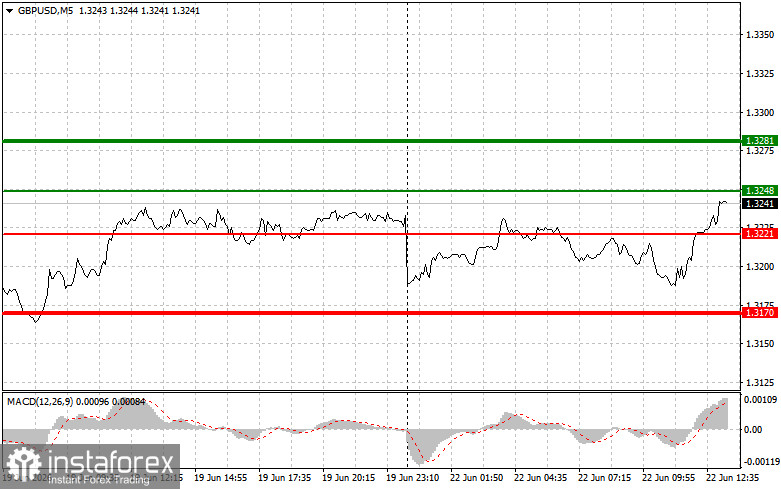
What is shown on the chart:
- Thin green line – entry price for buying the trading instrument.
- Thick green line – expected take-profit level or area for manual profit-taking, as further upside beyond this level is unlikely.
- Thin red line – entry price for selling the trading instrument.
- Thick red line – expected take-profit level or area for manual profit-taking, as further downside beyond this level is unlikely.
- MACD indicator – when entering the market, it is important to rely on overbought and oversold zones.
Important: Beginner Forex traders should be very cautious when making market entry decisions. Before major fundamental data releases, it is best to stay out of the market to avoid sharp price fluctuations. If you decide to trade during news events, always place stop-loss orders to minimize losses. Without stop-loss orders, you may quickly lose your entire deposit, especially if you do not use proper money management and trade large volumes.
Remember that successful trading requires a clear trading plan, similar to the one presented above. Spontaneous trading decisions based on current market conditions are an inherently losing strategy for intraday traders.


