The AUD/USD pair traded around 0.6890 on Tuesday, just below the round level of 0.6900, remaining stable as investors analyzed the minutes of the latest Reserve Bank of Australia (RBA) monetary policy meeting and exercised caution ahead of key US labor market data releases.
The RBA minutes indicated that the bank's leadership considers current financial conditions somewhat restrictive but is prepared to raise interest rates further if necessary to ensure price stability. The central bank also noted that tensions in the Middle East pose risks to inflation growth and negatively impact economic prospects.
These comments provide some support for the Australian dollar, but the effect remains limited. Investors tend to believe that the central bank prefers to assess the consequences of the monetary policy tightening that has already occurred before making any further changes; this view is also confirmed by analysts at TD Securities.
Meanwhile, economic data from China has provided a positive signal for the Australian dollar. The official PMI for China's manufacturing sector rose to 50.3 in June from 50.0 the previous month, surpassing expectations (forecast: 50.1). The PMI for the non-manufacturing sector also improved, jumping to 50.2 from 50.1 in May, exceeding the consensus forecast (49.9) and indicating ongoing expansion in the services sector.
Despite the encouraging data from Australia's largest trading partner, the Australian dollar remains under pressure against the US dollar. The American currency continues to see demand amid expectations for the release of key labor market data this week: investors are focused on the JOLTs report (on job openings and turnover), which will be published later on Tuesday, and the Nonfarm Payrolls report, expected later in the week.
As a result, the US Dollar Index (DXY) maintains its strength as markets continue to adjust their expectations for future actions by the Federal Reserve. Given cautious market sentiment, the AUD/USD recovery is being restrained, despite the relatively hawkish tone of the RBA meeting minutes and signs of stability in the Chinese economy.
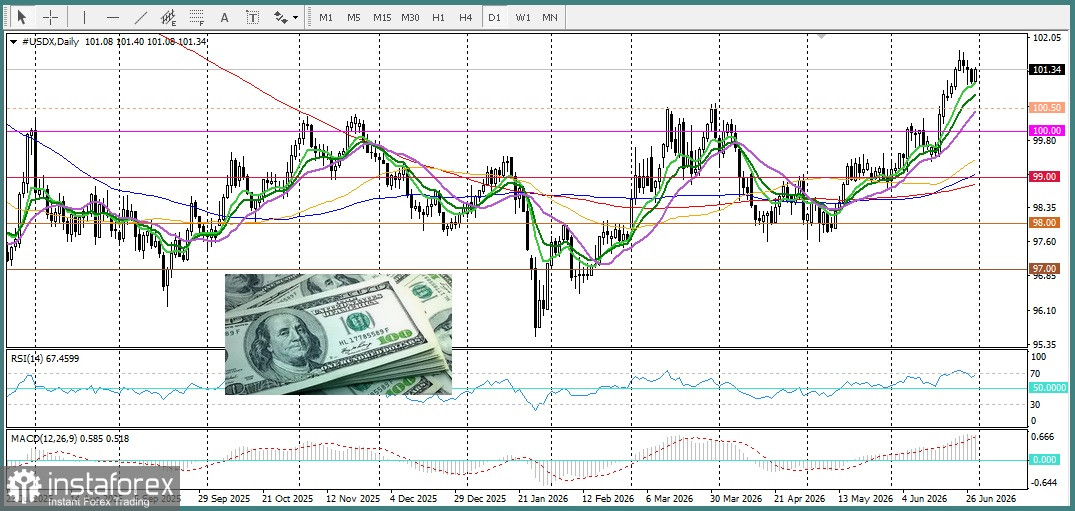
From a technical perspective, the pair is trading between the important 200-day EMA and SMA just below the round level of 0.6900. The 200-day SMA serves as support, while the 200-day EMA acts as resistance. After overcoming the initial resistance, the pair will encounter further obstacles at the 9-day EMA. If it fails to hold the support, it could accelerate the decline toward the March low around 0.6830 on the way to the round level of 0.6800. Oscillators are negative, confirming the advantage for bears. The relative strength index has dropped into oversold territory, indicating a weakening of bearish pressure in favor of bearish consolidation.
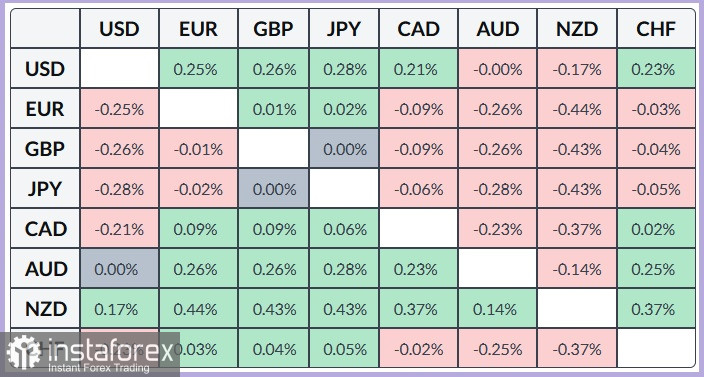
The table below shows the percentage changes in the Australian dollar's exchange rate against major currencies for today. The largest growth of the Australian dollar has been observed against the Japanese yen.