


















Last Friday, nothing changed as US markets were closed for a holiday, but on Thursday, the S&P 500 slipped by 0.01% and the Nasdaq 100 fell by 0.80%. The Dow Jones Industrial Average gained 1.14%.
Today, early attempts to revive Asian tech stocks fizzled, and markets entered the second half of the year with clear caution. Investors are increasingly skeptical about the sustainability of the AI-driven rally and prefer to lock in profits. The Asian memory-chip index dropped by about 1%, South Korea's KOSPI lost 1%, and Japan's Nikkei was down 0.4%.
Semiconductors are back in focus, and sentiment is mixed. SK Hynix fell by 3.8% ahead of a planned large US listing that could raise roughly $29bn to help the company compete globally in AI memory chips. There were positive signs too: Nvidia's server-assembly partner Hon Hai reported sales above expectations. That contrast neatly illustrates the sector's current state.
Reasons for caution are understandable and rooted in the recent sell-off. Memory names entered Q3 after the market's largest two-day drop in nearly a month. Capital rotation has become the key theme flagged by many strategists: managers locking in gains will keep selling high-flying AI names and move into laggards and undervalued sectors. Automakers, industrials, and healthcare are among the likely beneficiaries of flows out of AI.
All attention now shifts to earnings season, the decisive test for the entire AI narrative. Investors want proof that tech companies can turn massive AI-infrastructure investments into real profits. Many shares have already corrected to more acceptable levels, so upside surprises could trigger a substantial rebound, which keeps the story interesting.
Elsewhere, inflation fears eased further. Brent fell by about 0.2% to roughly $72/bbl as tanker traffic in the US-protected corridor through the Strait of Hormuz resumed and OPEC+ backed another modest quota increase for next month. That continues to weigh on prices and helps to reduce inflationary pressure. Gold stabilized near $4,175 after a three-day rally driven by speculation that the Fed will not rush to raise rates following a weak jobs report.
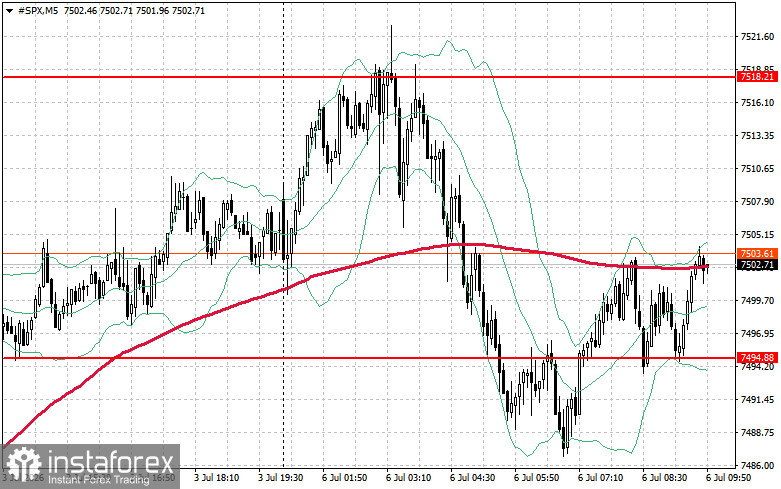
Technically, the S&P 500 analysis suggests that the immediate task for buyers is to overcome the resistance level of $7,518. Doing so would confirm upside and open the path to $7,544. Maintaining control above $7,574 would further strengthen buyers' positions. On the downside, buyers need to defend $7,494. A break below that level would likely push the index back to $7,474 and open the way to $7,451.


