


















Trade Review and Tips for Trading the British Pound
The test of the 1.3385 level occurred when the MACD indicator was just beginning to move upward from the zero line, confirming a valid entry point for buying the pound. However, the pair failed to develop a significant upward move.
All eyes are now on Andrew Bailey's speech. Particular attention will be paid to any comments regarding possible changes in interest rates. With inflation still elevated but signs of slowing economic growth becoming increasingly evident, the Bank of England is walking a fine line. On the one hand, raising interest rates could help contain inflation; on the other, it risks further slowing the economy, which is undesirable under the current circumstances. For this reason, every remark Bailey makes on this issue will be closely scrutinized by market participants.
In addition, the U.S. trade balance and the RCM/TIPP Economic Optimism Index are scheduled for release. The TIPP Index measures U.S. consumer confidence in the economy, although it carries considerably less weight than the major consumer sentiment surveys. Both releases are considered second-tier economic data, so they are unlikely to have a significant impact on the U.S. dollar. Under these circumstances, the British pound will largely be left to trade on its own. Without a meaningful catalyst from U.S. data or clear guidance from Bailey on interest rates, the GBP/USD pair is likely to remain driven by overall risk sentiment, extending the bullish trend seen in recent days.
As for my intraday strategy, I will mainly rely on the implementation of Scenario No. 1 and Scenario No. 2.
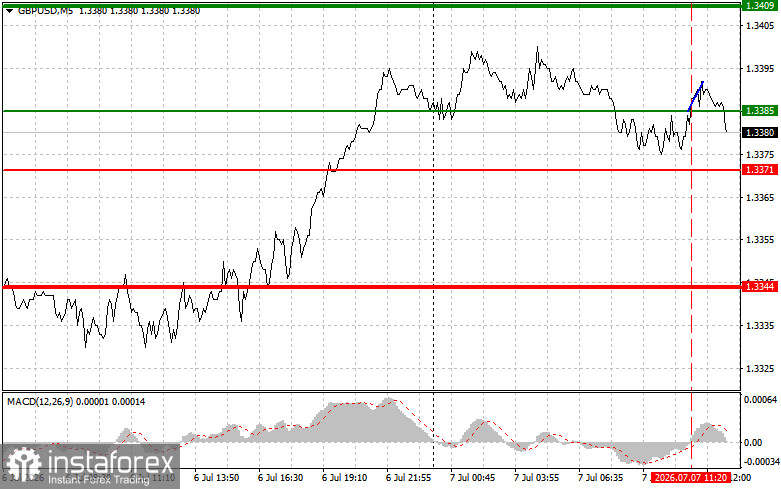
Buy Signal
Scenario No. 1: I plan to buy the pound today if the price reaches the entry point around 1.3393 (the green line on the chart), targeting a rise to 1.3434 (the thicker green line on the chart). Around 1.3434, I plan to close long positions and open short positions in the opposite direction, targeting a 30–35 point move from that level. A strong rally in the pound today can be expected only if the U.S. data comes in weak.
Important: Before buying, make sure the MACD indicator is above the zero line and is just beginning to move higher from it.
Scenario No. 2: I also plan to buy the pound if the price tests 1.3367 twice consecutively while the MACD indicator is in the oversold area. This will limit the pair's downward potential and trigger a bullish market reversal. In this case, a rise toward 1.3393 and 1.3434 can be expected.
Sell Signal
Scenario No. 1: I plan to sell the pound after the price breaks below 1.3367 (the red line on the chart), which should trigger a rapid decline in the pair. The key downward target for sellers will be 1.3329, where I plan to close short positions and immediately open long positions, targeting a 20–25 point move in the opposite direction. Selling pressure on the pound is likely to return if the U.S. data comes in strong.
Important: Before selling, make sure the MACD indicator is below the zero line and is just beginning to move lower from it.
Scenario No. 2: I also plan to sell the pound if the price tests 1.3393 twice consecutively while the MACD indicator is in the overbought area. This will limit the pair's upward potential and trigger a bearish market reversal. A decline toward 1.3367 and 1.3329 can then be expected.
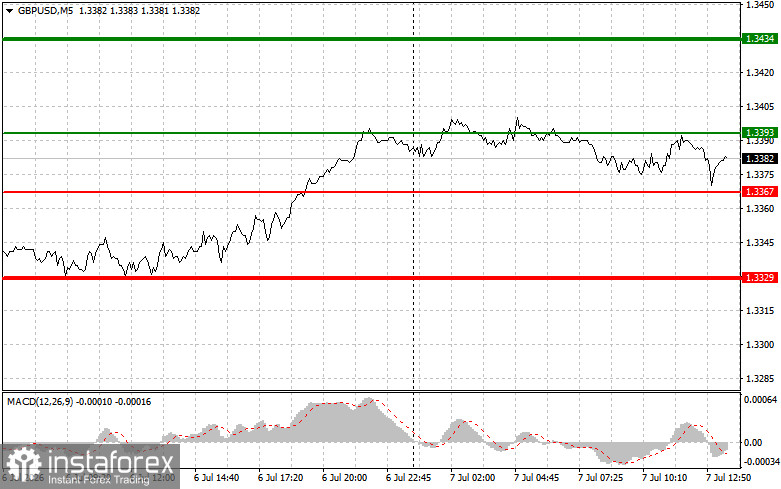
What the Chart Shows
- Thin green line: The entry price at which the trading instrument can be bought.
- Thick green line: The estimated Take Profit level, or the area where profits can be taken manually, as further upside beyond this level is unlikely.
- Thin red line: The entry price at which the trading instrument can be sold.
- Thick red line: The estimated Take Profit level, or the area where profits can be taken manually, as further downside below this level is unlikely.
- MACD indicator: When entering the market, it is important to use the overbought and oversold zones as guidance.
Important: Beginner Forex traders should make market entry decisions with great caution. It is generally advisable to stay out of the market before the release of major economic reports in order to avoid sharp price fluctuations. If you decide to trade during news releases, always use stop-loss orders to minimize potential losses. Without stop-loss orders, you can lose your entire trading capital very quickly, especially if you do not follow proper money management principles and trade excessively large positions.
Remember that successful trading requires a clear trading plan, such as the one outlined above. Making spontaneous trading decisions based solely on the current market situation is inherently a losing strategy for an intraday trader.


