


















Bitcoin and Ethereum continue to trade within a narrow range near their weekly highs, but all attempts to break beyond the upper boundaries have failed, suggesting a potential for a more significant correction. Currently, Bitcoin is trading at $62,800, while Ethereum is trying to break above $1,750.

Meanwhile, data from Santiment shows steady accumulation of Ethereum by two categories of market participants. Over the past month, wallets holding between 100 and 100,000 ETH—often referred to as whales and large holders—have increased their share of the total ETH supply by 1.73%. Even more telling is the movement among small investors: holders with balances under 0.01 ETH have increased their share by 1.82%, a relatively stronger gain than that of the whales. The simultaneous growth in accumulation by both large and small market participants is traditionally interpreted as a sign that a broad range of investors views current prices as attractive for entry, regardless of capital size.
However, alongside this, there was a different signal. CryptoQuant recorded the activation of the DIPI indicator, which tracks the stressful influx of Bitcoin into exchanges, including movements of old coins, transfers from long-term holders, and Bitcoin entering exchanges at a loss. Historically, strong spikes in this indicator have preceded the largest market capitulations; similar spikes were observed in 2018, 2022, and, according to CryptoQuant, again in 2026. The name of the indicator indicates pressure from the most "patient" market participants, those who have held coins for years and are now willing to liquidate even losing positions, which qualitatively differs from regular short-term sell-offs.
The combination of these signals paints a mixed picture, familiar from previous phases of this cycle. On the one hand, the accumulation of Ethereum by both whales and retail investors echoes the trend we observed with Bitcoin. On the other hand, the activation of the DIPI reminds us that the market has yet to undergo a full capitulation, a necessity we have discussed previously.
As for short-term trading, the strategy and conditions are described below.
Bitcoin
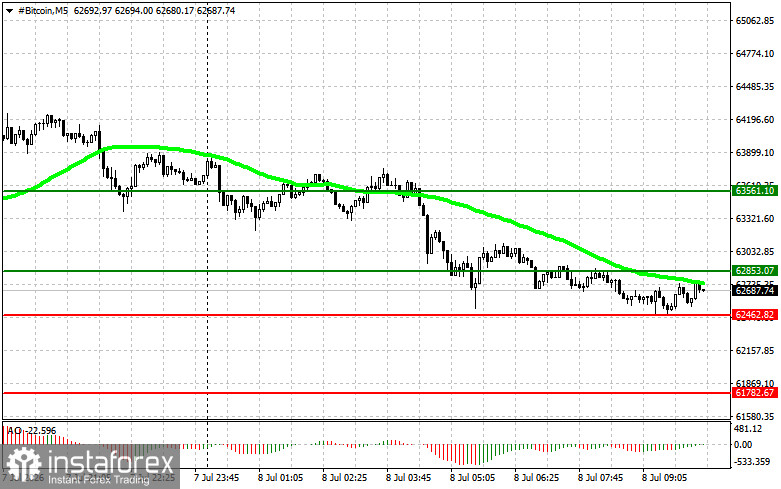
Buy Scenario
- Scenario No. 1: I will buy Bitcoin today upon reaching an entry point around $62,800, targeting a rise to the level of $63,500. At around $63,500, I plan to exit from buy positions and immediately sell on the bounce. Before buying on a breakout, ensure that the 50-day moving average is below the current price and that the Awesome oscillator is above zero.
- Scenario No. 2: Buying Bitcoin can also be considered from the lower boundary at $62,400 if there is no market reaction to its breakout in the opposite direction towards levels $62,800 and $63,500.
Sell Scenario
- Scenario No. 1: I plan to sell Bitcoin today upon reaching an entry point around $62,400, targeting a drop to the level of $61,700. At around $61,700, I will exit from sell positions and immediately buy on the bounce. Before selling on a breakout, ensure that the 50-day moving average is above the current price and that the Awesome oscillator is below zero.
- Scenario No. 2: I can also consider selling Bitcoin from the upper boundary at $62,800 if there is no market reaction to its breakout in the opposite direction towards levels $62,400 and $61,800.
Ethereum
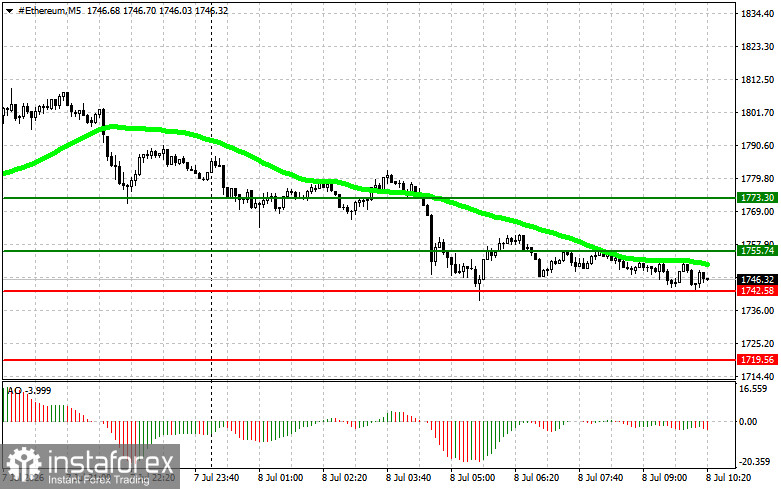
Buy Scenario
- Scenario No. 1: I plan to buy Ethereum today upon reaching an entry point around $1,755, targeting a rise to the level of $1,773. At around $1,773, I plan to exit from buy positions and immediately sell on the bounce. Before buying on a breakout, ensure that the 50-day moving average is below the current price and that the Awesome oscillator is above zero.
- Scenario No. 2: Buying Ethereum can also be considered from the lower boundary at $1,742 if there is no market reaction to its breakout in the opposite direction towards levels $1,755 and $1,773.
Sell Scenario
- Scenario No. 1: I plan to sell Ethereum today upon reaching an entry point around $1,742, targeting a drop to the level of $1,719. At around $1,719, I will exit from sell positions and immediately buy on the bounce. Before selling on a breakout, ensure that the 50-day moving average is above the current price and that the Awesome oscillator is below zero.
- Scenario No. 2: I can also consider selling Ethereum from the upper boundary at $1,755 if there is no market reaction to its breakout in the opposite direction towards levels $1,742 and $1,719.


