


















Trade Review and Trading Recommendations for the British Pound
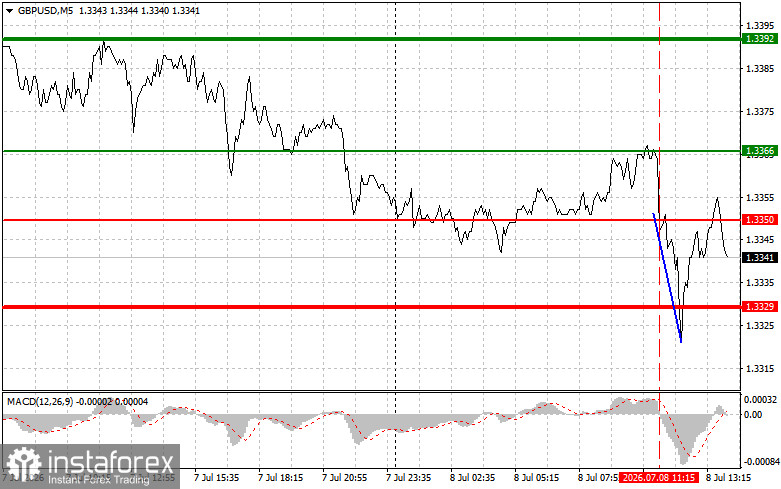
The test of the 1.3350 level occurred when the MACD indicator had just begun moving below the zero line, confirming a valid entry point for selling the pound. As a result, the pair declined to the target level of 1.3329.
Today, the U.S. president declared the ceasefire with Tehran effectively over and no longer valid, dismissed the prospect of further negotiations, and made a series of sharp remarks directed at the Iranian side, triggering another wave of selling in the British pound. In addition to the broader flight to safety, the pound is also being weighed down by energy-related concerns. An escalation in a key oil-producing region threatens to drive energy prices higher, and the United Kingdom, as a net fuel importer, is particularly vulnerable to such price fluctuations.
In the second half of the day, traders will focus on the release of the minutes from the Federal Reserve's June meeting, while the Wholesale Inventories report and U.S. Consumer Credit data, released during the same period, will serve as secondary market drivers. It is worth recalling that the June meeting was the first chaired by Kevin Warsh. Although the Federal Reserve left the benchmark interest rate unchanged at 3.50%–3.75% once again, the updated dot plot shifted in a more hawkish direction, with several committee members indicating that a rate hike before the end of the year remains possible. The market will closely examine the meeting minutes for confirmation of this shift. Since the British pound is highly sensitive to the tone of the document, GBP/USD could come under renewed downward pressure if the minutes reinforce a hawkish outlook.
As for my intraday strategy, I will primarily rely on implementing Scenario #1 and Scenario #2.
Buy Signal
Scenario #1
Today, I plan to buy the pound if the price reaches the entry level around 1.3357 (the green line on the chart), with a target at 1.3392 (the thicker green line on the chart). Around 1.3392, I plan to close long positions and open short positions in the opposite direction, anticipating a 30–35 point move. A strong advance in the pound should only be expected if the U.S. economic data comes in weaker than expected.
Important: Before opening a long position, make sure that the MACD indicator is above the zero line and has just begun moving higher.
Scenario #2
I also plan to buy the pound if the price tests 1.3333 twice consecutively while the MACD indicator is in oversold territory. This would limit the pair's downward potential and trigger a bullish market reversal. In this case, a move toward 1.3357 and 1.3392 can be expected.
Sell Signal
Scenario #1
Today, I plan to sell the pound after the price breaks below 1.3333 (the red line on the chart), which should trigger a rapid decline in the pair. The primary downward target will be 1.3299, where I intend to close short positions and immediately consider opening long positions, anticipating a 20–25 point rebound. Selling pressure on the pound is likely to intensify if the U.S. economic data is strong.
Important: Before opening a short position, make sure that the MACD indicator is below the zero line and has just begun moving lower.
Scenario #2
I also plan to sell the pound if the price tests 1.3357 twice consecutively while the MACD indicator is in overbought territory. This would limit the pair's upward potential and trigger a bearish market reversal. A decline toward 1.3333 and 1.3299 can then be expected.
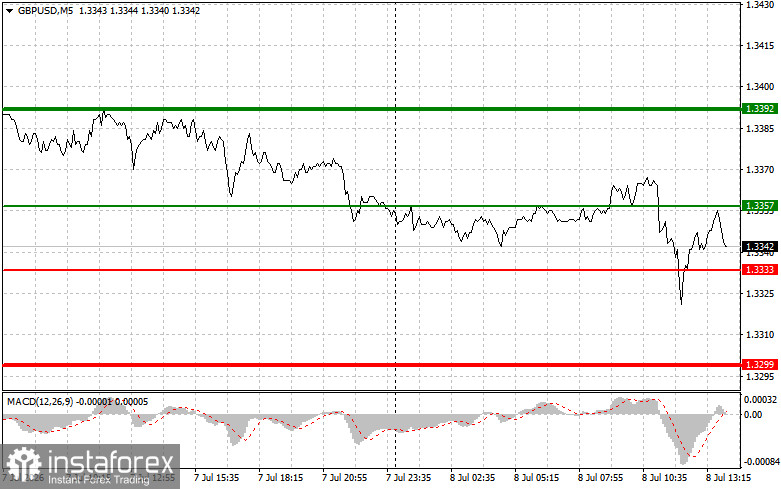
Chart Guide
- Thin green line – the entry price for opening long positions.
- Thick green line – the suggested Take Profit level or an area to lock in profits manually, as further gains above this level are considered unlikely.
- Thin red line – the entry price for opening short positions.
- Thick red line – the suggested Take Profit level or an area to lock in profits manually, as further declines below this level are considered unlikely.
- MACD indicator – when entering the market, pay close attention to overbought and oversold conditions.
Important
Beginner Forex traders should exercise extreme caution when making trading decisions. It is generally advisable to stay out of the market before the release of major economic reports to avoid sharp price swings. If you decide to trade during news releases, always use stop-loss orders to minimize potential losses. Trading without stop-loss orders can quickly result in the loss of your entire deposit, especially if you trade large position sizes without applying proper risk management.
Remember that successful trading requires a clear trading plan, such as the one outlined above. Making spontaneous trading decisions based solely on current market conditions is generally a losing strategy for intraday traders.


