


















Bitcoin dipped to around $62,000 yesterday but then recovered slightly. Ethereum remained relatively stable, though it was under pressure throughout the day.

Currently, there are no significant news events in the cryptocurrency market, but attention has been drawn to Bolivia's decision to consider recognizing USDT as a means of payment. Clearly, the dollar shortage in Bolivia has pushed the authorities to take a step that would have seemed unthinkable a few years ago in a country with a history of a complete ban on cryptocurrencies.
Minister of Economy and Public Finance Jose Gabriel Espinoza stated at a briefing yesterday that the government is working on incorporating USDT into the national payment system so that the stablecoin circulates alongside the dollar and the boliviano. The project is still in the technical development stage. The mechanism of integration, launch timelines, and regulatory framework have yet to be approved, and no official rules have been published by the central bank or lawmakers.
This initiative relies on a sharp increase in the actual use of cryptocurrency by the population following the lifting of restrictions in June 2024. According to data, the volume of crypto transactions rose from $46.5 million in the first half of 2024 to $294 million during the same period of the following year, representing a cumulative increase of 630% after the ban was lifted. The reason for such demand is pragmatic rather than ideological. A prolonged dollar shortage in the country has pushed a significant portion of economic activity into informal currency exchange channels, and USDT has become a convenient way for businesses and citizens to maintain access to dollar-denominated value.
As for short-term trading, the strategy and conditions are described below.
Bitcoin
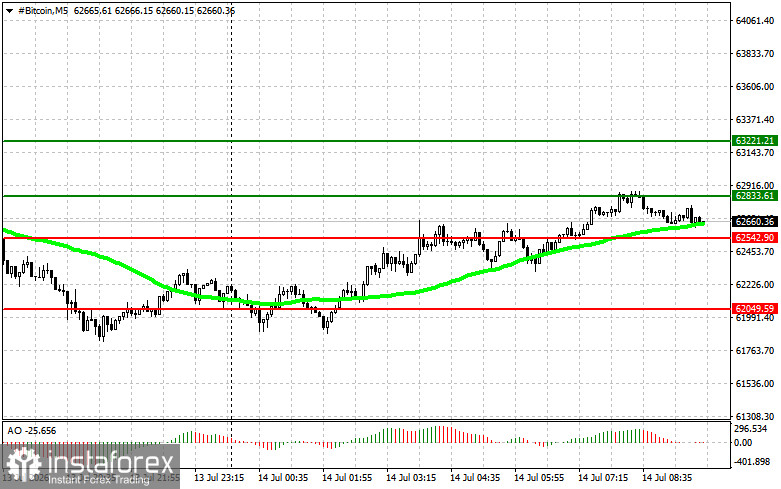
Buy Scenario
Scenario #1: I plan to buy Bitcoin today at an entry point around $62,900, with a target for growth to $63,200. At around $63,200, I plan to exit my buy positions and sell immediately on the bounce. Before buying on the breakout, ensure that the 50-day moving average is below the current price and that the Awesome indicator is in the positive zone.
Scenario #2: I can also buy Bitcoin from the lower boundary at $62,500 if there is no market reaction to the downside breakout, targeting $62,900 and $63,200.
Sell Scenario
Scenario #1: I plan to sell Bitcoin today at an entry point around $62,500, with a target of a drop to $62,000. At around $62,000, I plan to exit my sell positions and buy immediately on the bounce. Before selling on the breakout, ensure that the 50-day moving average is above the current price and that the Awesome indicator is in the negative zone.
Scenario #2: I can also sell Bitcoin from the upper boundary at $62,900 if there is no market reaction to the downside breakout, targeting $62,500 and $62,000.
Ethereum
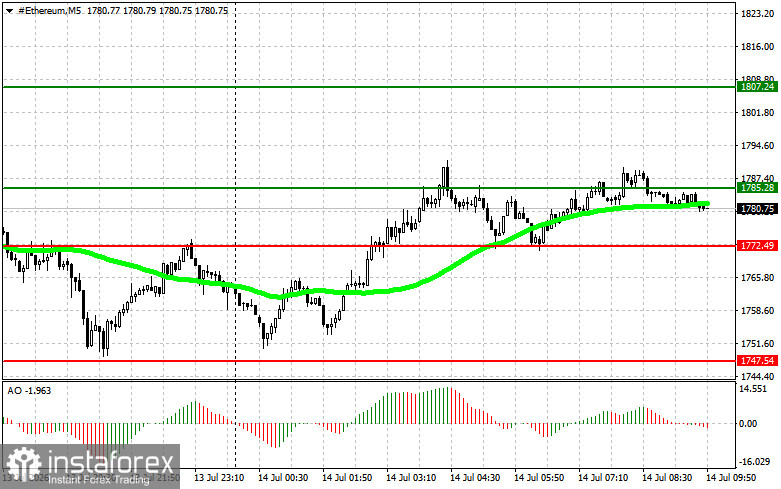
Buy Scenario
Scenario #1: I plan to buy Ethereum today at an entry point around $1,785, with a growth target of $1,807. At around $1,807, I plan to exit my buy positions and sell immediately on the bounce. Before buying on the breakout, ensure that the 50-day moving average is below the current price and that the Awesome indicator is in the positive zone.
Scenario #2: I can also buy Ethereum from the lower boundary at $1,772 if there is no market reaction to its downside breakout, targeting $1,785 and $1,807.
Sell Scenario
Scenario #1: I plan to sell Ethereum today at an entry point around $1,772, targeting a drop to $1,747. At around $1,747, I plan to exit my sell positions and buy immediately on the bounce. Before selling on the breakout, ensure that the 50-day moving average is above the current price and that the Awesome indicator is in the negative zone.
Scenario #2: I can also sell Ethereum from the upper boundary at $1,785 if there is no market reaction to the downside breakout, targeting $1,772 and $1,747.


