


















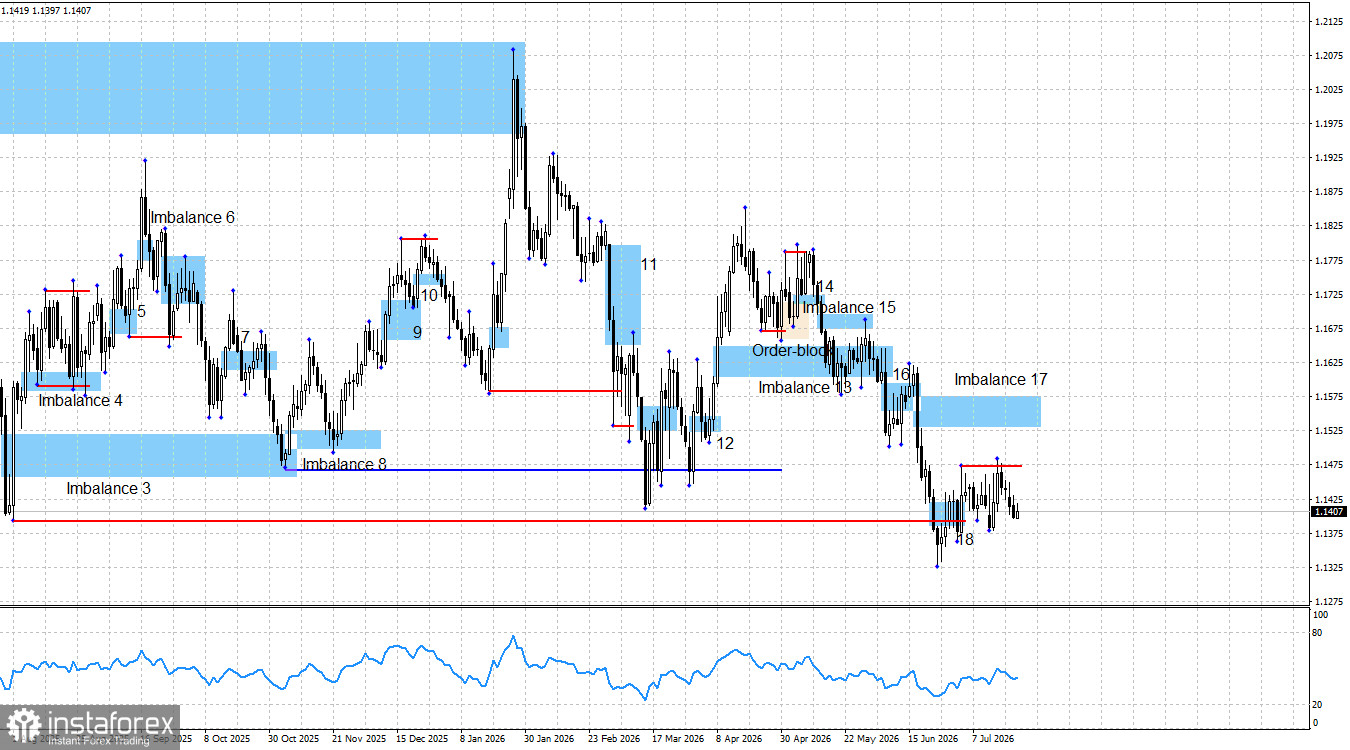
The EUR/USD pair remains within the local bearish impulse that began on April 17, while over the past three weeks the bulls have managed to push the bears back only slightly. Although the bulls have launched an attack, there has been little conviction behind the move. In my view, the euro is currently much closer to another decline than to an extension of its modest recovery. Over recent weeks, bullish traders have demonstrated little strength. The new week began with another, albeit minor, decline in the euro. The latest liquidity sweep points to a high probability that the downward move will continue. It is difficult to say how deep or prolonged the decline may be, but the bears have one clear target—the latest swing low at 1.1325. A liquidity sweep below that level could provide the bulls with a second opportunity. As for the fundamental backdrop, I still see little justification for the bears' continued dominance. Geopolitical developments have once again disappointed, but they are unlikely to be a decisive factor for traders, who barely reacted to either the temporary ceasefire or the reopening of the Strait of Hormuz. In my opinion, the bears may squeeze a bit more downside from the market, but they will not be able to sustain their offensive on enthusiasm alone. Tomorrow's ECB meeting is unlikely to generate much interest, especially following the recent decline in eurozone inflation.
It is also worth recalling that the latest U.S. labor market data were relatively weak, while the inflation report showed further easing. Job creation remains subdued. Over the past three months, the U.S. economy has added roughly 100,000 fewer jobs than traders had expected. As a result, slowing employment growth and easing inflation have cast doubt on the likelihood of a near-term FOMC rate hike. The U.S. dollar can no longer rely on Federal Reserve policy as a source of support.
Geopolitics has moved into the background. Tehran and Washington have withdrawn from the June 17 agreement, but this came as no surprise to market participants. President Donald Trump revoked authorization for Iranian oil exports, reinstated restrictions on Iranian shipping, while Iran once again closed the Strait of Hormuz and resumed attacks on vessels attempting to pass through it. The market failed to react either to the end of the conflict or to its renewed escalation. We did not see the anticipated decline in the U.S. dollar when geopolitical tensions eased, nor did we see the euro strengthen in response to the ECB's tighter monetary policy. The bears remain firmly in control despite the broader fundamental and geopolitical backdrop. At present, renewed geopolitical tensions merely provide them with a formal excuse for additional selling. In my view, however, traders are effectively pricing in geopolitical risks for the third time, including events that have not yet occurred.
The current chart structure continues to support the bearish impulse that began on April 17. Bearish Imbalance 17 has not yet been filled, while Imbalance 18 was invalidated by weak U.S. labor market data. No bullish patterns have formed, and none are likely to appear over the next few days given the market's lack of momentum. The bulls may continue a corrective advance toward Imbalance 17, but there is currently no compelling technical setup to trade such a move. A liquidity sweep has already occurred below the August 1 low from last year (marked by the red line on the chart), followed by a sweep above the July 2 high. These developments at least provide the bears with technical justification for maintaining pressure.
There were no notable economic releases on Wednesday. Neither the United States nor the eurozone published any meaningful data during the day, and overall trading activity remained subdued.
The bulls still have plenty of long-term reasons to regain control in 2026, and the conflict in the Middle East has not materially changed that outlook. Structurally and fundamentally, President Trump's policies—which contributed to the sharp decline of the U.S. dollar last year—remain largely unchanged. At present, I see no significant fundamental support for the dollar despite the FOMC's hawkish stance. EUR/USD is approaching a series of prominent lows and swing points where another liquidity sweep could occur, potentially signaling the end of the current bearish impulse.
Economic Calendar for the United States and the Eurozone
- Eurozone: ECB Interest Rate Decision (12:15 UTC)
- United States: Initial Jobless Claims (12:30 UTC)
- Eurozone: ECB Press Conference (12:45 UTC)
The July 23 economic calendar features two major ECB-related events. While Thursday's economic news may have only a limited impact on market sentiment, it is unlikely to generate a strong market reaction.
EUR/USD Forecast and Trading Advice
In my view, the pair remains in the process of forming a broader bullish trend. Although the fundamental backdrop shifted sharply in favor of the bears four months ago, the longer-term uptrend cannot yet be considered invalidated. The bulls may well launch another advance after liquidity is swept below the key lows. However, opening long positions at current levels is premature. It is better to wait for the formation of clear bullish patterns.
At present, traders have only Bearish Imbalance 17 as a meaningful technical reference. Liquidity has already been swept from the most recent swing points, while the fundamental case for sustained U.S. dollar strength remains questionable. Therefore, I continue to expect a bullish recovery, but it is essential to see technical confirmation before acting on that view. Alternatively, traders can wait for a fresh sell signal within Bearish Imbalance 17.


