


















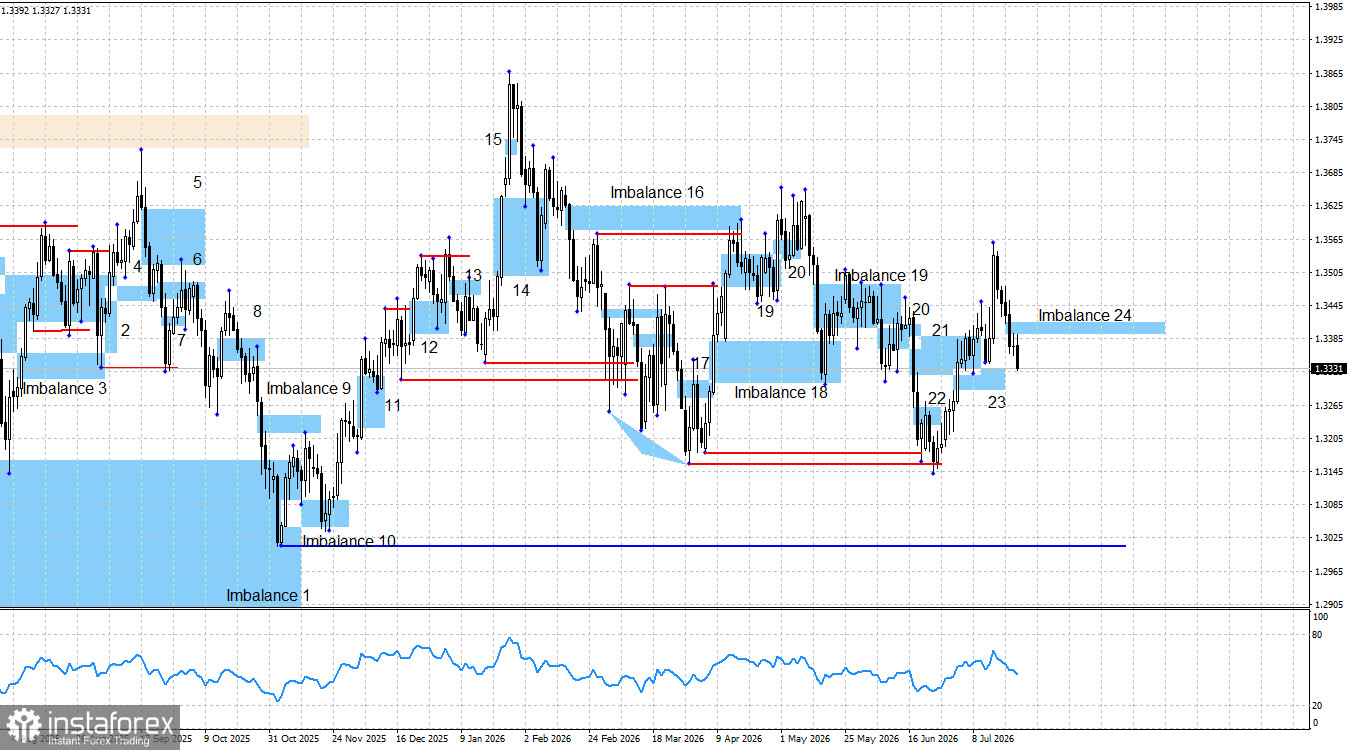
GBP/USD has posted strong gains in recent weeks, a move that could mark the beginning of a new bullish trend. However, bullish traders have recently paused their advance, allowing the pair to retreat. The rally was exceptionally sharp, and such moves are rarely sustained without a correction. The pullback already underway could therefore extend over the coming weeks.
This week's fundamental backdrop for the pound has been mixed. The UK labor market data, including employment and wage growth, were generally supportive of the pound. Inflation data, however, told a different story. UK inflation slowed more than markets had expected, effectively removing the case for further monetary tightening by the Bank of England. Instead, attention may gradually shift toward the possibility of policy easing later this year.
It is worth recalling that, following the latest Bank of England meeting, Governor Andrew Bailey made it clear that the disinflation process remains on track and that consumer inflation could return to the Bank's 2% target next year. The closer inflation moves toward that objective, the greater the likelihood of an interest rate cut. As a result, growing dovish expectations have put downward pressure on the pound.
That said, the renewed escalation in the Middle East has already pushed oil prices close to $100 per barrel. If elevated energy prices persist, they are likely to feed back into UK inflation, making it difficult for inflation to continue ignoring this factor.
The outlook for the Federal Open Market Committee (FOMC) is less straightforward. Initially, markets expected US inflation to accelerate if the Fed refrained from tightening monetary policy. Those concerns eased as oil prices fell to around $70 per barrel. However, oil has now rebounded to nearly $100, and a prolonged escalation in the Middle East, combined with disruptions in the Strait of Hormuz, could potentially drive prices toward $120 per barrel.
If that pessimistic scenario unfolds, oil prices could surpass their March-May highs, making further disinflation in both the United States and the United Kingdom much more difficult. Conversely, if geopolitical tensions ease and oil returns to the $60-70 per barrel range, additional Federal Reserve tightening may prove unnecessary. Consequently, the US dollar cannot yet rely on expectations of a more hawkish Fed as a sustainable source of support.
Technical Analysis
The technical picture continues to favor the bulls, and the broader uptrend could resume once the current correction runs its course. The key question is where buying interest will re-emerge.
Price has already swept liquidity below both the April 6 low and the March 31 low, providing a solid foundation for the rally seen in recent weeks. Given that the US dollar still lacks a compelling long-term bullish narrative—and has already posted substantial gains in 2026—I believe sellers may struggle to extend the decline significantly further.
For now, however, the nearest area capable of halting sterling's decline is Imbalance 23, a price imbalance that has already produced two successful bullish reactions. Whether it can hold for a third time remains to be seen.
Thursday brought no significant economic releases from either the United Kingdom or the United States. Nevertheless, traders interpreted the ECB meeting as somewhat dovish, triggering a decline in the euro that also weighed on the pound. At present, the pound's main technical support remains Imbalance 23.
Outlook
The broader macroeconomic backdrop continues to support a weaker US dollar over the longer term. Neither the conflict between Iran and the United States nor the possibility of additional Fed rate hikes in 2026 fundamentally changes that view.
Geopolitical tensions temporarily restored the dollar's safe-haven appeal, but the most intense phase of the conflict appears to have passed. Although the Federal Reserve is expected to raise interest rates in 2026—a factor that is generally supportive of the dollar—higher rates would also slow economic growth and weaken the labor market.
In addition, Kevin Warsh was appointed by President Donald Trump to lead the FOMC with the expectation that he would pursue a more accommodative monetary policy than Jerome Powell. Consequently, I continue to view any meaningful appreciation of the US dollar as temporary rather than the start of a sustained long-term trend.
Economic Calendar
United Kingdom
- Retail Sales (06:00 UTC)
- S&P Global Manufacturing PMI (08:30 UTC)
- S&P Global Services PMI (08:30 UTC)
United States
- S&P Global Manufacturing PMI (13:45 UTC)
- S&P Global Services PMI (13:45 UTC)
- New Home Sales (14:00 UTC)
The economic calendar for July 23 includes several releases, with the UK data likely to attract the greatest attention. Economic news could influence market sentiment throughout Friday's session, although significant volatility appears unlikely.
GBP/USD Forecast and Trading Outlook
The long-term outlook for GBP/USD remains bullish. Following liquidity sweeps below the two most recent swing lows, buyers regained control of the broader trend. Nevertheless, sterling could continue correcting lower toward the bullish trend invalidation level at 1.3007. Such a move, however, would require fresh bearish signals, which have yet to emerge.
For buyers, Imbalance 23 remains the primary support zone and could trigger a bullish reaction for the third time. For sellers, the 1.3392-1.3415 level is the key resistance level, as it contains the newly formed Bearish Imbalance 24. For now, the preferred approach is to monitor price action and wait for new trading signals before opening positions.


