


















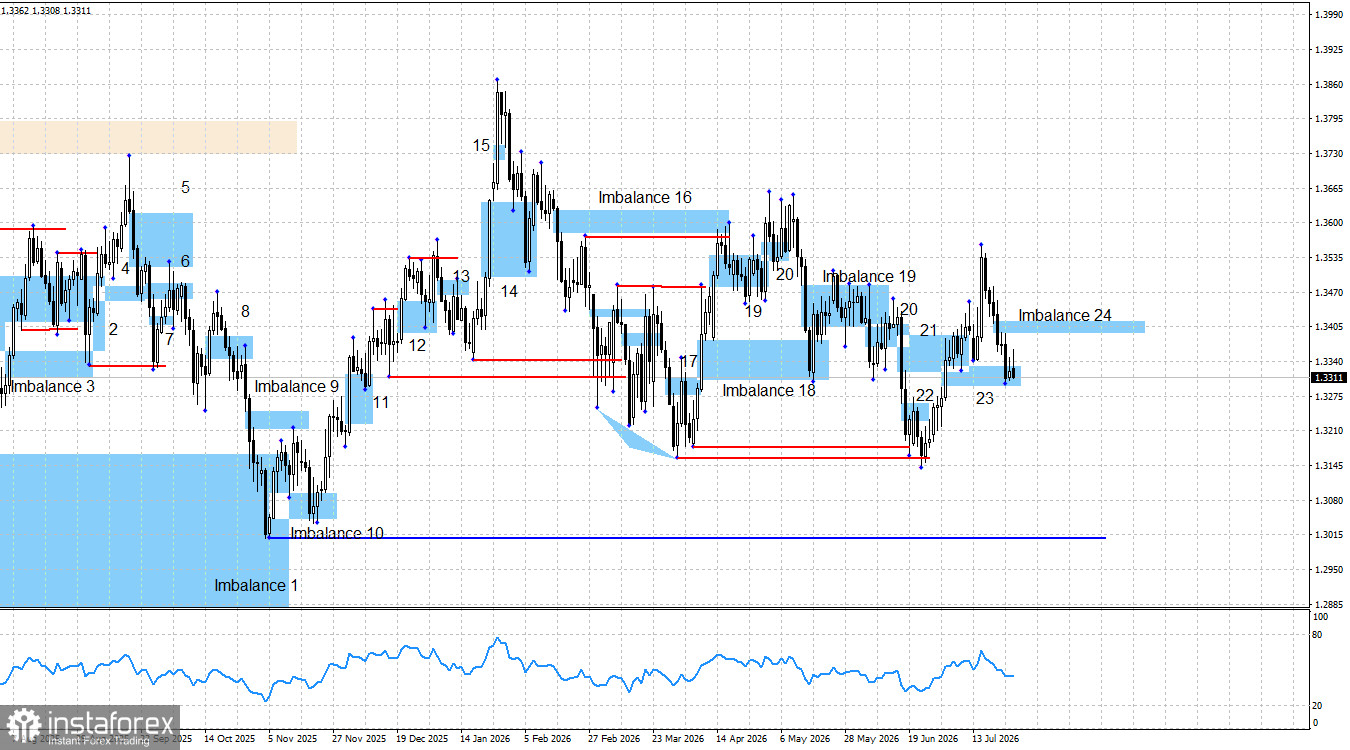
The GBP/USD pair has shown strong growth in recent weeks, which could become the beginning of a bullish trend. However, the pound is currently undergoing a corrective pullback that began a week and a half ago and may continue for another week and a half.
Last week, the fundamental background was not against the pound; nevertheless, bears attacked throughout the entire week without interruption. What should be expected from GBP/USD this week? Everything will come down to two events. On Wednesday evening, the results of the FOMC meeting will be announced, while on Thursday afternoon, the outcome of the Bank of England meeting will be released. Both events could trigger increased volatility, and their outcomes cannot be predicted in advance.
More precisely, both central banks are most likely to leave monetary policy parameters unchanged, but traders understand perfectly well that any comment or hint from Bailey or Waller, as well as any new wording in the final statements, could trigger a strong market move.
For now, the pound is being supported from another decline by imbalance 23. It is no longer acting as an imbalance for traders but rather as a support zone. It was previously tested twice, so I would not expect a third reaction to this pattern.
Monday once again created pressure on sterling, although the day initially started quite positively for the currency. Demand for the US dollar declined as Iran and the US attempted to return to the path of diplomacy. However, just a few hours later, bears resumed their attacks.
This week, oil rose to $100, and the consequences of renewed escalation in the Middle East and the blockade of the Strait of Hormuz could push prices even higher, potentially towards $120. Therefore, if events develop according to the most pessimistic scenario, oil prices will continue rising and retest the March–May highs.
In this case, hopes for slowing inflation in the US and the UK would disappear. If the situation develops according to the optimistic scenario, oil prices could return to the $60–70 per barrel range. In that case, further tightening by the Fed may not be required, while the Bank of England is currently not facing the same issue of high inflation. Therefore, the dollar cannot yet rely on the regulator's hawkish stance as a strong supporting factor.
The chart analysis shows a bullish advance that could resume. The question is: from what level?
The price first conducted a liquidity sweep from the low of April 6, and then from the low of March 31, after which a new bullish advance began. Given that the dollar still lacks strong reasons for a long-term trend and has already demonstrated impressive growth in 2026, I believe bears will not be able to continue attacking further.
However, at the moment, only imbalance 23 is capable of limiting the pound's decline. Will it hold back bears for the third time? Not necessarily.
The economic background on Monday was not the reason behind the movements we observed. Among the notable events, I can only highlight the US Durable Goods Orders report, but from the beginning of the week traders shifted their attention towards geopolitics. Last week, they also paid only limited attention to economic statistics.
Emotions continue to dominate the market rather than a cold and calculated assessment. Traders do not understand how events in the Middle East will develop, so they are not rushing to draw conclusions.
The overall fundamental background remains such that, in the long term, I cannot expect anything other than a decline in the US dollar. The war between Iran and the US has not changed this outlook. A possible Fed rate hike in 2026 has not changed it either.
Geopolitics forced the market to remember the dollar's safe-haven status for several months, but the conflict has already passed its most active phase. The Fed intends to raise interest rates in 2026, which is positive for the dollar. However, it should not be forgotten that monetary policy tightening will lead to slower economic growth and a weaker labour market, while Kevin Warsh was appointed by Donald Trump as FOMC Chair with the purpose of achieving monetary policy easing — something Jerome Powell was unable to deliver.
Therefore, in my view, any dollar growth is temporary and driven by short-term factors.
Economic Calendar for the US and the UK:
- US — ADP Employment Change (12:30 UTC).
- US — Consumer Confidence Index (14:00 UTC).
The economic calendar for 27 July contains two releases that I do not consider important. The impact of the economic background on market sentiment on Tuesday will be weak or absent.
GBP/USD Forecast and Trading Advice:
The long-term outlook for the pound remains bullish. After liquidity sweeps from the two latest swing lows, bulls regained the initiative. However, the British pound may still resume its decline towards the level that would invalidate the bullish trend — 1.3007.
To develop this move, new bearish signals will be required, and they are currently absent.
For bulls, imbalance 23 currently acts as the key support zone, and it may trigger a reaction for the third time.
For bears, the important area is 1.3392–1.3415, where bearish imbalance 24 is located.
Therefore, the current approach is to monitor the market, observe developments, and wait for the formation of clear signals.


