


















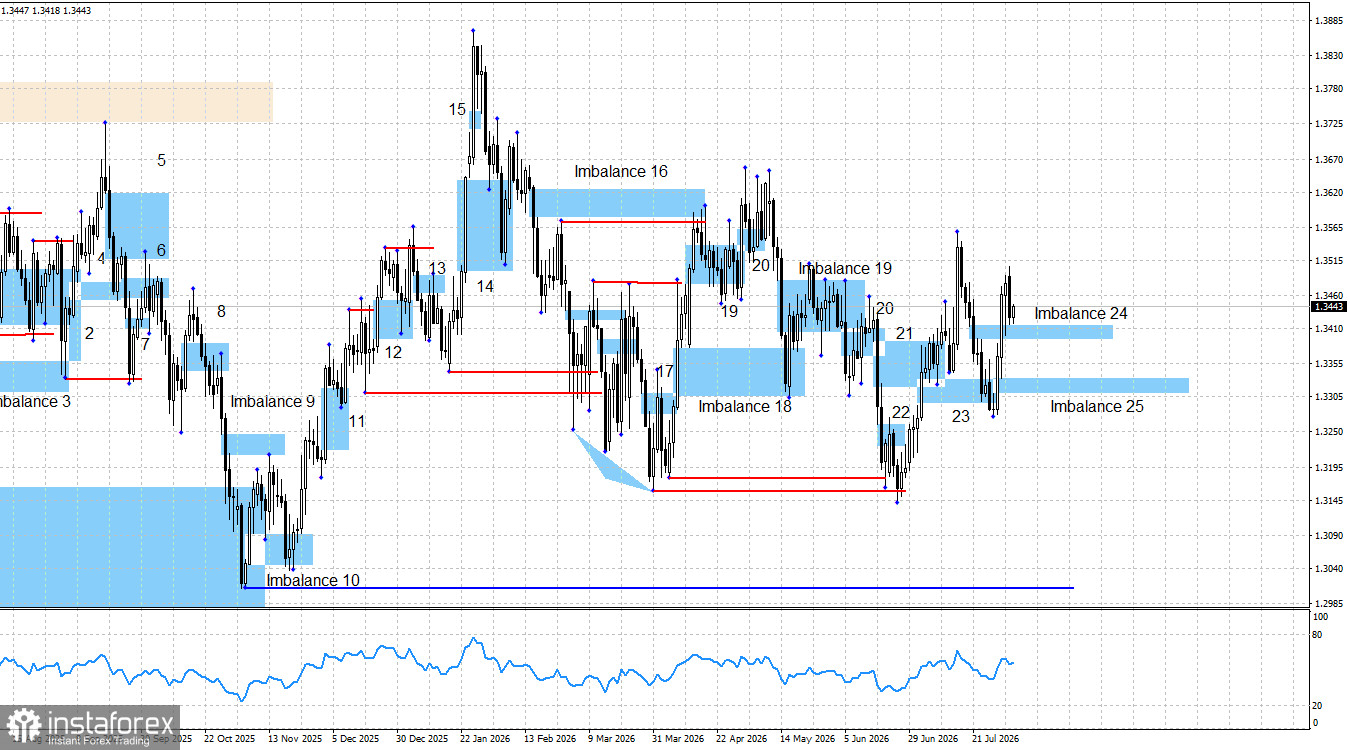
The GBP/USD pair posted strong gains last week, fully in line with the prevailing news backdrop. It can therefore be argued that the bulls launched a new advance at the end of June, followed by a typical corrective pullback, and are now attempting to resume the upward move.
Bearish Imbalance 24 was invalidated without triggering any meaningful price reaction. As a result, it can now be regarded as an inversion imbalance. The market reacted to this pattern from above as early as Friday, meaning it has already been validated and generated a bullish signal.
As for the fundamental backdrop, I believe it continues to favor the British pound. As I have noted before, geopolitical developments are no longer providing sustained support for the U.S. dollar, as new escalations in the Middle East conflict occur roughly every two weeks, with each episode having little impact beyond that of previous ones. According to some reports, negotiations between Tehran and Washington are continuing; according to others, they have been suspended or have collapsed altogether. Officially, Tehran denies holding direct talks with the United States but continues negotiations through intermediaries. It remains unclear how these indirect discussions could lead to resolving the conflict with the United States if Washington is not directly involved. Iran may be able to reach an agreement with Oman regarding control of the Strait of Hormuz, but it is uncertain how this would address the U.S. naval blockade.
Last week, oil prices climbed to $100 per barrel, and the consequences of a renewed escalation in the Middle East, together with a blockade of the Strait of Hormuz, could push prices as high as $120. Under the most pessimistic scenario, oil would continue to rally and surpass the highs recorded between March and May. In that case, inflation in both the United States and the United Kingdom would likely accelerate again. Under a more optimistic scenario, however, oil prices could return to the $60–70 per barrel range. In that environment, additional monetary tightening by the Federal Reserve might not be necessary, while the Bank of England is already no longer constrained by persistently high inflation. At present, however, it is the Federal Reserve that remains reluctant to adopt a more hawkish stance, whereas the Bank of England expects inflation to accelerate and appears prepared to tighten monetary policy further.
From a technical perspective, the charts point to a renewed bullish advance. Traders currently have two bullish imbalances (24 and 25), both of which can be considered potential buying zones. Imbalance 24 already generated a buy signal on Friday, and that signal now needs confirmation through continued upward movement. There are currently no bearish patterns on the chart. Therefore, if sellers attempt to regain control, there are no technical setups available to justify opening short positions.
Tuesday's economic calendar was relatively light, as the JOLTS report is not considered the most important release in the broader U.S. labor market data series. Nevertheless, buyers dominated trading for most of the day, reinforcing my expectations. There were also no major geopolitical developments, apart from Donald Trump's repeated statements that an agreement with Iran would be reached soon.
Overall, I continue to believe that the broader fundamental backdrop favors a long-term decline in the U.S. dollar. Neither the conflict between Iran and the United States nor the possibility of Federal Reserve rate hikes in 2026 has fundamentally changed that outlook. Geopolitical tensions temporarily reminded investors of the dollar's safe-haven appeal, but the conflict has already moved beyond its most intense phase. Although the Federal Reserve is expected to raise interest rates in 2026—which is supportive of the dollar—it should also be remembered that tighter monetary policy would likely slow both economic growth and the labor market. Moreover, Donald Trump appointed Kevin Warsh as Chair of the FOMC to pursue a more accommodative monetary policy, something Jerome Powell was unwilling to deliver. Therefore, in my view, any appreciation of the U.S. dollar is likely to be temporary rather than the beginning of a lasting trend.
Economic Calendar for the United States and the United Kingdom
United States
- ADP Employment Change (12:15 UTC)
- ISM Services PMI (14:00 UTC)
The economic calendar for August 5 includes two releases that I consider important. As a result, macroeconomic data could have a noticeable impact on market sentiment during the second half of the day.
GBP/USD Forecast and Trading Tips
The long-term outlook for the pound remains bullish. After liquidity was taken from the two most recent swing points, buyers resumed their advance, followed by a corrective pullback and another bullish push. I expect the pound to continue rising this week, although much will depend on the incoming news flow. Traders will focus on U.S. labor market and unemployment data, which are expected to play a major role in the FOMC's decision at its September meeting.
If the bears launch another offensive, bearish technical patterns will be required to justify short positions. At present, no such patterns are available. Meanwhile, the bulls have already received a fresh buy signal. The next upward targets are the highs of July 15 and May 1, located at 1.3557 and 1.3656, respectively.


