


















Yesterday, Iran announced that it had reached an agreement with Oman regarding a proposed shipping route through the Strait of Hormuz, which could be a step towards resuming operations on this crucial waterway for energy supplies. Oil reacted to this news with a decline: early Thursday, Brent was trading around $79 per barrel and WTI around $75, continuing its decrease after a 11 percent collapse in the first three trading sessions of the week.

A joint statement from Tehran and Muscat is under review and final refinement, said Iranian Foreign Ministry spokesman Esmail Baghaei to journalists on Wednesday. According to him, negotiations between the countries are "progressing," and an agreement will be reached "if certain third parties do not impede this process," without mentioning any role for Washington, only noting that the closure of the strait resulted from attacks by the US and Israel.
The White House has not provided any comment, although President Trump stated late last night that an agreement on the Strait of Hormuz is inevitable. However, Iran itself quickly tempered expectations for the breakthrough. Iranian state television downplayed the significance of the negotiation results, citing a source familiar with the situation, which stated that the agreement between Tehran and Muscat would not necessarily mean the immediate opening of the strait but would depend on changes in US behavior.
Tehran's position regarding control of the strait remains a key node of the entire conflict. Iran requires vessels to obtain permission to cross the strait and pay transit fees, and it attacks ships that it believes violate the rules. At the same time, the US has responded by blocking Iranian ports, which led to the breakdown of the ceasefire agreement last month. Although hostilities between the parties are currently paused, several other issues remain unresolved, primarily Iran's nuclear program, and an official negotiation agreement has not yet been reached.
Notably, even amid months of hostility, physical shipping through the region has not completely ceased.
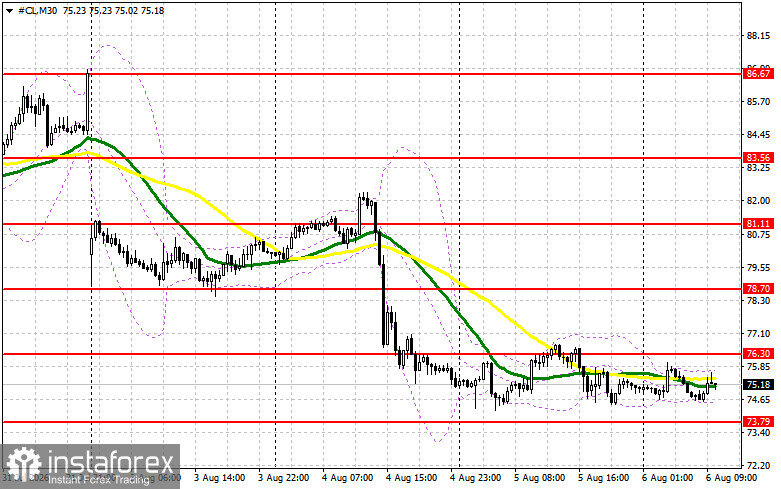
Regarding the current technical picture of oil, buyers need to reclaim the nearest resistance at $76.30. This will allow a target of $78.70, above which it will be quite challenging to break through. The furthest target will be the $81.11 area. If oil falls, bears will attempt to take control of $73.79. If successful, breaking this range will deal a serious blow to the bulls' positions and may drive oil down to a low of $71.69 with a potential move toward $69.58.


