


















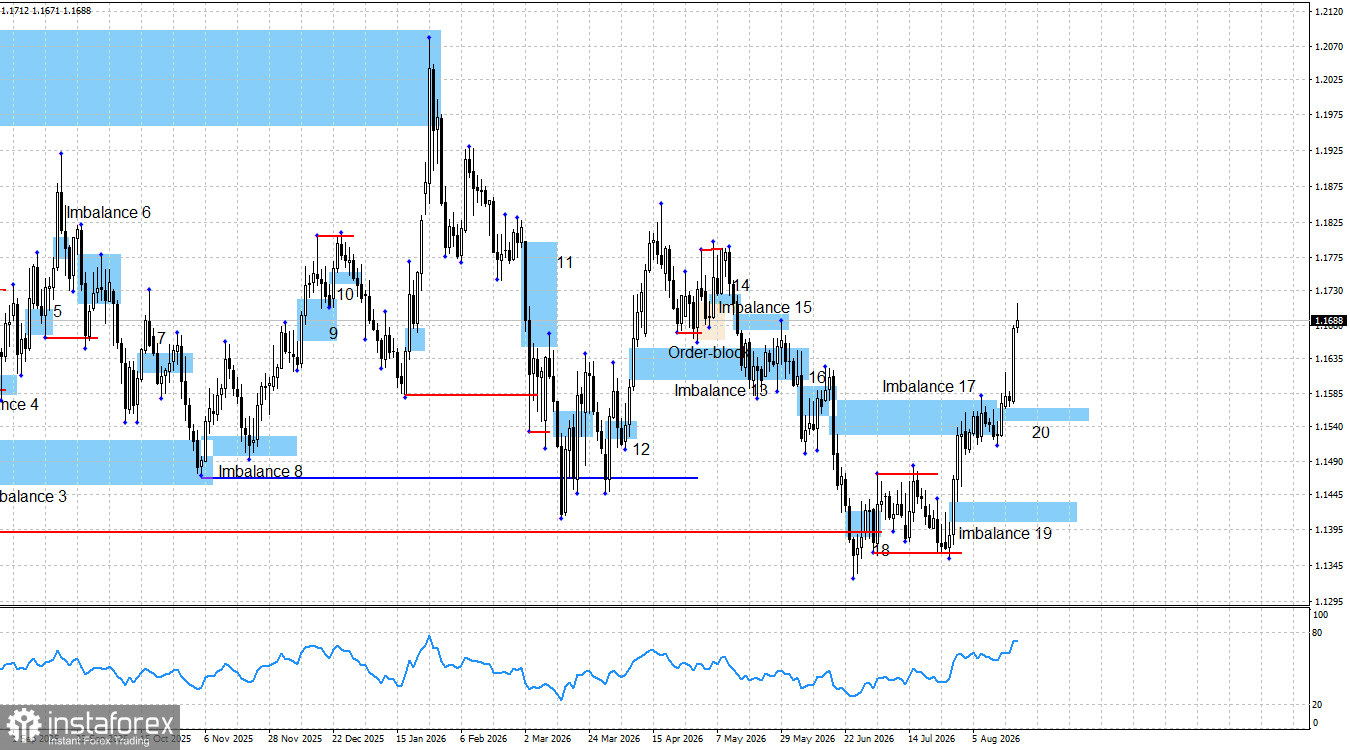
EUR/USD continues to rise, with the move beginning after two liquidity sweeps marked by red lines on the chart. Imbalance 17 restrained the bulls' advance for a long time and is now fully invalidated. A new pattern also formed this week—the bullish Imbalance 20, which now plays the key role. Unfortunately, the price did not test this imbalance before starting a new advance, so no buy signal was formed. Nevertheless, it can now be considered that the bearish momentum has ended and that the bulls will be the dominant side going forward.
In my view, the fundamental backdrop continues to fully support the bulls. First, it is clear on any chart that the European currency is trading well below its average level over the past year. Second, the market no longer expects the FOMC to tighten monetary policy in September. Third, the market has begun to question whether the Fed under Kevin Warsh can do everything necessary to bring inflation back to its target level. Fourth, U.S. economic data have recently been disappointing. Fifth, geopolitical developments no longer support the bears or the dollar. Sixth, the ECB may tighten monetary policy again this autumn. Seventh, the U.S. Treasury has decided to increase its purchases of long-term bonds, reducing demand for the dollar because demand for long-term bonds is also expected to decline. Therefore, I see no reason for a bearish advance.
As I warned in recent weeks, if the labor market once again produces a weak result, this will be a sufficiently strong reason for the Fed to refrain from raising rates. Of course, this cannot be stated with complete certainty, as one more inflation report and one more labor-market report are due before the September FOMC meeting. However, I am almost certain that the Fed will adopt a wait-and-see approach in September. Even if we do see monetary policy tightening by the end of the year, there are still sufficient reasons for the dollar to continue declining.
Let me remind you that expectations regarding Fed monetary policy are always just expectations and can change in response to geopolitical developments or economic data. The latest U.S. labor-market data showed weak figures, inflation slowed, and GDP growth decelerated. These three factors raise doubts about an FOMC rate hike not only in September but also in the foreseeable future. In my view, the bears' only current opportunity lies in a new escalation in the Middle East and a prolonged blockade of the Strait of Hormuz.
The current chart structure points to a highly probable continuation of the bullish momentum. Bearish Imbalance 17 was tested, the reaction to it was weak, and the pattern is now considered invalidated. Bullish Imbalance 19 remains untested. The new bullish Imbalance 20 also failed to provide traders with a buy signal. Nevertheless, the bulls still have much stronger positions and prospects than the bears.
The fundamental backdrop on Thursday was virtually nonexistent, so traders are now trading much less actively than on Wednesday, when the U.S. Treasury unexpectedly announced an increase in purchases of long-term Treasuries. This decision not only lowers Treasury yields and reduces investors' demand for these bonds, but also damages the reputation of the United States and the dollar. Government debt and the burden on the federal budget have become too high, and the Treasury has begun raising concerns. Therefore, I expect the bulls' advance to continue under almost any circumstances.
There are still numerous reasons for the bulls to advance in 2026, and even the outbreak of war in the Middle East has not reduced their number. Structurally and globally, Trump's policy, which led to a significant decline in the dollar last year, has not changed. At present, I see no significant factors supporting the U.S. currency despite the FOMC's formally hawkish stance. Geopolitical developments, which supported demand for the U.S. currency during much of the first half of 2026, can no longer do so. The conflict in the Middle East remains unresolved, but there have been no new hostilities from either Iran or the United States.
News Calendar for the United States and the European Union:
- Germany — Services Consumer Price Index (07:30 UTC).
- Germany — Manufacturing Consumer Price Index (07:30 UTC).
- European Union — Services Consumer Price Index (08:00 UTC).
- European Union — Manufacturing Consumer Price Index (08:00 UTC).
On August 21, the economic calendar contains four entries, none of which is important, especially in light of recent developments. The economic backdrop will have only a limited impact on market sentiment on Friday, particularly during the first half of the day.
EUR/USD Forecast and Trading Tips:
In my view, the pair remains in the process of forming a bullish trend. The fundamental backdrop shifted sharply in favor of the bears six months ago, but the trend itself cannot be considered invalidated or complete. Therefore, the bulls may well continue their advance after two liquidity sweeps from clearly defined lows. At present, bullish traders have support in the form of Imbalance 20. A new buy signal was not formed, unfortunately, but one may form in the future. I consider 1.1686 and 1.1797 to be the targets for the euro's advance.


