


















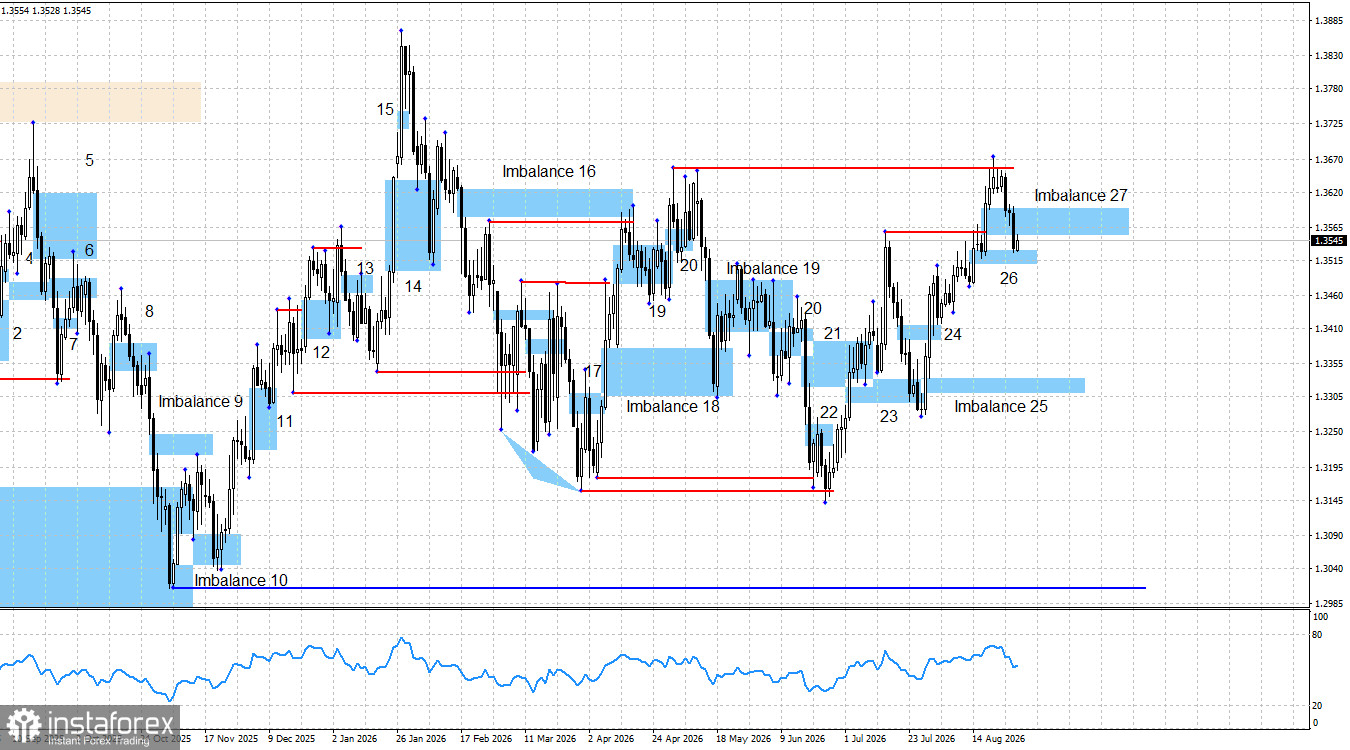
The GBP/USD pair was caught between two imbalances, 26 and 27, on Monday. At the same time, imbalance 27 cannot yet be considered invalidated, while imbalance 26 may trigger a price reaction in the near term. Let me remind you that the pair's decline on Friday was not entirely straightforward, but it can nevertheless be explained. What happened has already happened, so the focus should now be on where the price may move from its current levels. There were few reasons for traders to engage in active trading today, so the direction of the dollar and the pound will most likely be determined later this week. New data on business activity, the labor market, and unemployment in the United States will help traders determine whether conditions in the US economy are really as favorable as they appeared on Friday. Let me remind you that weakness in the US labor market significantly complicates matters for the Federal Reserve, which, according to Kevin Warsh, is seriously considering the possibility of tightening monetary policy. These concerns are putting pressure on the dollar. However, if this week's economic data support the US currency, it will be significantly easier to invalidate imbalances 26 and 27. In that case, the bears will gain the upper hand.
Let me remind you that in recent weeks, the dollar has faced numerous negative factors, including the US Treasury's decision to increase the volume of long-term bond buybacks, weak monthly Nonfarm Payrolls reports, a slowdown in the Consumer Price Index, slower GDP growth, and a decline in market expectations for Fed monetary policy tightening. Thus, from current levels, the dollar's decline may resume.
Do the bears have any prospects at present? In my view, no, or very limited ones. The annual Nonfarm Payrolls report was not particularly strong, while Kevin Warsh's remarks do not indicate that monetary policy tightening is guaranteed in September or at any other time. The dollar does not look hopeless, but most factors are not providing it with significant support. Certainly, the bulls will not be able to maintain constant pressure, because the pound also does not currently appear to be stronger than the dollar. However, I consider the pound's prospects more attractive.
As I have already noted, geopolitics is no longer having a favorable effect on the dollar, as negotiations between the United States and Iran have reached a complete deadlock. This is a significant negative for the dollar. Officially, Tehran is negotiating only with Oman. It remains unclear what these negotiations will lead to in terms of ending the conflict and reopening the Strait of Hormuz. Iran may be able to agree with Oman on the terms for controlling the Strait of Hormuz, but how would this resolve the conflict with the United States and end the US blockade of the strait? Meanwhile, Donald Trump has decided to impose a second type of blockade on Iran—a financial one—and also introduce sanctions against all countries that support Iran. A new global conflict may be developing, which at best will take the form of a trade or sanctions conflict.
Chart analysis indicates that the bulls are gaining the upper hand. At present, traders have three "bullish" imbalances (25, 26, 27), within which buying opportunities can be considered. The liquidity sweep of the May 1 high triggered a corrective retracement, and this retracement may be completed within imbalances 26 and 27. Only invalidation of both imbalances would make it possible to consider a full-scale bearish move.
There was no significant economic news flow on Monday. Therefore, traders found little basis for opening new positions today. Later this week, several important reports will be released in the United States, which should provide clearer and more favorable conditions for trading.
The overall fundamental backdrop remains such that, in the long term, I cannot expect anything other than a decline in the US currency. The war between Iran and the United States has not changed this view. Geopolitical developments prompted the market to reassess the dollar's safe-haven status for several months, but the conflict has already passed its active phase. The chances of FOMC monetary policy tightening have declined significantly in recent weeks, putting pressure on the US currency. Thus, in my view, any dollar appreciation is temporary and driven by short-term factors. I see no reason for a new bearish move.
News calendar for the United States and the United Kingdom:
- US – ISM Manufacturing PMI (14:00 UTC).
- US – JOLTS Job Openings (14:00 UTC).
On September 1, the economic calendar contains two events, with the ISM index being the most notable. Economic data may affect market sentiment on Tuesday during the second half of the day.
GBP/USD forecast and trading advice:
The long-term outlook for the pound remains "bullish." After liquidity sweeps of the two most recent swings and the formation of a series of buy signals, the bulls continue to dominate. I currently see no basis for a bearish move, as there are no bearish patterns or signals. The liquidity sweep of the May 1 swing pushed the pound slightly lower, but it has not yet disrupted the bullish trend. The next development to watch for is the formation of a bullish signal within imbalances 27 and 26, or their invalidation followed by a bearish move.


