


















Trade Analysis for Tuesday:
1H Chart of the EUR/USD Pair
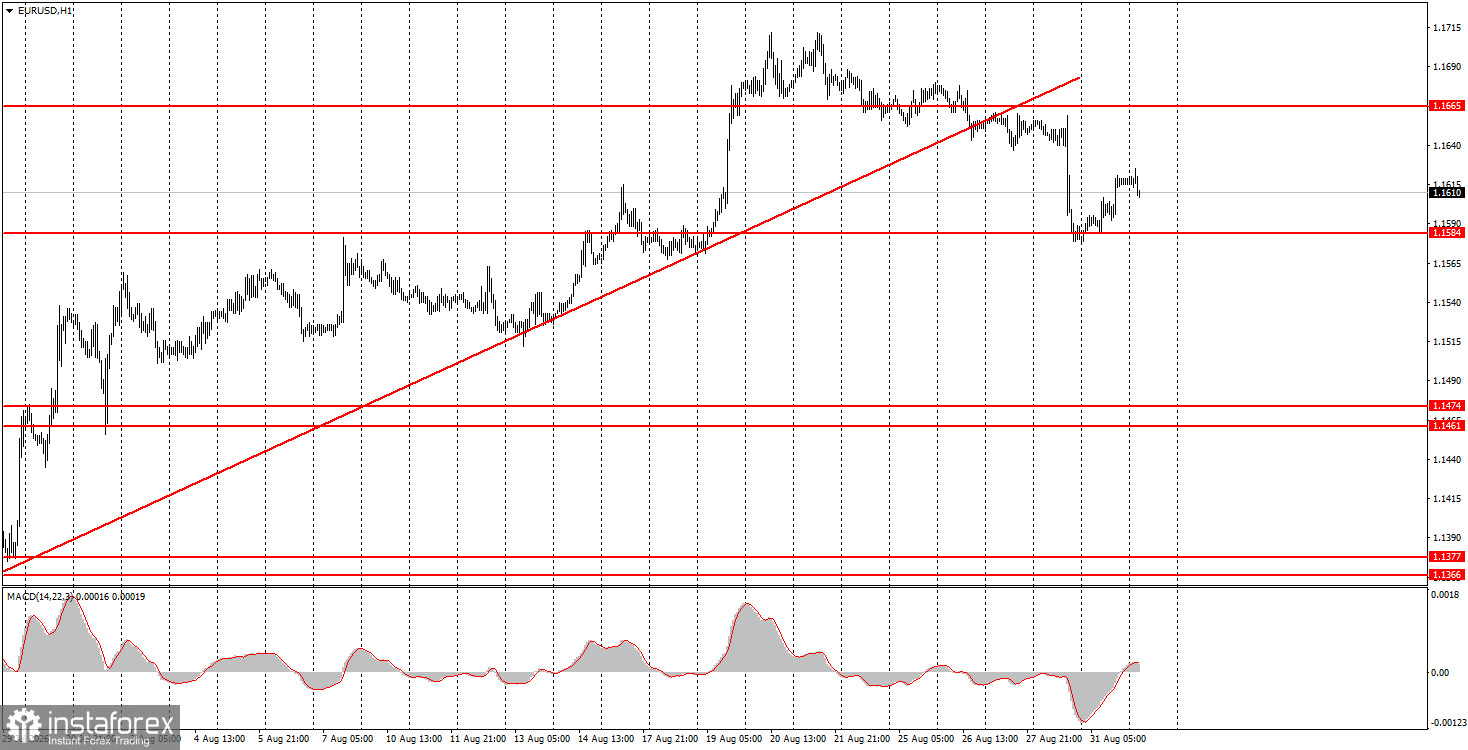
The EUR/USD currency pair traded very calmly on Tuesday, even though quite important data was published in both the Eurozone and the U.S. yesterday. It started with inflation in the Eurozone, which rose to 3.3% in August. Although the actual figure matched the forecast, we believe that this report could have provoked a rise in the European currency. The consumer price index increased by 0.4% in just one month, and given recent news from the Middle East and the new rise in oil prices, inflation is likely to continue rising. Therefore, the European Central Bank may further tighten monetary policy as early as September.
In the U.S., the reports were also significant. For example, the manufacturing PMI decreased from 55.6 to 54.6, contrary to higher expectations. Thus, both of these reports could have contributed to a rise in the pair. The only downturn for the euro came from the unemployment rate, which unexpectedly rose to 6.4%. However, given the previous day's volatility, the market seemed uninterested in any of the reports.
5M Chart of the EUR/USD Pair
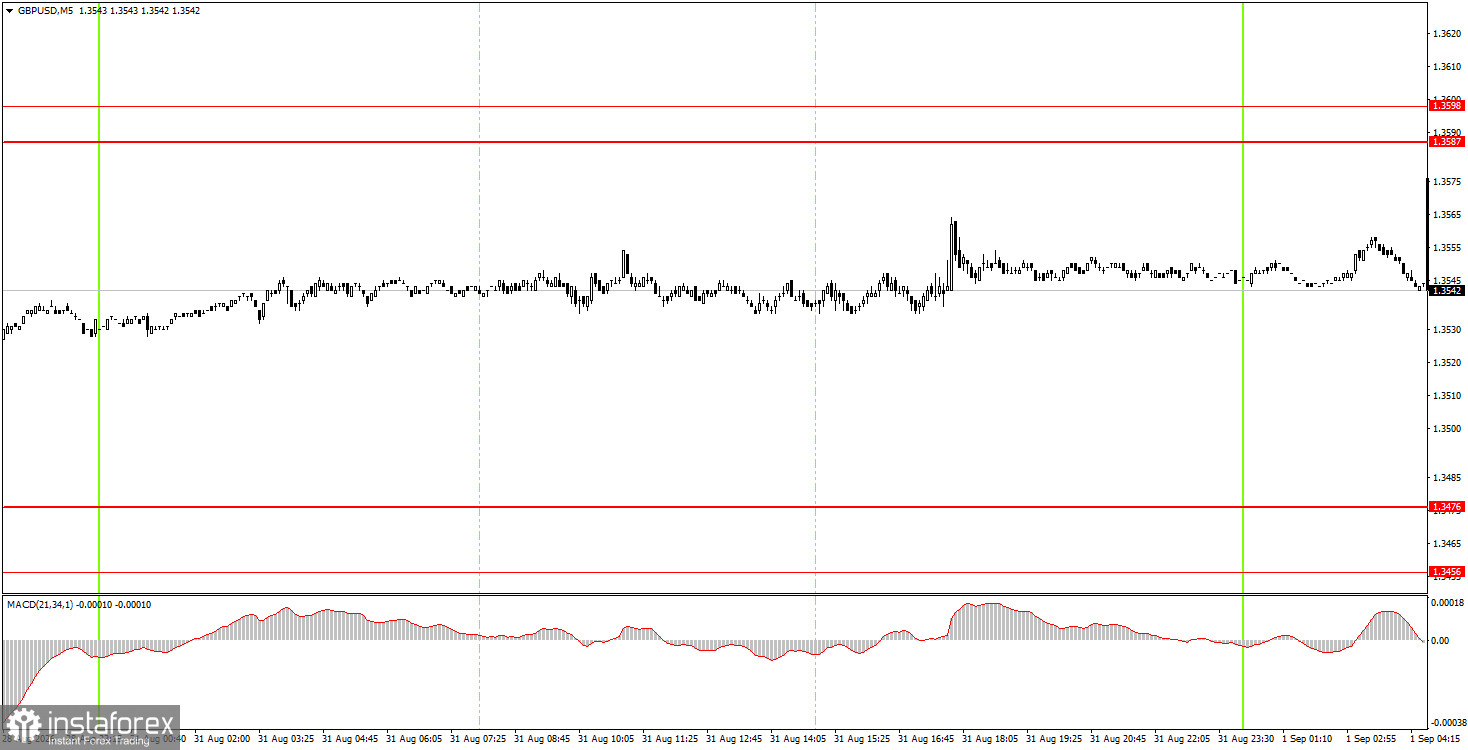
On the 5-minute timeframe on Tuesday, no trading signals were formed. Throughout the day, the price steadily decreased and eventually tested the support area of 1.1584-1.1594. Consequently, new trading signals are expected to form today. However, if volatility remains weak again as it has over the past month, it will be very challenging to achieve profits.
How to Trade on Wednesday:
On the hourly timeframe, the EUR/USD pair began a correction after a month of growth. Considering all the events of recent months, we believe the European currency should continue its steady growth even without local support. The American currency currently has no factors for growth, so we continue to expect upward movement. However, corrections are also necessary.
On Wednesday, novice traders may consider short positions targeting 1.1527-1.1531 if price consolidates below the 1.1584-1.1594 area. Long positions can be opened on a rebound from the 1.1584-1.1594 area, targeting 1.1655-1.1665.
On the 5-minute timeframe, the following levels should be considered: 1.1366-1.1377, 1.1461-1.1474, 1.1527-1.1531, 1.1584-1.1594, 1.1655-1.1665, 1.1745-1.1754, 1.1830-1.1837. On Wednesday, no macroeconomic or fundamental events are scheduled in the Eurozone, while the U.S. will publish the ADP labor market report, which we consider secondary. The market will once again be waiting for the Nonfarm Payrolls report.
Key Rules of the Trading System:
- The strength of a signal is determined by the time it takes to form the signal (rebound or breakout). The shorter the time taken, the stronger the signal.
- If two or more trades were opened at a certain level based on false signals, all subsequent signals from that level should be ignored.
- In a range (flat), any pair can generate many false signals or may not produce any at all. Technical levels may be disregarded.
- On the hourly timeframe, trading signals from the MACD indicator should be acted upon only when volatility is high, and a trend line or trend channel confirms the trend.
- If two levels are positioned too close to each other (within 5-20 pips), they should be considered a support or resistance area.
- After moving 15 pips in the right direction, a stop-loss should be set to break even.
What to Look for on the Charts:
Price levels (areas) of support and resistance are levels that serve as targets when opening buy or sell trades, or as sources of signals.
Red lines indicate channels or trend lines that illustrate the current trend and show the preferred direction for trading at the moment.
The MACD indicator (14,22,3) — the histogram and signal line — is an auxiliary indicator that can also be used as a source of signals.
Important speeches and reports (contained in the news calendar) can significantly influence the movement of currency pairs. Therefore, during their release, trading should be approached with utmost caution, or traders should exit the market to avoid sudden reversals against the preceding movement.
Beginner forex traders should remember that not every trade can be profitable. Developing a clear strategy and practicing money management are key to long-term success in trading.


