


















The GBP/USD currency pair showed little movement on Tuesday, with only some volatility in the second half of the day due to the ISM index. We will discuss the ISM index in separate articles, but here we will focus on the prospects of the Bank of England's monetary policy.
In 2026, the market has fully focused on events related to Trump and the U.S. This is unsurprising, as the U.S. continues to astonish the world with its policies. Donald Trump, who spent all of 2025 as the main peacemaker without receiving a Nobel Peace Prize, has become angry and decided to act as the main aggressor. Interestingly, does the American president know that there is no Nobel Prize for war? In any case, the two-week conflict with Iran is now in its seventh month, and the market, tired of geopolitics, has shifted its focus to the Federal Reserve's monetary policy. Although, in our view, the current state of the American economy does not warrant expectations of a rate hike, and Kevin Warsh was not brought in to replace Jerome Powell for that purpose, the market is still seriously considering the possibility of one, or even two, rate hikes.
And what about the BoE? Does its monetary policy even matter? Unfortunately, even if it does, it is very minimal. Additionally, inflation in the UK rose only to 2.9% in July, which clearly does not warrant immediate intervention by the central bank. Of course, the consumer price index could spike much higher in August. Still, overall inflation in the UK has been declining throughout 2026, unlike, for example, inflation in Europe or the US.
Understanding this gives us grounds to conclude that the BoE could tighten policy, but it has far less justification for doing so than the European Central Bank or the Federal Reserve. So, should we expect further growth from the British currency? We believe that it is still possible, even if the BoE does not tighten policy and the Fed manages to eke out one rate hike.
The main factor for the decline of the American currency, in our view, is Trump's policies. These policies have led to war with Iran, provoked a global energy crisis, pushed U.S. national debt above $40 trillion, and triggered a debt crisis in the country. The U.S. labor market has been in turmoil for the past year and a half; the trade balance remains negative, and the budget deficit persists. Trump has also initiated a global trade war, which continues in 2026. For instance, not long ago, the U.S. president announced 50% tariffs on Canada. When Ottawa and Mark Carney announced counter-tariffs, Washington immediately began preparing a response. Thus, the situation in the world, driven by Trump, is likely to continue to worsen. So is the situation in the American economy. It is also worth noting that the entire world is moving towards de-dollarization of the economy, and Trump himself did not need a strong dollar even during his first term.
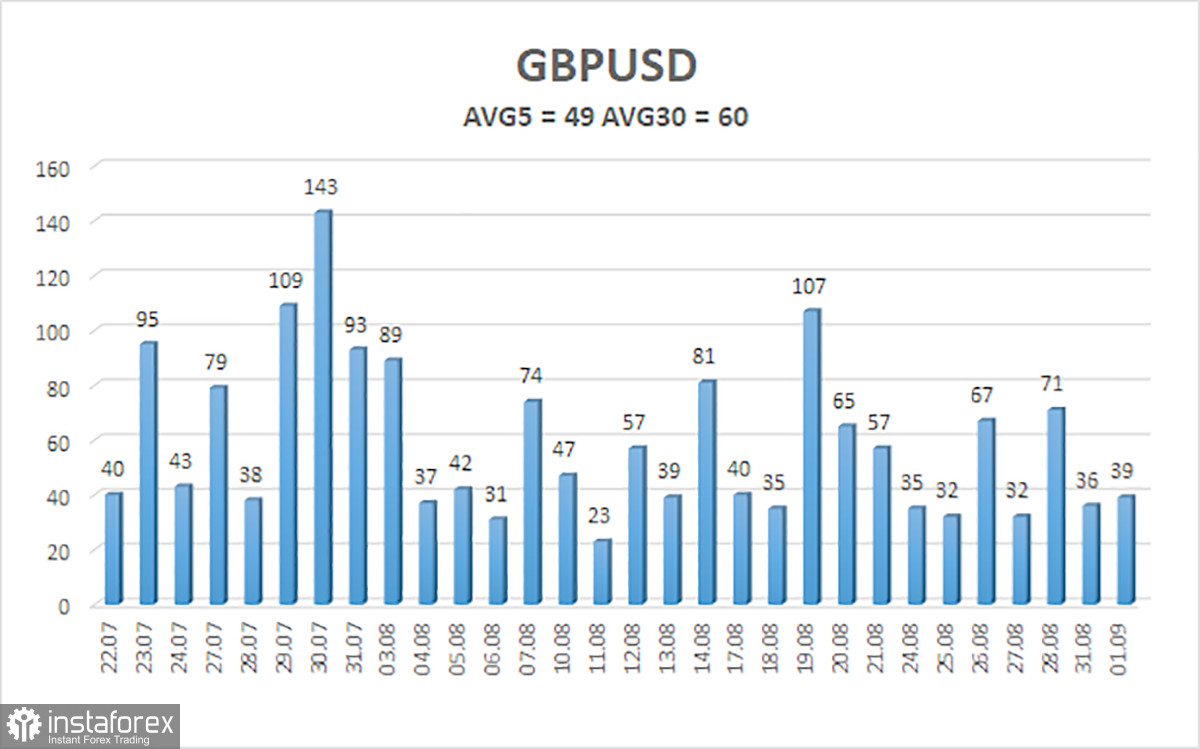
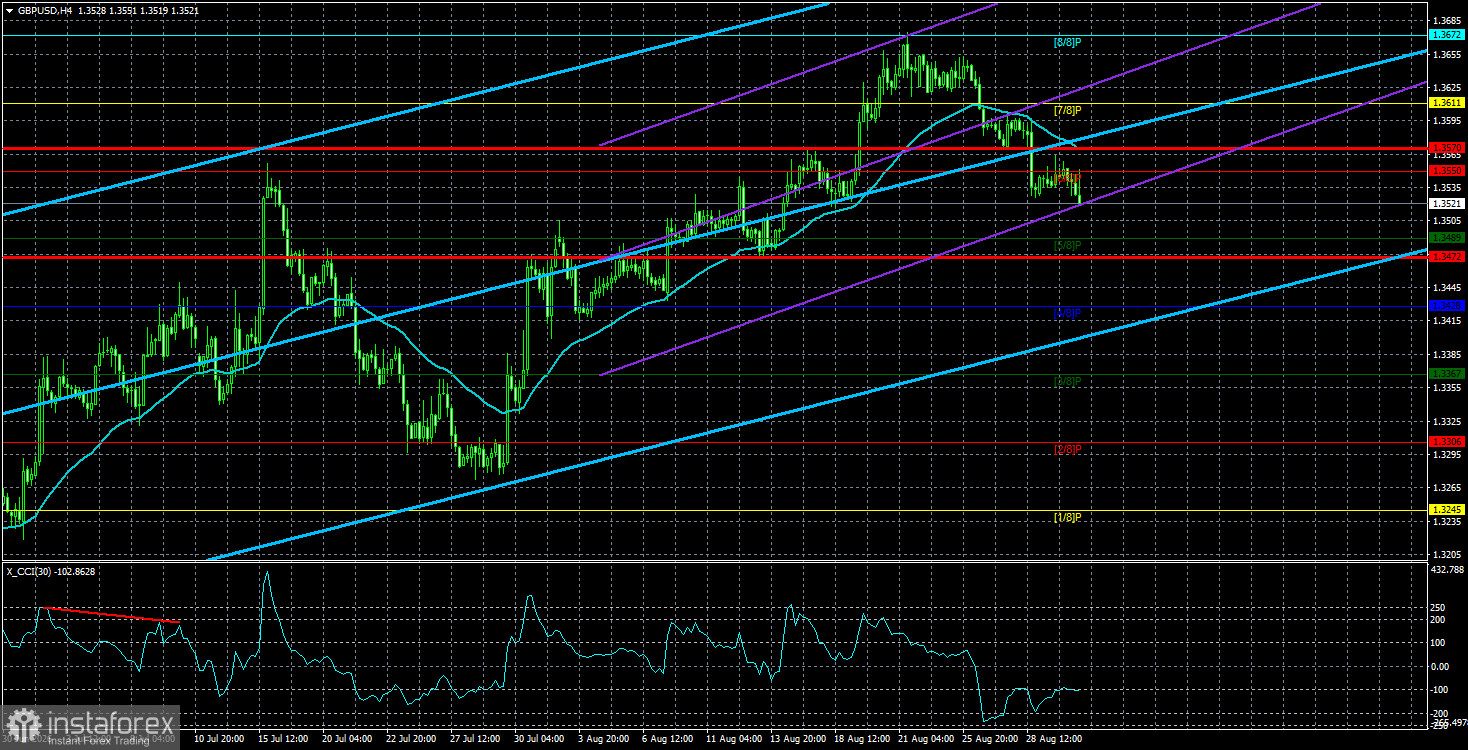
The average volatility of the GBP/USD pair over the last 5 trading days as of September 2 is 49 pips, which is considered "low". On Wednesday, September 2, we expect the pair to move within a range bounded by 1.3472 and 1.3570. The upper channel of the linear regression has turned upward, indicating an upward trend. The CCI indicator has entered oversold territory, signaling a possible end to the correction.
Nearest Support Levels:
- S1 – 1.3489
- S2 – 1.3428
- S3 – 1.3367
Nearest Resistance Levels:
- R1 – 1.3550
- R2 – 1.3611
- R3 – 1.3672
Trading Recommendations:
The GBP/USD pair continues its upward trend. Trump's policies will continue to exert pressure on the U.S. economy, so we do not expect long-term growth in the U.S. dollar. The year 2026 is currently proving positive for the dollar due to geopolitics, but every story has an end. On the weekly timeframe, the pair remains in a flat range between 1.3150 and 1.3780 within a four-year upward trend, supporting expectations of continued growth in the British currency in the medium term. Long positions with targets of 1.3611 and 1.3672 can be considered when the price is above the moving average. If the price is below the moving average line, trading can be conducted on a decline, with targets at 1.3489 and 1.3472.
Explanations for Illustrations:
- Regression Channels help determine the current trend. If both are directed in the same direction, the trend is strong.
- The Moving Average Line (settings: 20, 0, smoothed) defines the short-term trend and the direction in which trading should currently be conducted.
- Murray Levels are target levels for movements and corrections.
- Volatility Levels (red lines) indicate the probable price channel within which the pair will trade over the next 24 hours, based on current volatility indicators.
- CCI Indicator – its entry into the oversold area (below -250) or into the overbought area (above +250) indicates that a trend reversal in the opposite direction is approaching.


