


















Trade Analysis and Tips for the Japanese Yen
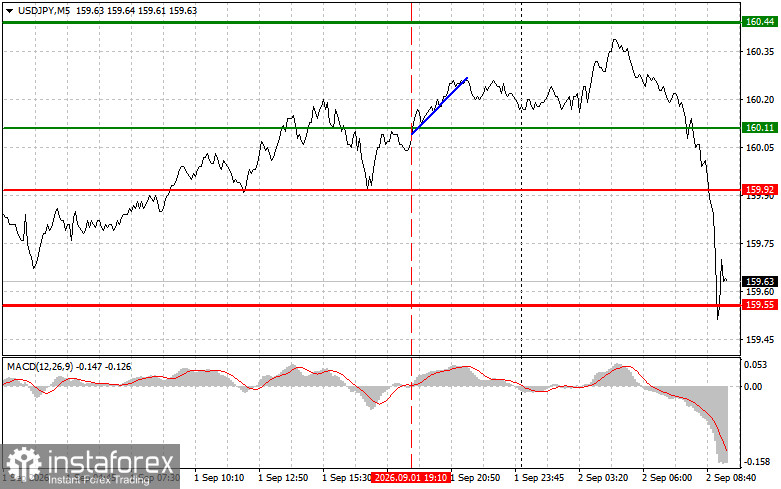
The price test at 160.11 occurred as the MACD indicator began moving upward from the zero mark, confirming the correct entry point to buy the dollar. As a result, the pair rose by 15 pips.
Two weak reports from the U.S. did not impress the dollar. The ISM manufacturing index fell to 54.6% with nearly all components declining, and the number of jobs in the labor market fell to 5.1 million; however, the American currency ignored this data. The reason lies in the sharp escalation in the Middle East, where, following the U.S. strike on an island in the Strait, Iran retaliated with strikes on the UAE and Jordan, providing support for the dollar as a safe-haven asset and through the inflationary oil channel.
For the yen, the current situation is somewhat contradictory. As a traditional safe haven, it could benefit from heightened tensions. Still, the simultaneous strengthening of the dollar and the threat of rising oil prices undermine its potential, given that Japan is almost completely dependent on energy imports.
However, the situation changed today, and the USD/JPY pair fell sharply. This reversal was caused by statements from Kazuo Ueda, who effectively announced a rate hike at the September 17-18 meeting, noting that as core inflation approaches 2%, the regulator has concluded that more attention should be paid to price growth risks than before. Swaps already fully price in the September move, and Ueda did not contradict these expectations.
The backdrop is concerning: the yield on Japanese 10-year bonds has reached 3% for the first time in thirty years, and the Ministry of Finance has requested record spending for the next financial year. If the Bank of Japan decides to act, it would be its fastest action during Ueda's tenure — until now, he has maintained six-month intervals.
Regarding the intraday strategy, I will focus on implementing scenarios #1 and #2.
Buy Scenarios
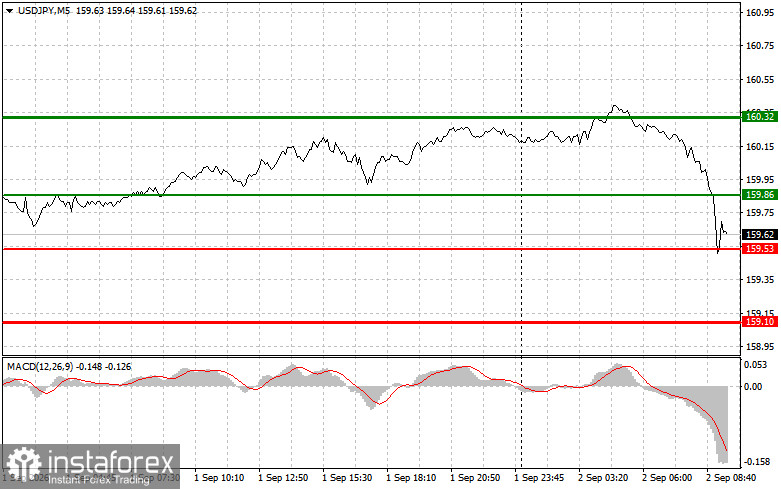
Scenario #1: I plan to buy USD/JPY today upon reaching an entry point around 159.86 (the green line on the chart), targeting growth to the level of 160.32 (the thicker green line on the chart). At approximately 160.32, I intend to exit my long positions and sell immediately in the opposite direction (anticipating a movement of 30-35 pips in the opposite direction from the level). It is best to return to buying the pair during corrections and significant dips in USD/JPY. Important! Before buying, ensure that the MACD indicator is above the zero mark and just starting to rise from it.
Scenario #2: I also plan to buy USD/JPY today in the event of two consecutive tests of 159.53, with the MACD indicator in the oversold area. This will limit the pair's downside potential and lead to an upward market reversal. Growth can be expected towards opposing levels of 159.86 and 160.32.
Sell Scenarios
Scenario #1: I plan to sell USD/JPY today only after the 159.53 level is updated (the red line on the chart), which will trigger a rapid decline in the pair. The key target for sellers will be 159.10, where I plan to exit my short positions and buy back immediately (anticipating a move of 20-25 pips in the opposite direction from that level). Sellers may return at any moment, so any hint from the central bank will be significant. Important! Before selling, ensure that the MACD indicator is below the zero mark and just starting to decline from it.
Scenario #2: I also plan to sell USD/JPY today if there are two consecutive tests of 159.86 while the MACD indicator is in the overbought area. This will limit the pair's upward potential and lead to a downward market reversal. A decline can be expected towards opposing levels of 159.53 and 159.10.
What to Look for on the Chart:
- Thin Green Line – Entry price at which you can buy the trading instrument;
- Thick Green Line – Estimated price where you can set Take Profit or manually secure profits, as further growth above this level is unlikely;
- Thin Red Line – Entry price at which you can sell the trading instrument;
- Thick Red Line – Estimated price where you can set Take Profit or manually secure profits, as further decline below this level is unlikely;
- MACD Indicator. When entering the market, it's important to consider overbought and oversold zones.
Important: Beginner traders in the Forex market need to be very cautious when making entry decisions. It is best to stay out of the market ahead of significant fundamental reports to avoid being caught in sharp price fluctuations. If you decide to trade during news releases, always set stop orders to minimize losses. Without stop orders, you can quickly lose your entire deposit, especially if you do not employ money management practices and trade large volumes.
Also, remember that successful trading requires a clear trading plan, similar to the one provided above. Making spontaneous trading decisions based on current market conditions is inherently a losing strategy for intraday traders.


