


















US stock indices closed lower once again yesterday. The S&P 500 fell by 0.71%, while the Nasdaq 100 dropped by 1.03%. The Dow Jones Industrial Average decreased by 0.79%.
Stocks, bonds, and gold all declined simultaneously as renewed hostilities in the Middle East pushed oil prices higher, fueling inflationary concerns and expectations for tighter monetary policy. The Asia-Pacific equity index, MSCI, dropped by 2%, also pulling down the MSCI All Country World Index. Today, futures for American stock indices continued to trade lower, and European indices also opened in negative territory.
Brent crude increased by 0.7% to $95.32 per barrel, heading towards a fourth rise in five days, as the escalation between the US and Iran heightened the risk of supply disruptions through the Strait of Hormuz. Diesel prices reached their highest level in over four months, while European natural gas hit its highest levels since 2023.
Notably, the rise in energy prices has primarily impacted bonds. The yield on 10-year Treasury bonds rose by one basis point to 4.81%, marking the highest level since the end of 2023, while 30-year yields returned to levels seen just before Scott Bessent expanded the buyback program to curb long-term borrowing costs. In other words, the effect of the Treasury's intervention in August has been fully exhausted.
An unusual characteristic of the current moment is the synchronized expectations among central banks. Traders assess the probability of a rate hike this month to be over 50% across all four major regulators. The market now prices in about a 70% chance of a Fed rate hike in September following Kevin Warsh's speech at Jackson Hole, while a hike by the ECB on September 10 is nearly fully priced in. The likelihood of action from the Reserve Bank of Australia on September 29 stands at 65%, and the Bank of Japan's move on September 18 is fully priced in. The Reserve Bank of New Zealand has already raised its rate today.
Gold, on the other hand, fell by 0.5% to approximately $4,305 per ounce, losing almost 6% over the previous three days, as rising rates make the non-yielding metal less attractive.
The military aspect of the conflict continues to unfold as per the same scenario: US military officials reported the conclusion of airstrikes, while Iran announced a missile attack on an American airbase in Jordan. This exchange follows weeks of relative quiet, during which the Trump administration shifted the focus from military action to economic pressure on Tehran.
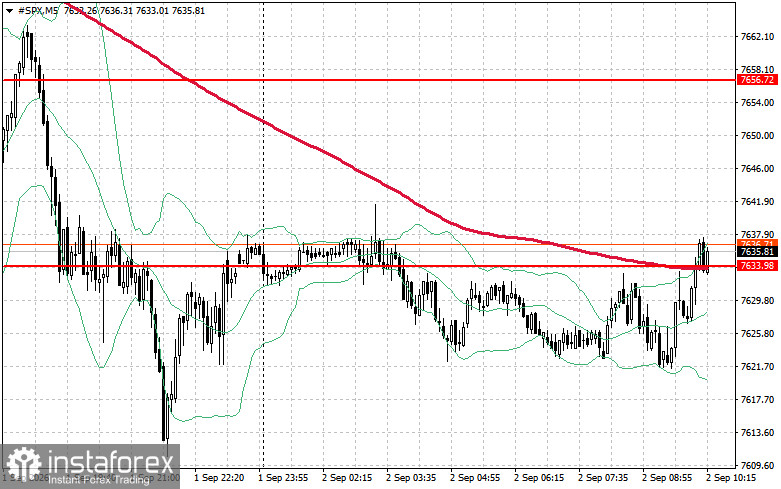
Regarding the technical picture for the S&P 500, the primary task for buyers today will be to overcome the nearest resistance level of $7,633. This would indicate growth and open up the possibility for a push to a new level of $7,656. Equally important for bulls will be maintaining control over $7,679 to solidify buyers' positions. In case of a downward movement amid a decline in risk appetite, buyers must assert themselves around $7,607. A break below that level would quickly push the trading instrument back to $7,574 and pave the way to $7,544.


