


















Trade review of Friday:
1H chart of the EUR/USD pair
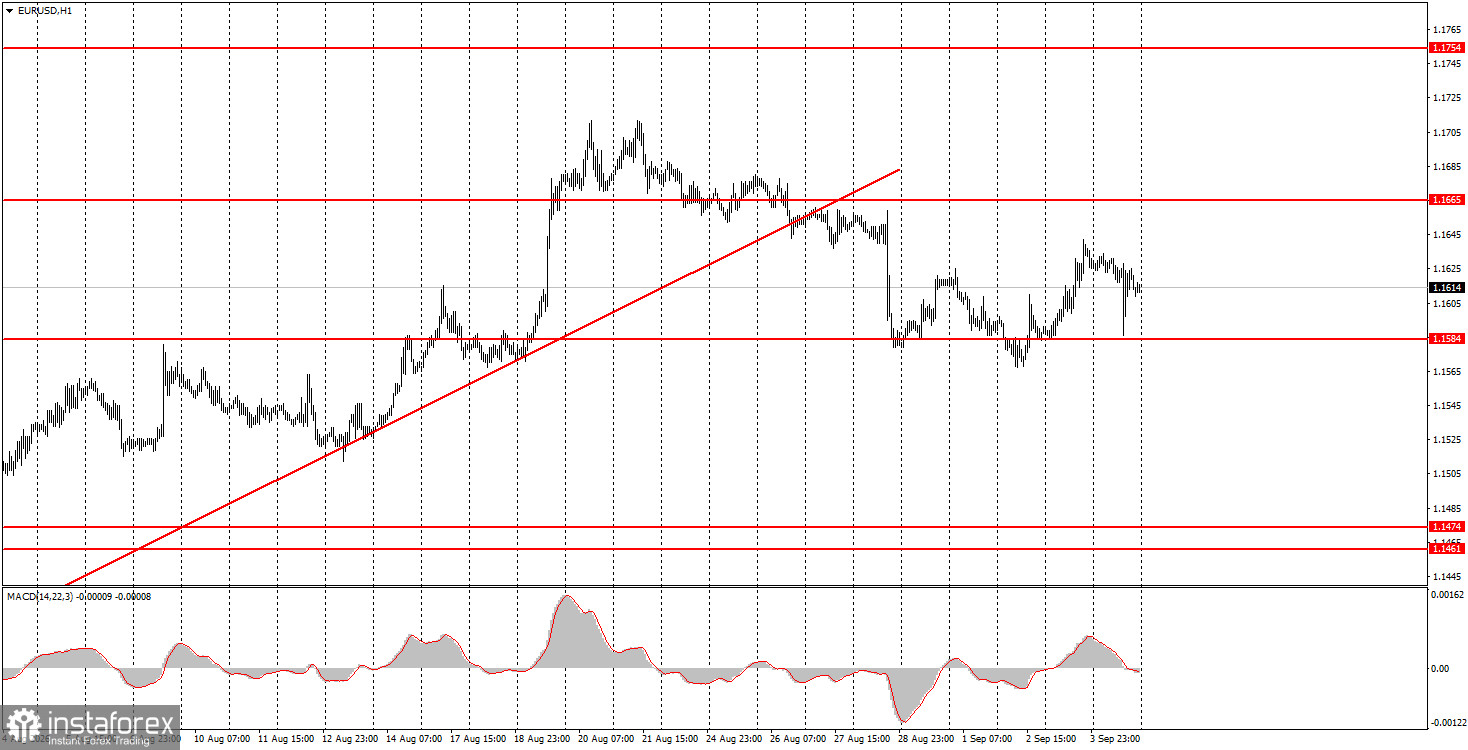
The EUR/USD currency pair showed truly paradoxical moves on Friday. For most of the week, the US dollar was in moderate strength, a trend that began last Friday under rather contradictory circumstances. Recall that the annual Nonfarm report was negative and Kevin Warsh's speech could hardly be called unambiguously "hawkish." Yet the dollar rose. From Monday to Wednesday, none of the macro reports supported the US currency, but demand for it continued to grow. On Thursday, a strong ISM services index was released and... the dollar fell by the end of the day. On Friday, the strongest Nonfarm Payrolls were released and the dollar... gained literally 15 pips. In our view, this all suggests that the current decline is a technical correction and that the market is preparing for a new rise. We still believe the probability of a Federal Reserve rate hike in September (the key market topic now) is low, so there are no solid grounds for the dollar to continue rising.
5M chart of the EUR/USD pair
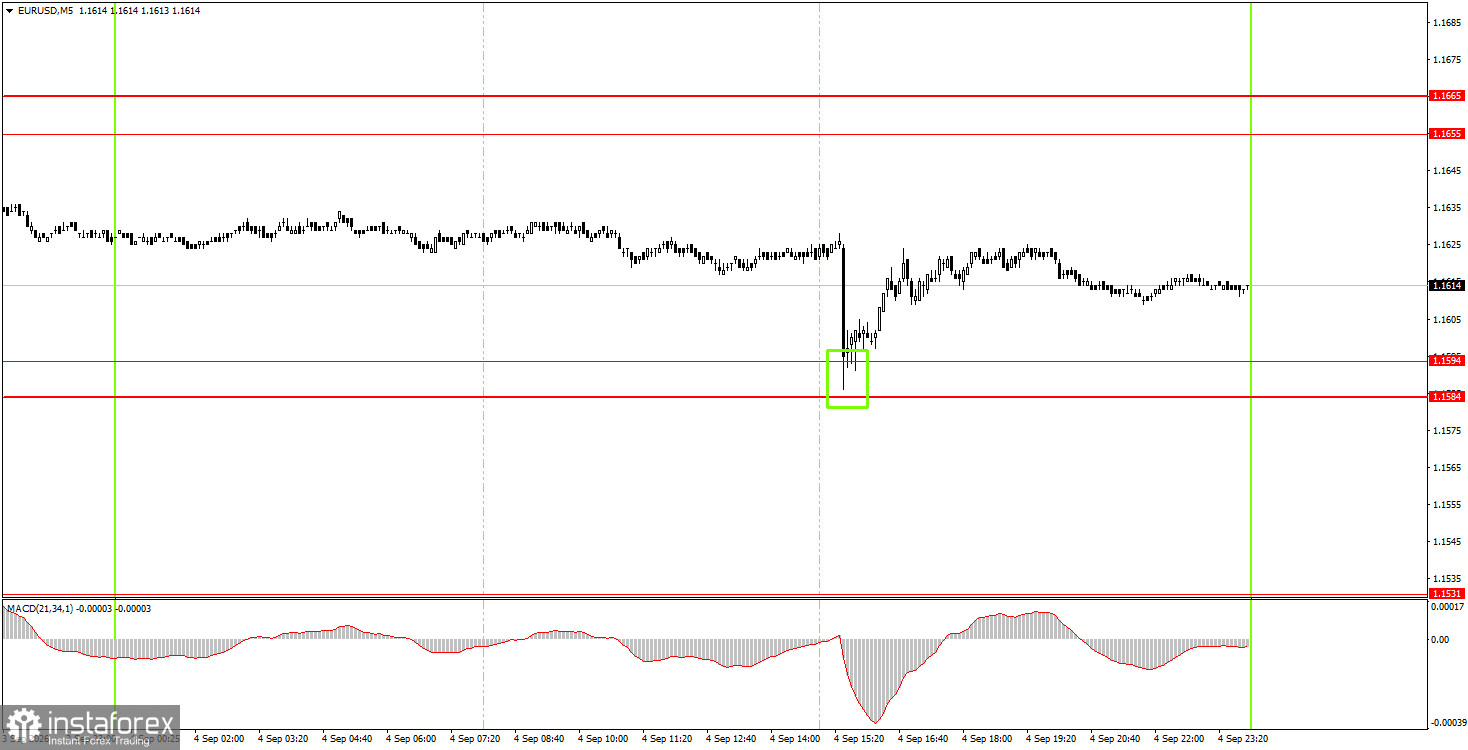
On the 5-minute TF on Friday, one buy signal formed that may continue to develop next week—at the very start of the US session, price bounced from the 1.1584–1.1594 area, allowing novice traders to open long positions. By the end of the day, those long positions could already have yielded profit. Alternatively, traders could have moved stop-loss to breakeven and waited for larger gains.
How to trade on Monday:
On the hourly timeframe, the EUR/USD pair continues a correction after a month-long rise. Taking into account all events of recent months, we believe the euro should continue to rise steadily even without local support. The US dollar currently has no growth drivers apart from the market's near-religious belief in a Fed rate hike.
On Monday, novice traders may consider short positions targeting 1.1527–1.1531 if price breaks the 1.1584–1.1594 area. Buy trades can be held with targets of 1.1655–1.1665 after a bounce from 1.1584–1.1594.
On the 5-minute TF, consider the levels 1.1366–1.1377, 1.1461–1.1474, 1.1527–1.1531, 1.1584–1.1594, 1.1655–1.1665, 1.1745–1.1754, 1.1830–1.1837. On Monday, the eurozone will publish the third estimate of Q2, GDP, and Germany will release industrial production data. These are not the most important releases, so volatility on the first trading day of the week may be low.
Key Rules of the Trading System:
- The strength of a signal is determined by the time it takes to form the signal (rebound or breakout). The shorter the time taken, the stronger the signal.
- If two or more trades were opened at a certain level based on false signals, all subsequent signals from that level should be ignored.
- In a range (flat), any pair can generate many false signals or may not produce any at all. Technical levels may be disregarded.
- On the hourly timeframe, trading signals from the MACD indicator should be acted upon only when volatility is high, and a trend line or trend channel confirms the trend.
- If two levels are positioned too close to each other (within 5-20 pips), they should be considered a support or resistance area.
- After moving 15 pips in the right direction, a stop-loss should be set to break even.
What to Look for on the Charts:
Price levels (areas) of support and resistance are levels that serve as targets when opening buy or sell trades, or as sources of signals.
Red lines indicate channels or trend lines that illustrate the current trend and show the preferred direction for trading at the moment.
The MACD indicator (14,22,3) — the histogram and signal line — is an auxiliary indicator that can also be used as a source of signals.
Important speeches and reports (contained in the news calendar) can significantly influence the movement of currency pairs. Therefore, during their release, trading should be approached with utmost caution, or traders should exit the market to avoid sudden reversals against the preceding movement.
Beginner forex traders should remember that not every trade can be profitable. Developing a clear strategy and practicing money management are key to long-term success in trading.


