


















Despite the large sell-off that hit the crypto market at the end of last week, the overall situation remains under buyers' control, preserving the chances of further development of the bull market.

Meanwhile, at the end of last week, Vitalik Buterin published technical details of EIP-8141, a proposal intended to make a regular Ethereum account noticeably more flexible without requiring external software. As Buterin explains, the idea is based on a new transaction type numbered 0x06, called the Frame Transaction, which divides a single transaction into a verification frame and one or more execution frames, and network nodes are required to simulate execution before admitting the transaction to the mempool. This architecture allows a wallet to independently set signing and gas-payment rules, change keys without changing the address, and more easily migrate to post-quantum protection, because, instead of a single elliptic-curve-based signature scheme, an account can freely define its own cryptographic system.
The practical benefits of such a solution are primarily obvious to ordinary users and wallet developers. Buterin expects to implement the full set of changes as part of the Hegota hard fork within the next year, and the proposal is already being coordinated with accompanying EIP-8130 to preserve transaction readability for infrastructure and EIP-8272 to work with recent state roots.
In my view, the framing of the task itself makes EIP-8141 a far more fundamental change than another cosmetic wallet update, so I expect the main developer discussion in the coming months before the proposal is included in the final Hegota specification to center on mempool-policy details and compatibility with existing solutions.
Is this good for Ether and its ordinary users — definitely yes.
As for short-term trading, the strategy and conditions are described below.
Bitcoin
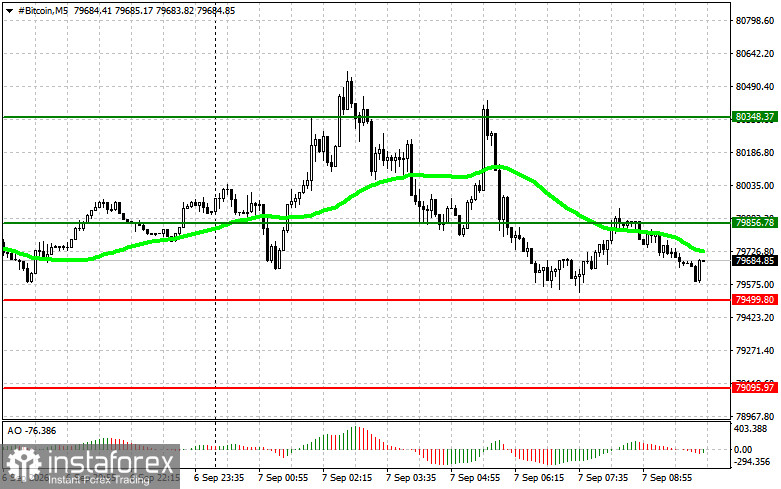
Buy scenario
Scenario No. 1: I will buy Bitcoin today if the entry point around $79,800 is reached, with a target to rise to $80,300. Around $80,300, I will exit longs and sell immediately on the rebound. Before buying the breakout, make sure the 50-day moving average is below the current price and the Awesome indicator is above zero.
Scenario No. 2: Bitcoin can be bought from the lower boundary of $79,500 if there is no market reaction to its downside breakout, aiming for $79,800 and $80,300.
Sell scenario
Scenario No. 1: I will sell Bitcoin today if the entry point around $79,500 is reached, with a target to fall to $79,000. Around $79,000, I will exit shorts and buy immediately on the rebound. Before selling the breakout, make sure the 50-day moving average is above the current price and the Awesome indicator is below zero.
Scenario No. 2: Bitcoin can be sold from the upper boundary of $79,800 if there is no market reaction to its upside breakout, targeting $79,500 and $79,000.
Ethereum
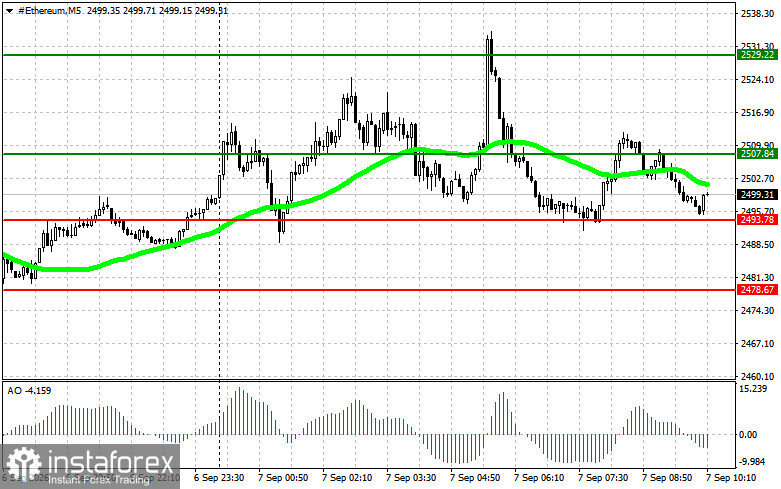
Buy scenario
Scenario No. 1: I will buy Ether today if the entry point around $2,507 is reached, with a target to rise to $2,529. Around $2,529, I will exit longs and sell immediately on the rebound. Before buying the breakout, make sure the 50-day moving average is below the current price and the Awesome indicator is above zero.
Scenario No. 2: Ether can be bought from the lower boundary of $2,493 if there is no market reaction to its downside breakout, targeting $2,478.
Sell scenario
Scenario No. 1: I will sell Ether today if the entry point around $2,507 is reached, with a target to fall to $2,478. Around $2,478, I will exit shorts and buy immediately on the rebound. Before selling the breakout, make sure the 50-day moving average is above the current price and the Awesome indicator is below zero.
Scenario No. 2: Ether can be sold from the upper boundary of $2,507 if there is no market reaction to its upside breakout, targeting $2,493 and $2,478.


