


















The dollar has still failed to find a reason for a strong move. Large market participants do not want to open positions ahead of an event that could change everything and prefer to wait. That event is already on the horizon: tomorrow, the ECB will raise its rate to 2.5 percent, and it is this prospect that is currently keeping the market in a state of paralysis.

This morning brought France's industrial production report, and it turned out to be disappointing. Output declined again, with weakness affecting virtually the entire manufacturing sector. Transport equipment manufacturing looks the weakest, having declined for the second consecutive month, while metallurgy, chemicals and pharmaceuticals, and electronics production also fell. Food manufacturing barely remained around zero. There were some areas of growth in the report, but I would not be too quick to rely on them. Oil refining increased, but this looks like a rebound after the previous collapse rather than a reversal. Mining and energy production reached their highest level since the end of 2021, but the economy deserves no credit for this.
France was hit by a second heat wave in July, prompting people to turn on their air conditioners and sending electricity demand soaring. This means that the only confidently growing segment of French industry is being supported by the weather. For a regulator that is tightening policy tomorrow, this is another reminder of how fragile the industrial core of the eurozone is.
The US agenda is light after lunch, with the only notable release being ADP's weekly change in employment. This indicator reflects what is happening with jobs right now and usually affects expectations for the Federal Reserve's interest rate. However, I consider its weight to be low today. Recent months have shown that even strong employment figures do not lead to dollar gains because the market is focusing on inflation rather than employment. A strong report will most likely have little impact, while a weak one will add pressure on the dollar, but only temporarily.
For the euro and pound, this means that there is no serious threat from the US currency today. Both pairs can remain within their usual ranges, and I do not expect a sharp move in response to ADP.
Momentum
Here, we enter the market after the price has moved confidently beyond an important level and join an already established move.
For the euro, I am watching 1.1657 on the upside. A breakout above this level opens the way to 1.1673 and then 1.1690. This scenario could develop on weak ADP data, when the dollar retreats slightly, but I would not expect a large move, as buyers are acting cautiously ahead of the meeting. On the other hand, the key level is 1.1640; a break below it points to 1.1620 and 1.1588. This scenario could play out if the market takes the French figures into account and decides to reduce euro positions ahead of tomorrow. In both cases, I enter after consolidation beyond the level rather than on the first touch, because in a quiet session, a brief break beyond a level followed by a quick return is very common.
For the pound, the upward level is 1.3573, with a breakout taking the pair toward 1.3596 and 1.3620. On the other hand, 1.3550 is the key level, with targets at 1.3530 and 1.3505. The British currency has no domestic news today, so it is simply following the dollar. This is an important point for beginners. When a pair has no specific catalyst of its own, its movement is always secondary, and it should be explained through the second currency rather than the first.
Mean Reversion
We trade against those who rushed into the breakout. The price moves beyond a level, fails to find significant buying or selling interest there, and returns, while the closing of unsuccessful positions pushes it even further.
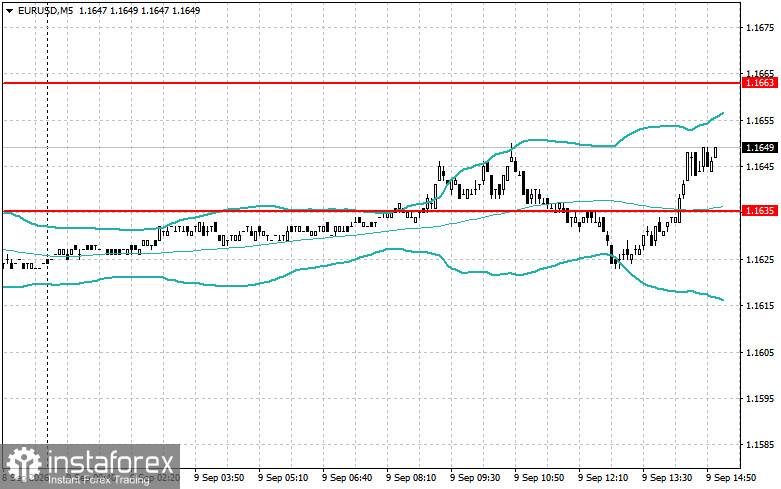
For the euro, the upward reference level is 1.1663. I look for selling not when the price moves above the level, but after the attempt to consolidate above it fails and the quote returns below the level. The lower boundary is 1.1635, where, following the same principle, I look for buying after an unsuccessful attempt to push the market lower. I prefer this approach to the breakout strategy today, and the reason is simple. The market is standing still in anticipation of tomorrow, and in such conditions, moves beyond the range boundaries are more often false breakouts than genuine ones.
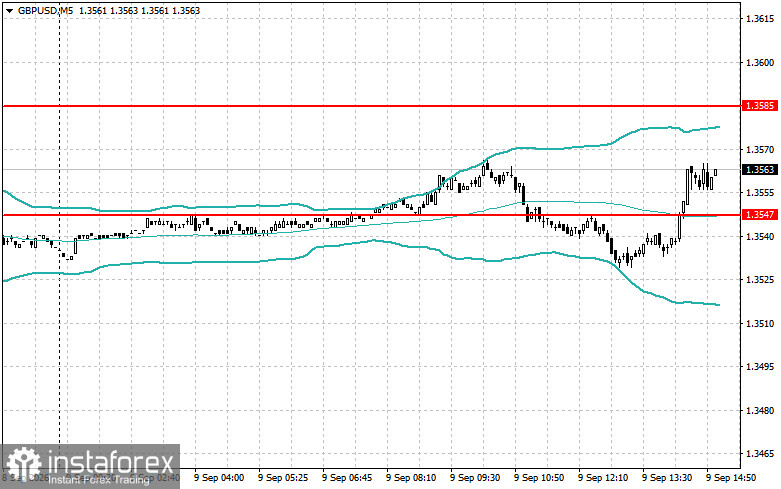
For the pound, the levels are 1.3585 on the upside and 1.3547 on the downside. The approach is the same. I place the stop beyond the extreme point of the false break rather than behind a nearby round number, because there are always plenty of traders hunting obvious levels in the market.


