


















Trade review and trading tips for the euro
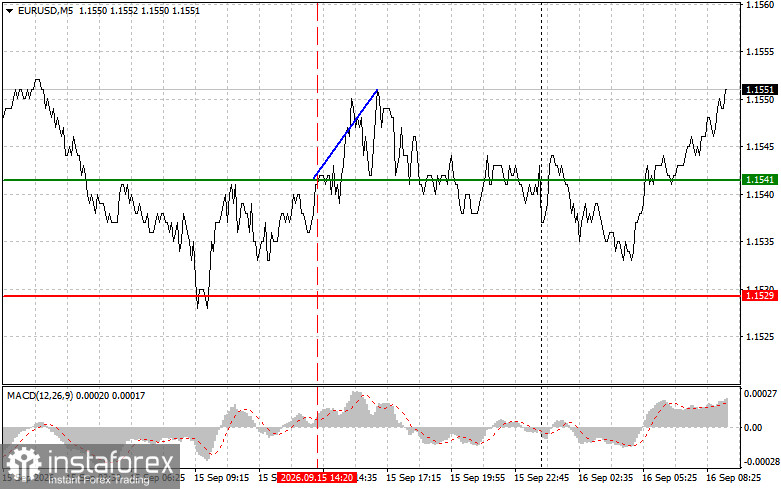
The price test at 1.1541 occurred as the MACD indicator began moving up from the zero line, confirming a correct entry point to buy the euro. As a result, the pair gained 10 pips, and that was it.
The Empire State manufacturing index fell by 13 points in September to 7.6 after August's four-year high, but remained in positive territory, which does not indicate a full-blown deterioration in regional business conditions. That put some pressure on the dollar and supported the euro, which had fallen earlier on the ZEW report. According to the ZEW data, German expectations barely moved while the assessment of current conditions improved noticeably; euro-area expectations, by contrast, declined — in my view a direct consequence of last week's European Central Bank rate hike, which the market currently treats more as a growth risk than a catalyst for optimism. This divergence between a resilient Germany and a cautious euro area continues to weigh on EUR/USD, and without fresh strong signals from Germany the pair will likely struggle to find a reason for a confident recovery in the coming days.
This morning the market will receive euro-area releases: Italy's consumer-price index and the region's industrial-production figures. Italian inflation traditionally acts as one of the final pieces in the euro-area HICP picture, complementing the already released figures for Germany, France and Spain. At the same time, industrial production will show how resilient the real sector is amid higher energy prices and geopolitical tensions around the Strait of Hormuz. Nevertheless, I believe both releases are unlikely to be true triggers for EUR/USD: the market is almost fully focused on the upcoming Fed meeting, and any medium-tier European data risk remaining peripheral for traders, especially given that the ECB has already signaled its stance after the recent rate rise. Only a clear surprise from Italian inflation or industrial production would likely shift expectations for the ECB's path; otherwise, the euro will mostly move in line with dollar sentiment rather than its own data.
For intraday strategy, I will rely mainly on Scenarios No. 1 and No. 2.
Buy scenarios
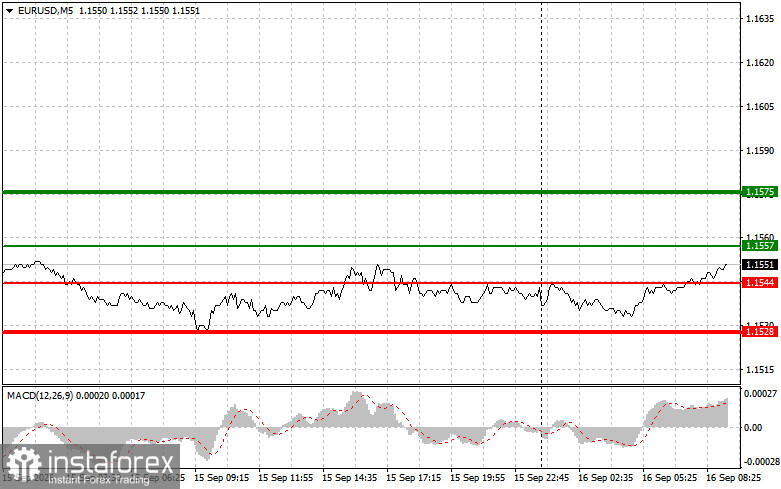
Scenario No. 1: buy the euro today if the price reaches around 1.1557 (green line on the chart), targeting a rise to 1.1575. At 1.1575, I plan to exit long positions and also sell the euro in the opposite direction, aiming for a 30–35 pip move from the entry. Expect euro gains only as part of a correction. Important: before buying, ensure the MACD indicator is above the zero line and only beginning to rise.
Scenario No. 2: I also plan to buy the euro today in case of two consecutive tests of 1.1544 while the MACD is in oversold territory. That would limit the pair's downside potential and lead to an upward reversal. One can expect moves to the opposite levels 1.1557 and 1.1575.
Sell scenarios
Scenario No. 1: I plan to sell the euro after it reaches 1.1544 (red line on the chart). The target will be 1.1528, where I plan to exit shorts and immediately buy in the opposite direction (expecting a 20–25 pip reversal from that level). Pressure on the pair will return today if data are weak. Important: before selling, ensure the MACD indicator is below the zero line and only beginning to fall.
Scenario No. 2: I also plan to sell the euro today in case of two consecutive tests of 1.1557 while the MACD is in overbought territory. This would limit the pair's upside potential and trigger a downward reversal. Expect a decline to the opposite levels of 1.1544 and 1.1528.
What to Look for on the Chart:
- Thin Green Line – Entry price at which you can buy the trading instrument;
- Thick Green Line – Estimated price where you can set Take Profit or manually secure profits, as further growth above this level is unlikely;
- Thin Red Line – Entry price at which you can sell the trading instrument;
- Thick Red Line – Estimated price where you can set Take Profit or manually secure profits, as further decline below this level is unlikely;
- MACD Indicator. When entering the market, it's important to consider overbought and oversold zones.
Important: Beginner traders in the Forex market need to be very cautious when making entry decisions. It is best to stay out of the market ahead of significant fundamental reports to avoid being caught in sharp price fluctuations. If you decide to trade during news releases, always set stop orders to minimize losses. Without stop orders, you can quickly lose your entire deposit, especially if you do not employ money management practices and trade large volumes.
Also, remember that successful trading requires a clear trading plan, similar to the one provided above. Making spontaneous trading decisions based on current market conditions is inherently a losing strategy for intraday traders.