


















Trade Review and Tips for Trading the Euro
The price test at 1.1397 occurred when the MACD indicator had already moved well above the zero line, limiting the pair's upside potential. For that reason, I did not buy the euro.
The dollar finished the week in a firm position, supported by US consumer-sentiment data. The University of Michigan index rose to 48.1 in September. The gain is small, but the direction matters: rising household confidence signals readiness to spend, meaning the US economy still relies on consumers. That is bearish for EUR/USD. Strong domestic demand in the US gives the Federal Reserve grounds to continue raising rates.
This morning the euro will not receive support from macro releases, as the eurozone calendar is empty, and market attention will focus on Christine Lagarde's speech. If she maintains a hawkish tone — and there are reasons to expect this — it would strengthen the case for further European Central Bank tightening. That would benefit euro holders, since a higher policy rate helps keep European assets attractive for longer; however, because everyone is watching the dollar and the Fed, a material trend reversal in EUR/USD is unlikely. Part of the hawkish scenario is already priced in, so any help from Lagarde will be partial, and dollar sentiment will remain the main driver for the pair during the European session.
For intraday strategy, I will mainly rely on Scenarios No. 1 and No. 2.
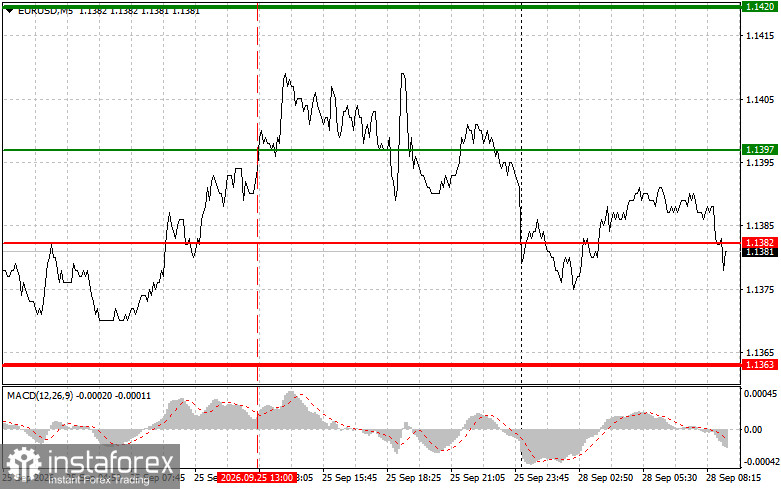
Buy Scenarios
No 1: Buy the euro today around 1.1393 (green line on the chart), targeting 1.1420. I plan to exit at 1.1420 and then sell the euro in the opposite direction, targeting a 30–35 pip counter-move. Expect euro gains only after very strong data. Important: before buying, ensure the MACD is above zero and has just begun rising.
No 2: Also buy the euro if the price tests 1.1382 twice in a row while MACD is in the oversold area. This would limit the pair's downside potential and trigger a reversal up. Expect moves to 1.1393 and 1.1420.
Sell Scenarios
No 1: I plan to sell the euro once it reaches 1.1382 (red line on the chart). The target will be 1.1362, where I plan to exit short positions and immediately buy in the opposite direction (expecting a 20–25 pip counter-move). Pressure on the pair will return if Lagarde takes a dovish stance. Important: before selling, ensure the MACD is below zero and has just begun falling.
No 2: I also plan to sell the euro if the price tests 1.1393 twice in a row while MACD is in the overbought area. This would limit upside potential and trigger a reversal down. Expect declines toward 1.1382 and 1.1363.
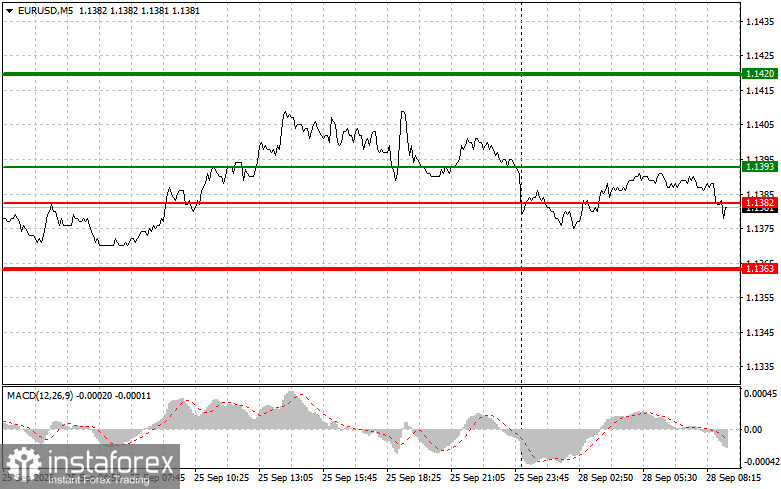
What to Look for on the Chart:
- Thin Green Line – Entry price at which you can buy the trading instrument;
- Thick Green Line – Estimated price where you can set Take Profit or manually secure profits, as further growth above this level is unlikely;
- Thin Red Line – Entry price at which you can sell the trading instrument;
- Thick Red Line – Estimated price where you can set Take Profit or manually secure profits, as further decline below this level is unlikely;
- MACD Indicator. When entering the market, it's important to consider overbought and oversold zones.
Important: Beginner traders in the Forex market need to be very cautious when making entry decisions. It is best to stay out of the market ahead of significant fundamental reports to avoid being caught in sharp price fluctuations. If you decide to trade during news releases, always set stop orders to minimize losses. Without stop orders, you can quickly lose your entire deposit, especially if you do not employ money management practices and trade large volumes.
Also, remember that successful trading requires a clear trading plan, similar to the one provided above. Making spontaneous trading decisions based on current market conditions is inherently a losing strategy for intraday traders.


