


















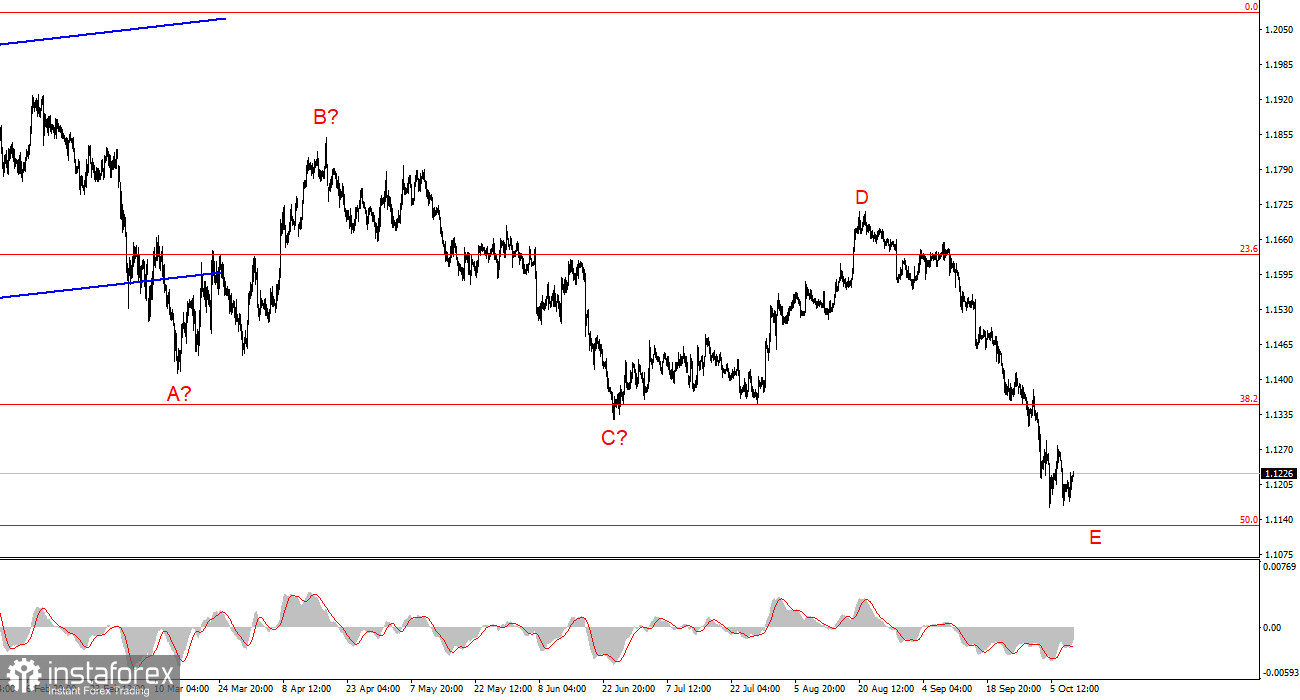
The wave count on the EUR/USD 4-hour chart has become more complex. On the higher timeframe (lower chart), the downward trend segment has taken the form of a five-wave structure, A-B-C-D-E, which could be completed at any time, as it appears structurally complete. All waves within this segment are approximately the same size, so it is considered corrective. If this assumption is correct, the development of an impulsive upward trend segment will begin once it is complete, with targets located well above the 1.2000 level.
On the lower timeframe (upper chart), the development of an impulsive wave sequence is continuing, which may belong to wave E of the higher timeframe. If this is indeed the case, the dollar's strengthening is nearing its end, regardless of how strongly it continues to rise. A fifth wave of the downward structure may form, as the structure appears impulsive. However, in any case, the current wave pattern suggests that the downward wave sequence is nearing completion on both charts. News developments and a sharp shift in market sentiment have led to a strong appreciation of the US dollar, but sustaining its upward movement is becoming increasingly difficult.
The Euro Has Managed to Hold Its Ground
The EUR/USD exchange rate rose by 10 basis points on Thursday, allowing the first conclusions to be drawn about the current week. Overall, sellers maintained pressure, but after three weeks of declines, they were unable to push the pair lower. The news flow was relatively limited. The Fed minutes provided no significant information for traders, while comments from officials at the ECB, Bank of England, and Fed indicated that all three central banks were prepared to tighten monetary policy but were not willing to raise interest rates aggressively. Consequently, all three central banks are likely to raise rates gradually, no more frequently than once every two meetings.
This conclusion puts the euro, pound, and dollar in broadly similar positions. It should also be noted that the debt crisis is affecting not only the United States but also EU countries. Bond yields are rising across many developed economies, while demand for these securities is declining. Thus, high yields, which place an additional burden on government budgets, are not exclusively an American problem. This, once again, puts the euro, pound, and dollar in broadly similar positions.
Among other developments, the US ISM Services PMI edged lower in September but remained relatively high overall. As a result, the dollar did not face any serious problems. As for geopolitics, there were no significant changes in the Middle East. Yemen alone began a campaign to liberate the country from the Houthis, who are allies of Iran. In effect, a second war has begun in the Middle East, but it has not yet affected the energy sector or the global economy. In less than a month, congressional elections will begin in the United States.
Overall Conclusions
Based on the EUR/USD analysis, the pair remains within a global corrective trend segment, A-B-C-D-E. If this assumption is correct, the decline will continue, with targets below the low of wave C at 1.1325. This scenario was initially considered an alternative, and without the Fed meeting, it would have remained a backup scenario. However, the Fed delivered a surprise, leaving the market with no alternative but to initiate another wave of US dollar buying. Nevertheless, the dollar has been bought for several consecutive weeks, despite the absence of new supportive factors. Selling would not be advisable under the current news conditions; instead, preparations for a potential reversal would be more appropriate.
The higher timeframe shows a downward trend segment taking the form of A-B-C-D-E. Consequently, EUR/USD may continue to decline below the low of wave C, while the internal wave structure of wave E may develop into a five-wave impulse.
The main principles of the analysis are as follows:
- Wave structures should be simple and easy to understand. Complex structures are difficult to trade and often involve changes in the wave count.
- If there is no clear understanding of what is happening in the market, it is better to stay out of the market.
- There can never be absolute certainty about the direction of price movements. Do not forget to use protective Stop Loss orders.
- Wave analysis can be combined with other types of analysis and trading strategies.


