


















The global equity sell-off intensified yesterday as semiconductor stocks collapsed in both the United States and Asia, extending a reversal of this year's AI-driven rally. The MSCI Asia Pacific index fell by 2.8%, closing near its lowest level since July. South Korea's Kospi, a key barometer for AI-related flows, plunged by 8%, briefly halting trading. Samsung Electronics and SK Hynix each lost more than 10%.
Pressure persisted in the West. Nasdaq 100 futures slipped by 0.9%, and European contracts saw a 1% drop after the opening bell. The immediate trigger for the US chip sell-off was the fastest rise in US inflation in five months, prompting traders to price in more Fed hikes even if officials take a pause in October. The market is currently pricing in roughly 40 basis points of tightening by the end of January, and the odds of an October move have ticked up slightly.
The bond market behaved differently than in recent days. Treasuries initially fell after the inflation print but quickly recovered as investors found yields near multi-year highs attractive. Buying of safe-haven assets continued into the Asian session. The 10-year Treasury yield dipped by 8 basis points to 5.11%, while the two-year yield, most sensitive to Fed policy, lost 7 points to 4.72%.
The core question is whether the multibillion-dollar investments in AI will pay off. Stubborn US inflation, fueled by high oil prices from the Middle East conflict, raises the odds of more aggressive tightening. Corporate news added to the worry: CoreWeave shares plunged by 17% amid doubts about financing for AI infrastructure. The Russell 2000 small-cap index also slipped into correction territory. Further concern came from reports that Anthropic's Q3 revenue was only $16.8 billion — seen by some analysts as disappointing, and especially troubling given the company's IPO plans and the broader ROI debate for AI spending.
Other markets reacted predictably. Gold rebounded after three down days to trade near $4,145/oz (previously around $4,164). Brent crude fell by 1.6% to $104.35/bbl from $106.30, as fears of supply disruptions in the Middle East eased.
In my view, as long as the market is assessing both inflation and AI execution risk, volatility in tech stocks will persist and bounces will likely be weak and short-lived. If oil continues to fall and bond yields decline, equities should get relief, but a durable reversal requires clear signals from the Fed. Fed Chair Kevin Warsh's speech on Friday in Bangkok will be closely watched. Any hawkish tone would amplify pressure on Asia and AI-linked names.
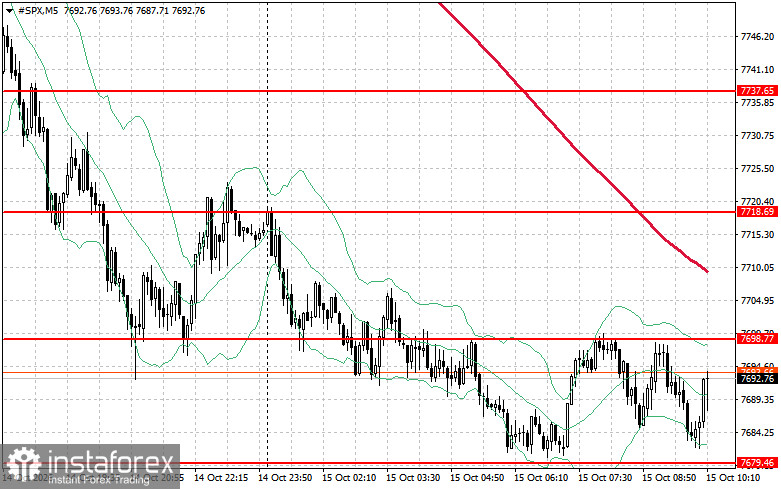
As for S&P 500 technicals, the immediate task for buyers today is to overcome the resistance level of $7,698. That would show upside momentum and open the path toward $7,718. Holding $7,737 is also a priority for bulls to strengthen positions. If the price moves lower amid falling risk appetite, buyers must show up near $7,679. A break below that level would likely push the index down to $7,656 and open the way to $7,633.