


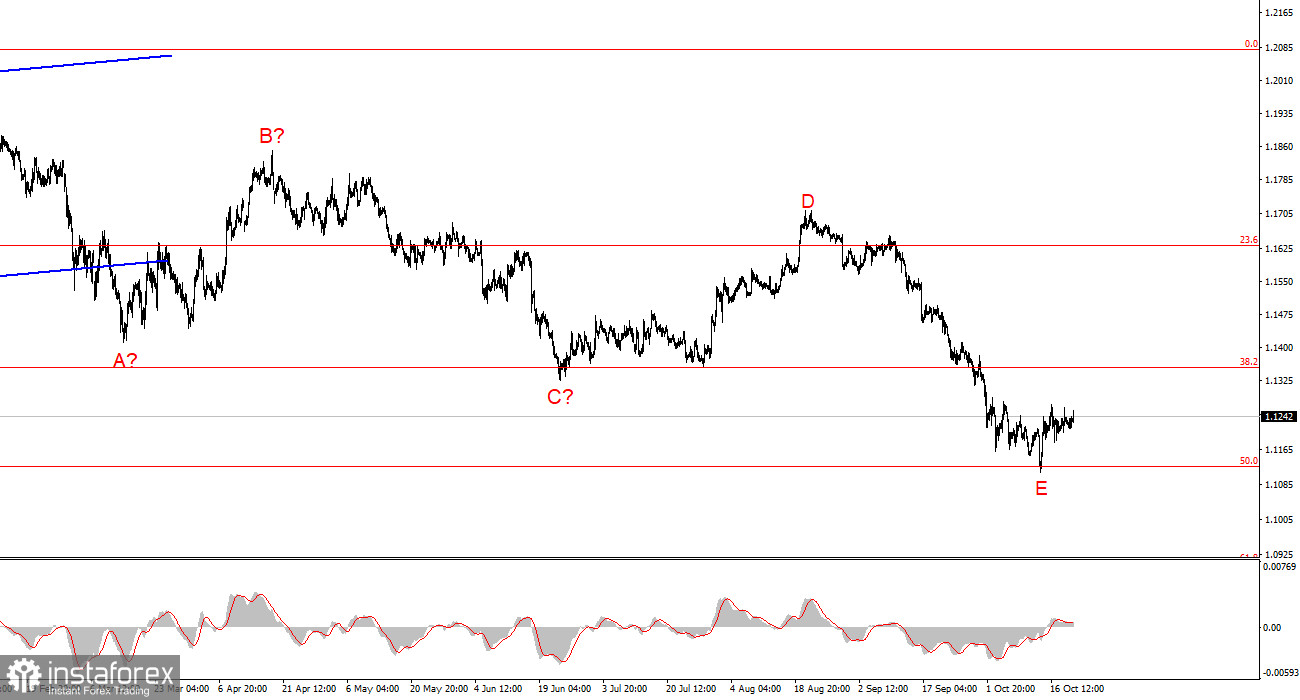
The wave count on the 4-hour EUR/USD chart has become more complex. On the higher timeframe (bottom chart), the downward trend segment has taken the form of a five-wave structure, A-B-C-D-E, which could be completed at any time, as it appears to be fully developed. All the waves in this segment are approximately the same size, so it is considered corrective. If this assumption is correct, the formation of an impulsive upward trend segment will begin once the correction is complete, with targets well above the 20th level.
On the lower timeframe (top chart), an impulsive wave sequence continues to develop, which may belong to wave E on the higher timeframe. If this is indeed the case, the dollar's strengthening is nearing its end, regardless of how much further it rises. The anticipated wave 5 of E has either been completed or is close to completion. In any case, the current wave structure suggests that the formation of the downward wave sequence is nearing its end on both charts. News developments and a sharp shift in market sentiment have led to a strong appreciation of the US dollar, but the number of new factors supporting further dollar strength is steadily declining.
The EUR/USD exchange rate remained virtually unchanged on Wednesday. Market activity has been very low this week, and there has been virtually no significant news from the European Union or the United States. By and large, the most interesting news has come from the United Kingdom, where the unemployment rate fell to 4.7% and inflation rose to 3.5%. In the first case, forecasts had been more pessimistic, while in the second, they had been more optimistic. Both reports favored the British pound, which is why the pound is rising while the euro is not.
As previously stated, the euro's current price levels are not considered fair. Moreover, the wave count indicates that the trend should transition to an upward segment on both timeframes. It is also worth noting that the ECB could raise interest rates three times this year, unlike the Federal Reserve and even the Bank of England. Therefore, in this assessment, the euro has supportive news factors. However, market participants either do not recognize them or are unwilling to acknowledge them.
There were no significant events in the United States or the European Union on Wednesday or Thursday. The only hope is for Friday, when October business activity indices will be released in many countries around the world. These reports are not expected to determine the direction of EUR/USD. It is worth recalling that over the past month alone, traders have largely ignored disappointing US labor market and unemployment reports. They have also paid little attention to the ECB's monetary policy tightening. Consequently, business activity indices are not a priority for traders. The euro remains under pressure from France's budget crisis, mass unrest in EU countries, and a significant outflow of capital from the EU bond market. The euro may remain under market pressure until these issues are resolved.
General Conclusions
Based on the EUR/USD analysis, the pair remains within the broader corrective trend segment A-B-C-D-E. However, this structure appears fully developed and may therefore be complete. In this assessment, the current period presents a favorable opportunity not only to buy the euro but also to anticipate the development of a full-fledged upward trend segment. According to the higher timeframe, the euro is expected to rise to at least the 17th–18th levels. The failed attempt to break above 1.1126, corresponding to the 50.0% Fibonacci level (bottom chart, higher timeframe), also indicates that the market may be preparing for a move higher.
On the higher timeframe, the downward trend segment has taken the form of A-B-C-D-E. The internal wave structure of wave E has developed into a five-wave impulse pattern, but this pattern may already be complete. If this assumption is correct, a new upward trend segment will begin to develop.
The main principles of this analysis:
- Wave structures should be simple and easy to understand. Complex structures are difficult to trade and often involve changes in the expected market pattern.
- If there is uncertainty about what is happening in the market, it is better to stay out.
- There can never be 100% certainty about the direction of price movement. Do not forget to use protective Stop Loss orders.
- Wave analysis can be combined with other forms of analysis and trading strategies.


