


Trade Review and Tips for Trading the Japanese Yen
The test of 156.84 occurred in the first half of the day, when the MACD indicator had just begun moving down from the zero line, confirming a valid entry point for selling the US dollar. As a result, the pair fell by almost 30 points.
The second half of the day will be driven by US business activity data. The preliminary US PMIs for October are expected to come in at 55.5 for manufacturing, down from 55.9, and 58.0 for services, down from 58.8. The previous composite PMI reading was 58.4. These figures are very high, and if the actual data meet expectations, they will reinforce expectations of further Federal Reserve tightening, push Treasury yields higher, and support the dollar.
This matters for the yen because Japan depends on energy imports paid for in US dollars, while high oil prices have already widened the trade deficit. Although today's Japanese data were relatively positive, September CPI came in at 2.1%, up from 1.9%, while the core index rose to 2.1% from 1.8%. However, the manufacturing PMI disappointed, coming in at 53.3 against a forecast of 54.5, while the services PMI increased to 52.0.
The Bank of Japan may raise interest rates at its October 30 meeting, with market estimates putting the probability at around 25%. However, that remains a future possibility, and the dollar will be the decisive factor today. If US data prove stronger than expected, pressure on the yen will return, along with renewed attention to levels at which Japanese authorities have previously intervened.
As for the intraday strategy, the focus will be primarily on implementing Scenarios 1 and 2.
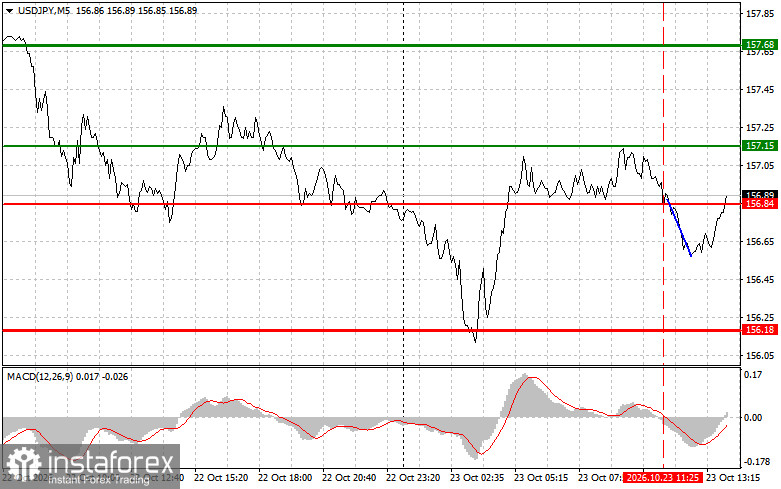
Buy Signal
Scenario 1: Buy USD/JPY today when the price reaches the entry point around 156.95 (the thin green line on the chart), targeting a rise to 157.41 (the thick green line on the chart). Around 157.41, close long positions and open short positions in the opposite direction, targeting a move of 30–35 points in the opposite direction from that level. A rise in the pair is possible today, but the upward potential is limited. Important: Before buying, make sure the MACD indicator is above the zero line and has only just begun rising from it.
Scenario 2: Buy USD/JPY today if the price tests 156.74 twice consecutively while the MACD indicator is in oversold territory. This would limit the pair's downward potential and trigger an upward market reversal. The pair could then rise toward the opposing levels of 156.95 and 157.41.
Sell Signal
Scenario 1: Sell USD/JPY today after the price breaks below 156.74 (the thin red line on the chart), which could trigger a rapid decline in the pair. The key target for sellers will be 156.18. At that level, close short positions and immediately open long positions in the opposite direction, targeting a move of 20–25 points in the opposite direction from that level. Selling pressure on the pair could return today if the central bank intervenes. Important: Before selling, make sure the MACD indicator is below the zero line and has only just begun falling from it.
Scenario 2: Sell USD/JPY today if the price tests 156.95 twice consecutively while the MACD indicator is in overbought territory. This would limit the pair's upward potential and trigger a downward market reversal. The pair could then decline toward the opposing levels of 156.79 and 156.18.
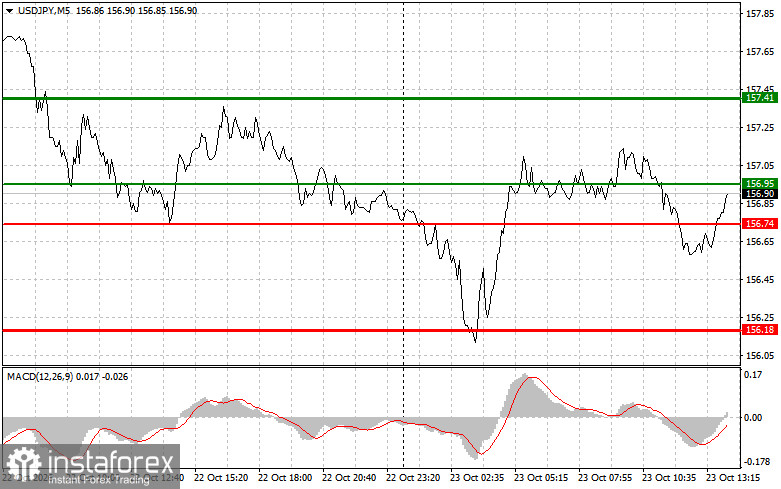
What the Chart Shows
- Thin green line — the entry price at which the trading instrument can be bought.
- Thick green line — the estimated price at which Take Profit orders can be placed or profits can be closed manually, as further gains above this level are considered unlikely.
- Thin red line — the entry price at which the trading instrument can be sold.
- Thick red line — the estimated price at which Take Profit orders can be placed or profits can be closed manually, as further declines below this level are considered unlikely.
- MACD indicator — when entering the market, it is important to consider overbought and oversold conditions.
Important: Beginner Forex traders should make entry decisions with great caution. It is generally best to stay out of the market before the release of major fundamental reports to avoid exposure to sharp exchange-rate fluctuations. If trading during news releases, always place stop-loss orders to minimize losses. Without stop-loss orders, the entire trading account can be lost very quickly, especially when money management rules are not followed and large position sizes are used.
Remember that successful trading requires a clear trading plan, such as the one outlined above. Making spontaneous trading decisions based on current market conditions is a fundamentally flawed strategy for an intraday trader.


